
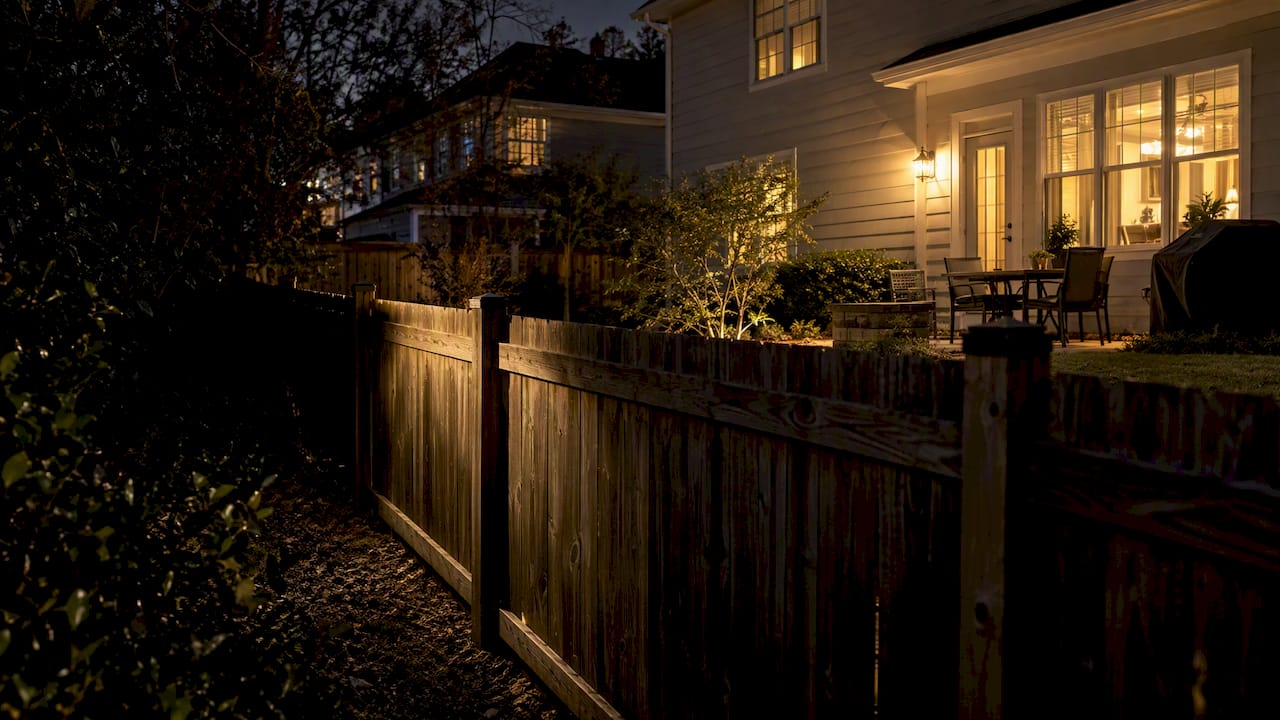
Light trespass is light that leaves the place it was meant for and lands where nobody wants it: a neighbor’s bedroom window, a street, a backyard. You prevent it by choosing shielded fixtures, aiming them at the task, keeping brightness low, putting lights on controls, and using warm color temperatures. The same steps also tend to improve how well you can see at night.
This guide covers how to design lighting that stays home, what to check on an existing system, how Charlotte’s rules fit in, and what to do when the offending light belongs to someone else.
TL;DR
- Light trespass comes from unshielded, over-bright or poorly aimed fixtures. Fixing it is mostly a design problem, not a wattage problem.
- DarkSky International’s five principles: light only when needed, only where needed, no brighter than necessary, controlled, and warm in color (3000K or lower).
- More light does not mean more security. Research cited by DarkSky found very little confidence that improved lighting prevents crime.
- If a neighbor’s light is the problem, start with a friendly conversation, then document dates, times and photos before going to the city.
Table of Contents
- What light trespass looks like in a real yard
- The five principles that prevent trespass
- Does more light make you safer?
- Prevent trespass before you install: BUG ratings
- A worked example: a rear corner floodlight
- Water, pools and docks
- Charlotte rules to know
- Our perspective: why permanent lighting should be designed to stay home
- When your system needs a second look
- If a neighbor’s light is the problem
- Commercial and multifamily properties
- Planning permanent lighting with trespass in mind
- FAQ
- Sources
What light trespass looks like in a real yard
Most light trespass is ordinary. It rarely comes from a stadium. It comes from a few common situations:
- A bright floodlight on the back corner of a house that shines across the property line into a bedroom.
- A bare-bulb wall pack at a garage that throws glare at the street and into a passing driver’s eyes.
- Path or uplights aimed outward instead of down at a walkway, so the beam crosses the fence.
- Holiday or accent lighting left on all night at full brightness and in a cool, bluish white.
- A commercial parking lot fixture facing the homes behind it.
In each case the light source is visible from places it should not be. That is the simplest test of trespass: if you can see the bulb or a hot spot of glare from the neighbor’s side, the fixture needs attention.
There are two parts to the problem. One is spill, light landing on a surface it was never meant to reach. The other is glare, light that goes straight into someone’s eyes. Municipal guidance on this tends to split complaints the same way: unwanted light illuminating a property, and excessive brightness, according to the Municipal Research and Services Center.
The five principles that prevent trespass
The most useful framework we know comes from DarkSky International. Its five principles for responsible outdoor lighting are a checklist you can run on any property.
- Use light only when it is useful. If a fixture has no task, remove it.
- Direct light only where it is needed. Shielding keeps the beam on the walkway, step or wall.
- Keep light no brighter than necessary. Lower output means less spill and less glare.
- Use controls. Timers, dimmers and motion sensors keep lights off when no one needs them.
- Choose warmer colors. DarkSky recommends 3000K or lower.
DarkSky’s board policy adds that responsible lighting should weigh all five principles together. Shielding alone will not help if a fixture is 10 times brighter than the task requires.
Shielding and aiming
Shielding is the single most effective step. A fully shielded fixture sends light downward and hides the source from the side. Aim matters just as much: a shielded light tilted toward the property line can still spill.
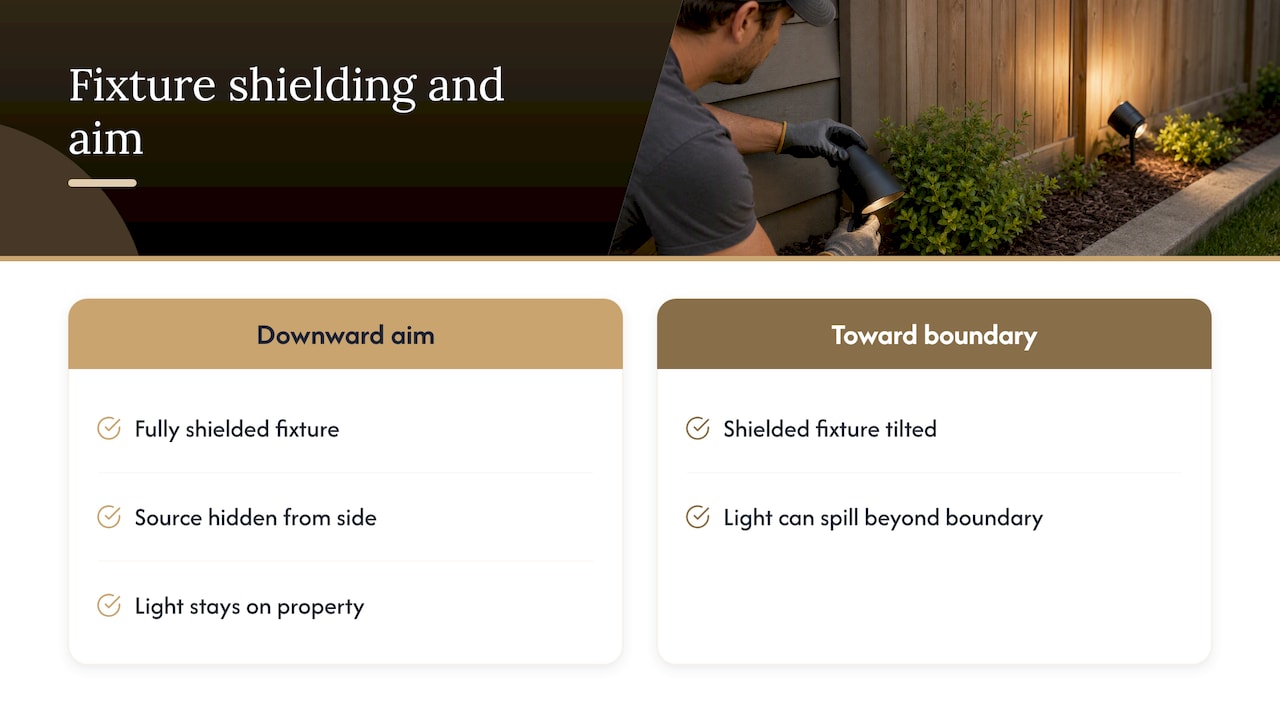
We recommend a simple walk-around after dark. Stand at each property line and look back at your house. Any bare bulb, bright lens or glare point you can see is a candidate for a shield, a lower mounting position, or a new aim. If your lighting layout makes this hard to judge, our guide to how outdoor lighting reduces glare without losing curb appeal shows what to look for.
Brightness: lower than you think
Homeowners often assume a bright light is a safe light. The evidence is thinner than that. A review prepared for Pacific Gas and Electric reports that the psychological benefit of light levels off at low levels, around 1 footcandle (about 10 lux). Past that point, extra light adds little and increases spill and wasted energy.
That is why a few low-output fixtures, layered, usually work better than one powerful floodlight. We cover the ranges in our landscape lighting brightness levels guide.
Color temperature
Warm light has less of the blue content that causes the harshest glare. DarkSky’s Dark Sky Friendly Home Lighting guide points to warm color temperatures of 3000K or lower as the better choice for people and local wildlife. Warm LEDs and dimming also help with insects: see our piece on cutting porch bugs with warm LEDs and dimming.
Controls
A light that is off cannot trespass. Motion sensors, timers and dimming schedules let you keep a path softly lit at a low level and raise it only when someone approaches. Our guide to motion sensors outdoors explains where they help and where they cause nuisance triggers, such as a sensor that sees the neighbor’s driveway.
Does more light make you safer?
This is the question behind many over-bright installations, and it deserves a straight answer.
DarkSky’s outdoor lighting and safety brochure notes that many people assume more light means more safety, but that the research is inconclusive. It quotes a U.S. National Institute of Justice study: “We can have very little confidence that improved lighting prevents crime.” That does not mean lighting is useless. It means intensity is the wrong lever.
What helps is visibility. Unshielded fixtures create glare, and glare makes your pupils contract, so the areas just outside the beam look darker. The U.S. Department of Energy’s guidance on exterior lighting also notes that vertical illuminance matters for security, meaning how well you can see a person’s face or a door, rather than how bright the ground looks.
So a trespass-free design and a good security design overlap:
- Shield fixtures so you see the scene, not the bulb.
- Light entries, steps and driveways evenly, without hot spots and deep shadows.
- Keep camera views free of glare. A camera aimed into a bright unshielded light often records a white blur.
- Use motion-activated boosts at a few key points rather than blasting the whole yard all night.
We go deeper on this in our top landscape lighting security solutions for homeowners and our security lighting placement test.
Prevent trespass before you install: BUG ratings
Professionals do not wait for a complaint. They check how a fixture will behave before it goes on the wall. The standard tool is the BUG rating, which scores a luminaire for Backlight, Uplight and Glare. The U.S. Green Building Council’s reference guide describes how designers use BUG ratings to verify fixture performance for a particular site.
You do not need to memorize the numbers. Ask your installer three questions:
- What are the backlight, uplight and glare ratings of the fixtures you propose?
- Where will each fixture be mounted, and where will it be aimed?
- How close is the nearest neighboring window or lot line?
A contractor who can answer all three has thought about trespass. One who answers only with wattage has not.
A worked example: a rear corner floodlight
Take a common case. A homeowner mounts a single high-output floodlight at the back corner of the house to cover the yard. It is wired to a switch and stays on until bed.
The problems are predictable. The light is mounted high, so the beam travels far. It has no shield, so the bulb is visible from next door. It is a cool white, so the glare is harsh. It runs for hours with nobody outside.
The fix uses the five principles in order:
- Remove it, or ask whether that area needs light at all.
- Replace it with two or three low-output, shielded fixtures aimed at the patio, steps and gate.
- Lower the output to what the task needs.
- Put it on a schedule or motion sensor with a dim baseline.
- Use a warm color, 3000K or lower.
The yard gets better visibility, the neighbor’s window goes dark again, and the electric bill drops.
Water, pools and docks
Water surfaces reflect light, and reflection is a common and overlooked source of trespass. Light aimed at a pool or dock can bounce into neighboring windows or across a lake. The goal is the same: low, shielded, controlled light. A homeowner’s guide to pool lighting design explains how carefully controlled lighting can support visibility and a sense of safety without excessive brightness.
Charlotte rules to know
If you live in Charlotte, the City’s Unified Development Ordinance sets limits. For nonresidential property, outdoor lighting must be located, screened or shielded so that it does not directly illuminate abutting residential lots or impair the vision of motorists. That matters to property managers, retail centers, offices and venues that back onto homes.
Three practical points follow:
- Rules differ by city, county and zoning district, and ordinances change. Check the current text with the City of Charlotte or your local planning office before a commercial project.
- Homeowners associations often add their own rules for color, brightness and hours. Share your lighting plan with the HOA before installation.
- If you have a dispute with a neighbor, whether a specific ordinance applies to a residence depends on your jurisdiction. For a legal question, talk to your local code enforcement office or an attorney.
Our perspective: why permanent lighting should be designed to stay home
We install permanent roofline tracks, landscape lighting and architectural accents across the Charlotte area, so we see both sides of this issue. Permanent lighting has real advantages for trespass control, and a few traps.
The advantages come from how the system is built. Track-based roofline lighting sits close to the surface it lights, rather than throwing a beam from a distance. Each point can be dimmed or switched from your phone, so you can set a warm, low level for everyday evenings and reserve full color for a holiday. Schedules mean the display is not running at 3 a.m. for no one.
The traps are brightness and color. A system that is easy to set to full white at full output is also easy to overdo. We think the right default is a restrained one: warm white most nights, lower output on the side of the house facing a neighbor, and color used for occasions. A good installer will set those limits with you and then check them after dark, from the property line.
We also build with Carolinas conditions and HOA and municipal compliance in mind, which is part of how we approach every design. Our approach to security is the one this article describes: consistent, subtle visibility rather than intensity.
— Dave
When your system needs a second look
If you already have lighting and suspect it spills, work through this audit on a dry night:
- Walk the property line and look back at your home. Note every visible bulb or glare spot.
- Check windows next door. Is any lit from your side?
- Check the street. Does any fixture shine into a driver’s eyes?
- Look at your camera feeds. Any washed-out areas near lights?
- Review schedules. Which lights run all night, and do they need to?
- Note color. Anything cooler than 3000K near a bedroom window is worth changing.
Often the fix is small: a shield, a lower mounting point, a dimmer setting. Sometimes a layout needs a redesign. Our guide to landscape lighting layering techniques shows how to use several soft layers in place of one harsh source.
If a neighbor’s light is the problem
You may be on the other end: your neighbor’s light is the one shining in. A few steps usually work better than a confrontation.
- Talk first. Many neighbors do not realize their lighting is intrusive. Brisbane City Council’s guidance, which reflects good practice even though it is Australian, says a polite, informal conversation is the best first step.
- Offer a specific fix. Suggest a shield, a timer or a motion sensor. People accept a solution more readily than a complaint.
- Document. Take photos from inside your home at night and keep a log of dates and times. Authorities need evidence to judge whether a nuisance exists.
- Block it on your side in the meantime. Blackout curtains or window film reduce the effect while you wait.
- Escalate locally. If talking fails, contact your city or county code enforcement, or your HOA if one applies. Rules vary by place, and in North Carolina that means checking your own town’s ordinance.
Commercial and multifamily properties
Property managers carry more exposure. Parking lots, building facades and signage are often the largest sources of trespass, and they sit close to residential neighbors. Beyond complying with the Charlotte rule above, a few habits help:
- Specify fully shielded fixtures with low backlight and glare ratings.
- Dim or switch off decorative and facade lighting after business hours.
- Aim any security lighting at doors and walkways, not at neighboring lots.
- Re-check after tenant changes or signage additions.
Our permanent lighting for commercial buildings guide covers how scheduling and zoning of a permanent system work for these properties.
Planning permanent lighting with trespass in mind
If you are planning a new system, we can design it to stay on your property from the start. We offer landscape lighting design, permanent roofline lighting with smartphone control, and a GlowCare maintenance subscription so your settings and fixtures stay in order over time. Our installation process explains what happens from the first visit to the final night check.
For a free estimate, start at Forever Glow Lighting. Tell us where the nearest neighbor’s windows are, and we will plan around them.
FAQ
How do I prevent light trespass?
Use fully shielded fixtures, aim them at the task, keep output low, add timers or motion sensors, and choose warm color temperatures of 3000K or lower. Check your work by standing at the property line after dark. If you can see a bulb or a glare spot, adjust it.
What are examples of light trespass?
A floodlight shining into a neighbor’s bedroom is the classic one. Others include parking lot lights facing homes, path lights aimed past a fence, glaring wall packs that shine at the street, and decorative lighting left on all night at full brightness.
Does leaving a light on at night deter burglars?
The evidence is weak. A National Institute of Justice study cited by DarkSky found very little confidence that improved lighting prevents crime. Lighting that lets you see clearly, without glare, is more useful than a bright light left on all night.
How do I block a neighbor’s bright light?
Start with a friendly conversation and suggest a shield, timer or sensor. While that plays out, use blackout curtains or window film. If it continues, keep photos and a dated log, then contact your local code enforcement or HOA.
Sources
- Five Principles for Responsible Outdoor Lighting, DarkSky International
- Outdoor Lighting and Safety brochure, DarkSky
- Board Policy on the Application of the Lighting Principles, DarkSky
- Dark Sky Friendly Home Lighting program guide
- Light Nuisances, MRSC
- Outdoor Lighting and Security White Paper, CALMAC
- Exterior Lighting for Energy Savings, Security, and Safety, U.S. Department of Energy
- Light pollution reduction reference guide, U.S. Green Building Council
- Charlotte Unified Development Ordinance, Municode
- Light and glare complaints, Brisbane City Council