
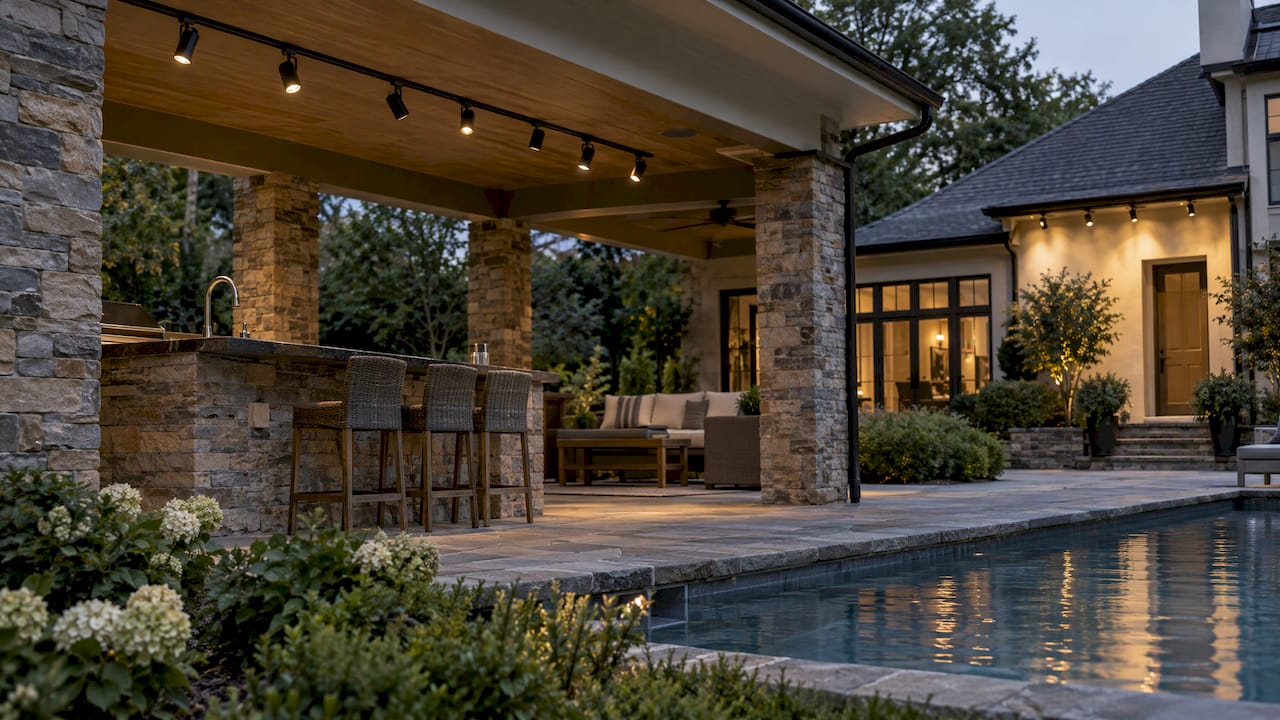
Yes, track lighting can go outside, but only systems built and listed for wet locations. For a Charlotte home, the right choice depends on what you want lit: a covered patio or pergola, the roofline and facade, or the ground-level landscape. Below we compare the four options homeowners usually weigh, explain the ratings that matter, and show where permanent roofline LED track, the system we install, fits best.
TL;DR
- Ordinary indoor track is not meant for outdoor use. Look for wet-location listings and an IP65 or higher rating.
- Outdoor-rated 12V track suits patio covers, pergolas and outdoor kitchens. It works as task or accent lighting at a small scale.
- For a whole roofline or facade, permanent LED track mounted under the eaves covers more ground and works year-round, in warm white or any color, from your phone.
- Ground-level landscape fixtures light paths, beds and trees. They pair well with roofline track instead of replacing it.
- In Charlotte, check permit and lighting rules before any new circuit or sign-like lighting goes in.
Table of Contents
- Can you use track lighting outside?
- What ratings and construction to look for
- Four ways to light the outside of a house
- How to choose: a short checklist
- What Charlotte homeowners should check first
- Our perspective
- Plan your exterior lighting with us
- FAQ
- Sources
Can you use track lighting outside?
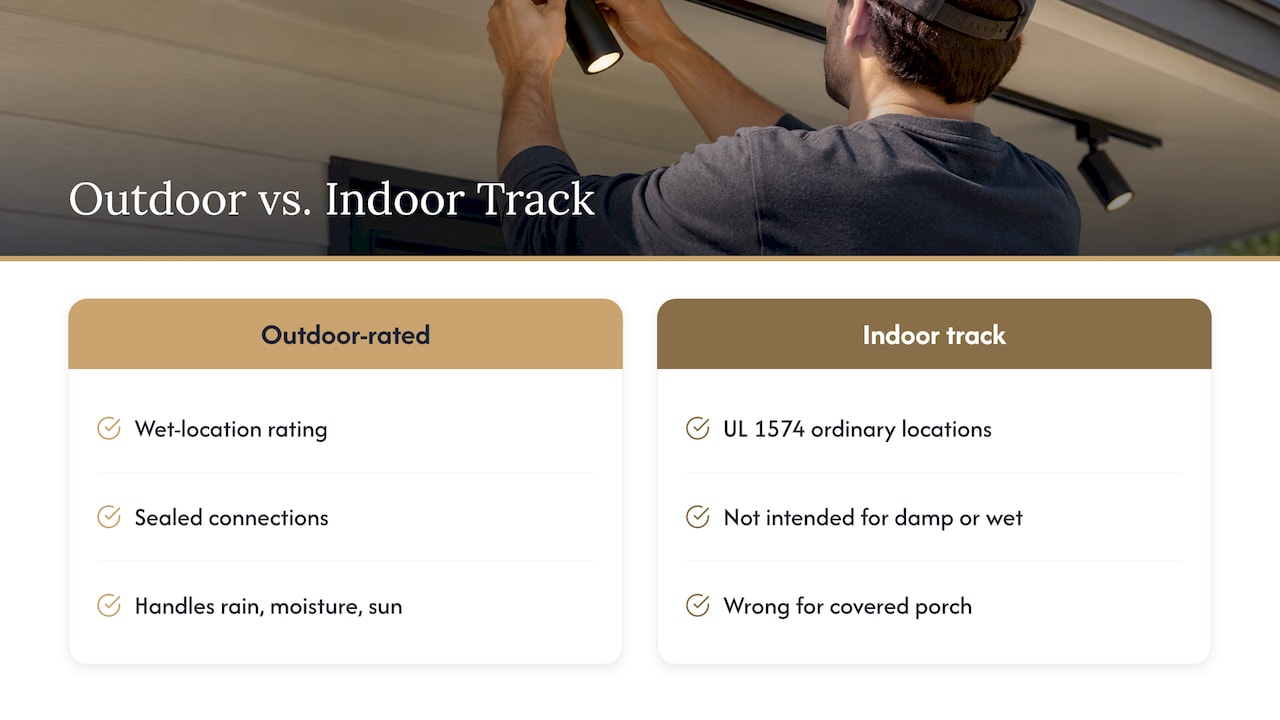
Yes, with the right product. Outdoor track systems use extruded aluminum, a protective powder-coat finish, sealed connections and a wet-location rating, so they can handle rain, moisture and sun. Lightology’s outdoor track guide lists patio covers, soffits, outdoor kitchens and facades as typical places for them.
The key word is “outdoor-rated.” The standard for track systems, UL 1574, covers track for ordinary locations. Its limitations say covered track systems are not intended for damp or wet locations, or for places with physical damage or corrosive vapors. A track head from the home center’s indoor aisle is therefore the wrong product on a porch ceiling, even a covered one.
What ratings and construction to look for
Three things tell you whether a track system belongs outside.
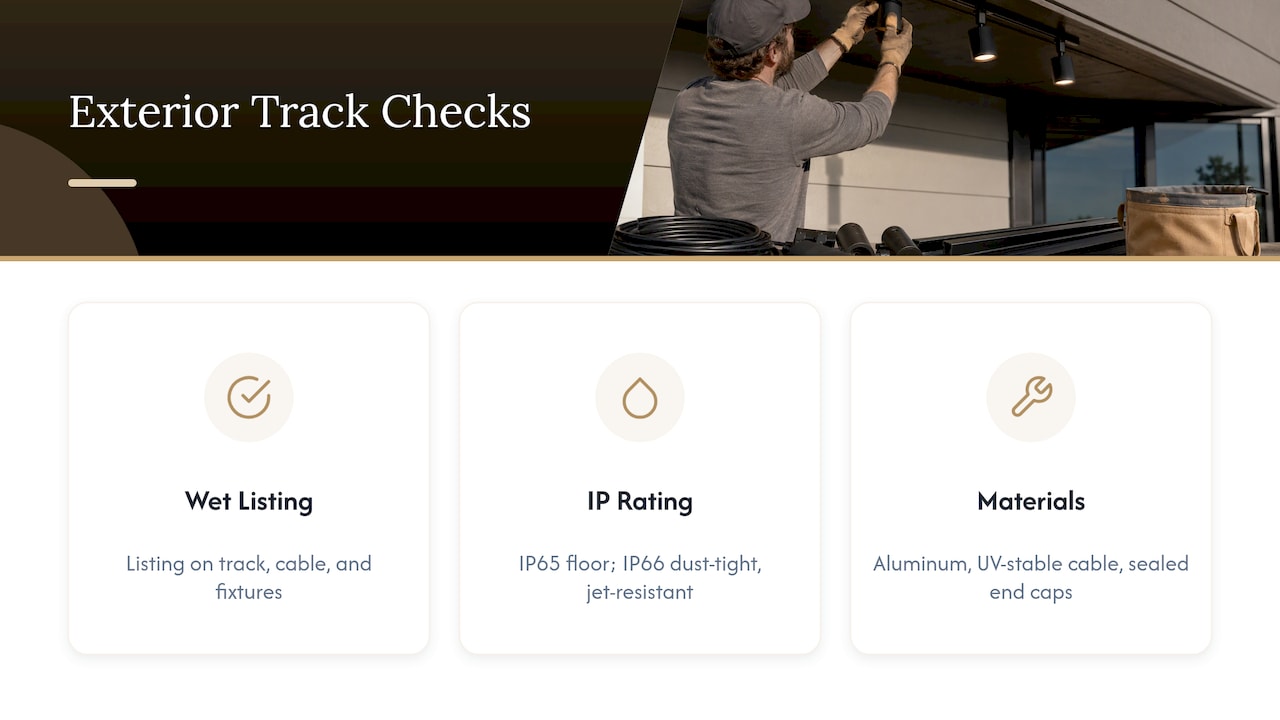
A wet-location listing. UL explains that line-voltage luminaires are evaluated to UL 1598, including wet-location requirements. Low-voltage lighting can be evaluated under UL 1838 or UL 2108. Look for the listing mark on the track, the cable and the fixtures, not only on the box.
An IP rating. The first digit shows protection against solids and the second against water. UL’s IP testing overview notes that IP66 means dust-tight and protected against powerful water jets. The U.S. Department of Energy’s site-lighting specification calls for wet-location listing and an optical cavity of at least IP65, a reasonable floor for any exterior fixture.
Materials and finish. Look for aluminum, a powder-coat or marine-grade finish, UV-stable cable and sealed end caps. In the Carolinas, with summer sun, heavy rain and humidity, these details decide whether a system looks good in year five.
Four ways to light the outside of a house
Most homeowners searching for exterior track lighting are really choosing between these options.
| Option | Best for | Power | Coverage | Typical limits |
|---|---|---|---|---|
| Outdoor-rated 12V track kit (brands such as PureEdge and WAC make these) | Covered patios, pergolas, outdoor kitchens | Low voltage with a remote transformer | A few feet to a few dozen feet | Heads are visible by day, and it suits sheltered spots more than a whole facade |
| Line-voltage outdoor track | Commercial canopies, large soffits | 120V or 277V | Long runs | Needs an electrician and permit review, and a more industrial look |
| Permanent roofline LED track (our system) | Whole roofline, gables, facade accents, holiday displays | Low-voltage smart controller | Entire perimeter | Professional design and installation |
| Ground-level landscape fixtures | Paths, garden beds, trees, walls | Low-voltage landscape transformer | Targeted spots | Does not light the roofline |
Outdoor-rated 12V track kits
These are the closest match to what most people picture. Most outdoor track runs on 12V AC or DC, which pairs easily with standard landscape transformers, according to Lightology. Adjustable heads let you aim light at a table, a grill or a wall.
They work best where the track is under a roof: a pergola, an outdoor kitchen, a covered deck. The practical tradeoff is that the fixtures stay visible in daytime and the lighting is aimed at one area, not wrapped around the home.
Line-voltage outdoor track
Line-voltage systems carry full household current. That allows longer runs and higher output, which is why you see them on commercial canopies. They also bring stricter installation rules. Confirm the whole assembly, including track, connectors and heads, is listed for wet locations, and have a licensed electrician install it. For most houses this is more system than the job needs.
Permanent roofline LED track
This is the modern answer when the goal is the roofline and facade. A low-profile track is mounted under the eaves and color-matched to the trim. The LED points sit inside it and are controlled from a smartphone. By day the track blends into the home. At night it can run warm white for everyday accent lighting, a team color on game day, or full holiday patterns.
This is what we do at Forever Glow Lighting. Our installs are custom designed, use commercial-grade hardware chosen for the Carolinas’ climate, and are planned with HOA and municipal rules in mind. If you want to compare the track types before you decide, our guide to permanent roofline lighting types walks through them, and our page on IP67 and track materials explains why the ratings matter on a roofline.
Ground-level landscape lighting
Pathway lights, uplights for trees and wall washes solve a different problem: they light what is at ground level. They do not replace track. A common approach is to light the architecture from above and the landscape from below. Our landscape lighting layering techniques show how the two layers fit together, and the curb appeal ideas give examples you can picture on your own lot.
If trees are close to the house, plan for them before the lights go in. Healthy, well-placed trees and greenery shape how the light falls, and tree removal and landscaping planning is worth settling first so you do not move fixtures later.
How to choose: a short checklist
- Define the area. A pergola or outdoor kitchen points to a 12V track kit. A full roofline points to permanent track. Paths and beds point to landscape fixtures.
- Confirm voltage. Know whether the system is line voltage or 12V low voltage, and choose power feeds and connectors to match, as Lightology advises.
- Check listings. Wet-location listing on every part, and an IP65 or higher rating on the fixtures.
- Check beam spread and color temperature. Heads on the same track should match so the light looks even.
- Plan control. Decide if you want a wall switch, a timer or smartphone scenes. Color change and scheduling are what separate modern systems from basic track.
- Plan service. Outdoor lighting is exposed to weather every day. Ask who handles maintenance and warranty claims, and whether the warranty is written for your climate.
What Charlotte homeowners should check first
New circuits and new outdoor wiring generally involve electrical permit review, and outdoor receptacles and circuits have GFCI protection requirements under the North Carolina electrical code. Your installer should confirm current requirements with the city or county before work begins, rather than leave it to you.
Charlotte also has rules about exterior lighting levels and signage-style lighting. We cover these in our guides on Charlotte outdoor lighting permits and UDO Article 16 and the Charlotte exterior lighting ordinance. If you live in an HOA, send the design to the board early. Color-matched, low-profile track is generally easier to approve than visible fixtures, which is one reason we design to those standards from the start.
If your roofline has gutters, placement matters. See our notes on installing roofline lights near gutters.
Our perspective
We get this question from homeowners who started out shopping for track heads and ended up wanting something bigger. That is a good instinct.
A track kit is a fixture. A permanent lighting system is a design. When we lay out a roofline, we think about where the eye lands at night: the gables, the porch columns, the corners that give the house its shape. We pick track that matches your trim so it disappears by day, and we use hardware made for Carolina heat, humidity and storms.
The other half is control. With a smartphone app you can run warm white most nights, switch to a color for a party, and put up holiday displays without a ladder. That is the practical reason homeowners choose permanent track over seasonal strings.
Lighting also helps with security. Even, balanced coverage on the front and sides of a house means suspicious activity is more likely to be seen, and it removes dark corners near doors and driveways.
Dave
Plan your exterior lighting with us
Forever Glow Lighting designs and installs permanent roofline track, architectural accents, landscape lighting, patio and bistro lighting, deck and step lighting and commercial exterior lighting across the Charlotte area. Each project starts with a free estimate, and our GlowCare maintenance subscription keeps the system running after installation.
Start with our architectural lighting service for roofline and facade work, our patio lighting page for covered outdoor spaces, or contact us for a free estimate. For budgeting, our permanent lighting installation cost guide for Charlotte explains what drives the price.
FAQ
Is outdoor track lighting waterproof?
Outdoor-rated track is built to resist rain, but the rating decides how well. An IP65 rating protects against water jets, and IP66 adds protection against powerful jets and dust, per UL’s IP overview. Also check for a wet-location listing. Indoor track is not designed for wet locations.
What is the modern alternative to track lighting outdoors?
For a roofline or facade, it is permanent LED track under the eaves that stays up all year and is controlled by phone. For paths, beds and trees, it is low-voltage landscape lighting. Many homes use both together.
Can I use track lighting on a covered patio or pergola?
Yes. These are the most common places for outdoor-rated track, since the heads can be aimed at seating, a grill or an outdoor kitchen. Choose a wet-location-listed system and a transformer matched to the track voltage. For patios, we also install bistro and string lighting and deck and step lighting.
Do I need a permit for exterior lighting in Charlotte?
New circuits and new wiring generally need electrical permit review, and local lighting-level rules can apply. Your installer should confirm what applies to your property. Our Charlotte permit guide explains the common checks.
Sources
- Landscape and Outdoor Luminaire Lighting, UL
- UL 1574 track lighting systems standard
- IK and IP Testing for Lighting Products, UL
- LED Site Lighting Performance Specification, U.S. Department of Energy
- Outdoor Track Lighting and Architectural Exterior Track, Lightology
- Tree removal and landscaping, Texas Tree Transformations