
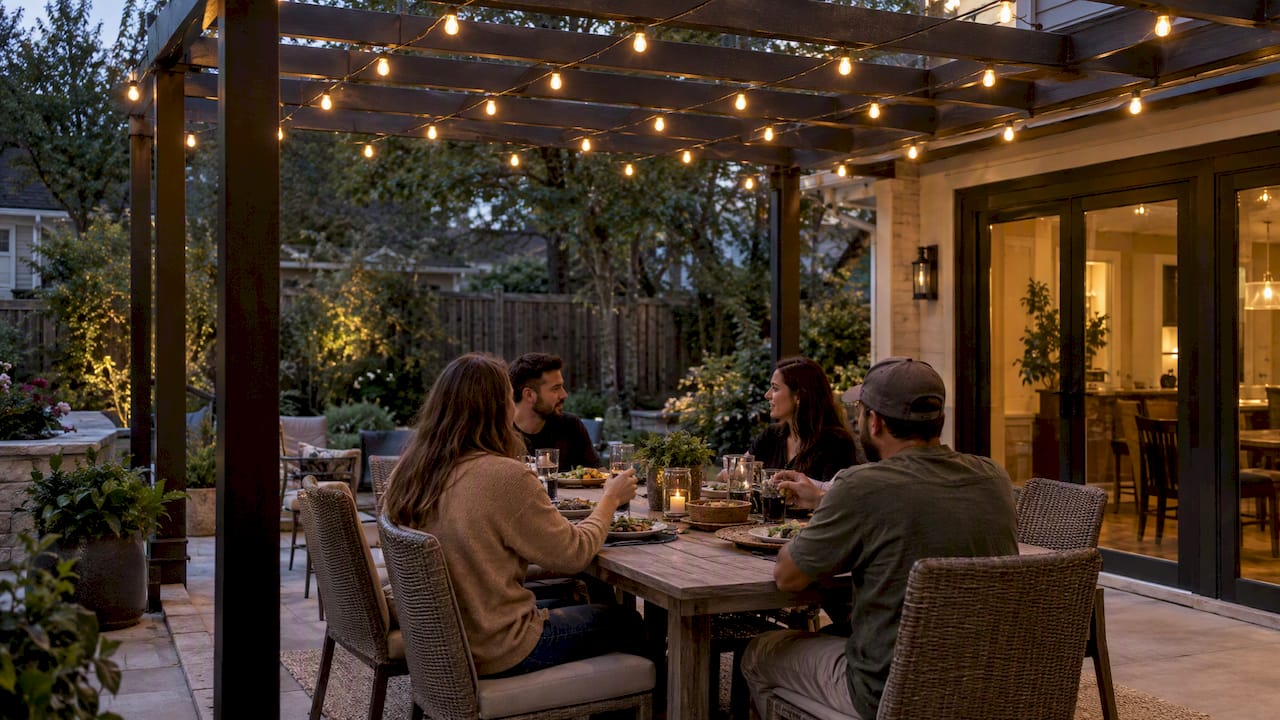
V, grid, zig-zag, and fan-out are the easiest, most flexible patio string light patterns to pull off at home. Use a V shape for narrow side yards, a grid for covered patios and pergolas, zig-zag for long rectangular spaces, and a fan-out for a single focal canopy over a dining table. Whatever pattern you pick, choose UL-marked, outdoor-rated string lights built for the span, and keep safe heights and spacing in mind before you climb a ladder.
TL;DR:
- A grid needs four to six anchor points; a maypole’s center pole must bear the combined pull of every strand.
- Measure each anchor span and add about 10% for a gentle curve; runs over 40 feet are easier to manage as multiple strings.
- Choose lights with a UL Supplement SD listing for year round use; use outdoor rated cords with GFCI protection, and avoid male to male cords.
- Hang the lowest bulbs 8 to 10 feet above seating, then raise them over walkways and driveways to clear people and vehicles.
- A professional anchor assessment is prudent for complex spans, multiple anchor types, maypole layouts, or installations subject to HOA design requirements.
Table of Contents
- 1. Six Patio Lighting Patterns and How to Hang Them
- 2. How Do You Hang Patio Lights Safely and to Code?
- 3. Choosing Bulb Style, Color, and Controls
- 4. Installer Checklist and When to Call a Professional
- 5. How String Light Patterns Shape the Mood of a Patio
- 6. Coordinating String Lights With Landscape and Architectural Lighting
- 7. Keeping a Pattern Looking Good Season After Season
- 8. Real-World Patio Patterns Worth Copying
- 9. Design Principles Behind a Pattern That Actually Looks Right
- 10. Where I Land on Mood vs. Durability
- How Forever Glow Lighting Makes Any Pattern Permanent
- FAQ
- Sources
1. Six Patio Lighting Patterns and How to Hang Them
Each of these patterns solves a different shape problem. Pick based on your patio’s footprint first, then your style preference.
- V-pattern: Two lines cross from a single high point down to two lower anchors, forming a V when viewed from below. It suits narrow side yards or tight courtyards and needs just two support points plus one elevated anchor, often a wall bracket or tree branch.
- Grid/square pattern: Parallel rows cross at even intervals to form a checkerboard overhead, ideal for rectangular covered patios or pergolas with four corner posts. Plan for four to six anchor points and measure both directions before buying string length.
- X/diamond pattern: Strings cross corner to corner over a square or rectangular space, creating a diamond when seen from the center. This works well over smaller dining areas and needs only the four corner anchors already in place.
- Zig-zag/W pattern: Strings weave back and forth between two parallel support lines, covering long rectangular yards or deck runs without needing a center anchor. It is forgiving of uneven anchor heights since each zag absorbs slack independently.
- Horizon/fan pattern: Multiple strings radiate from one high point down to a wide arc of lower anchors, like a fan opened sideways. It creates a dramatic single focal point, best suited to a dining table, fire pit, or seating circle.
- Tent/maypole pattern: Strings radiate from a tall center pole down to a full circle of ground or wall anchors, forming a tent-like canopy. This pattern demands the most planning since the center pole must support the combined pull of every strand.
For string length, measure the direct anchor-to-anchor distance for each run, then add about 10% slack so bulbs hang with a gentle, natural curve rather than pulling taut. A patio string light layout that spans more than 40 feet usually works better as multiple chained strings rather than one continuous run, since shorter runs reduce sag and make bulb replacement simpler. If your patio has a pergola already, browsing a few pergola lighting ideas before you commit to a pattern can help you see how beams and rafters double as built-in anchors.
Common mistakes include underestimating slack, anchoring to a single weak point instead of distributing the load, and mixing string gauges mid-run, which creates uneven sag and strain on connectors.
2. How Do You Hang Patio Lights Safely and to Code?
Height and spacing decisions matter as much as the pattern itself. Hang the lowest bulbs high enough over seating and dining areas so guests don’t brush against them, and go higher over walkways or driveways to clear vehicles and reduce visible sag, following common professional hanging guidance.(https://foreverglowlighting.com/patio-string-lights-height/).
Bulb spacing typically ranges from closer together for a dense canopy to farther apart for a sparse, starry effect, depending on the look you want. Our spacing guide for homeowners breaks down support distances by string type, generally 6 to 20 feet between anchors.
UL Solutions reports that string lights listed under Supplement SD for all-year use carry heavier wire gauge, thicker insulation, and more rigorous strain relief testing than seasonal lights, which matters for anything left up through multiple seasons.
Follow these steps before you power anything on:
- Confirm every string carries a UL mark rated for outdoor and, if left up year round, all-year use.
- Use outdoor-rated, jacketed extension cords and plug into a GFCI-protected outlet.
- Never use a male-to-male extension cord. The CPSC has specifically warned that these cords, sold under various listings online, pose electrocution, fire, and carbon monoxide risks.
- Check each anchor point (screw eyes, beam mounts, poles) can bear the combined tension of every strand pulling on it.
- Confirm total wattage draw stays within the product’s rated limit and the circuit’s capacity before plugging in.
The CPSC’s extension cord guidance lists the observable safety features a cord should have; a cord missing them presents a real hazard rather than a minor inconvenience.
3. Choosing Bulb Style, Color, and Controls
Bulb shape and color temperature set the mood before a single pattern decision matters. Classic globe or filament bulbs give a warmer, more decorative look but tend to run hotter and have shorter practical lifespans than modern LED equivalents, which last longer and use less power for a similar glow.
- Warm white (2200 to 2700K) suits cozy dining and lounge areas, the tone most people picture when they imagine string lights.
- 3000K reads slightly crisper and works well where the patio also handles brighter evening activities like cooking or games.
- Plug-in dimmer controllers offer simple on-off and brightness adjustment for a single zone.
- Hardwired smart systems allow scheduling, zone control, and color changes from a phone, with more consistent reliability than battery or plug-in remotes over time.
- Layering string lights with ground-level uplights or spotlights on nearby trees or walls adds depth instead of leaving everything at one flat height.
Pro Tip: Pair warm white string lights overhead with a cooler uplight on one accent tree. The contrast keeps the eye moving instead of flattening the whole yard into one tone.
4. Installer Checklist and When to Call a Professional
Before buying anything, run through five steps: measure every anchor-to-anchor span, pick the pattern that fits your footprint, plan anchor points that can hold the combined tension, confirm your string lights and cords are UL-rated and outdoor-jacketed, then test the full run before securing it permanently.
- Measure first, buy second. Guessing on string length leads to mid-project returns.
- Match pattern to space shape rather than forcing a tent pattern onto a narrow side yard.
- Verify anchor strength, especially on fences, gutters, or siding not built for sustained pull.
- Confirm wattage and cord ratings match year-round or seasonal use as intended.
Complex spans, multiple anchor types, HOA design requirements, or a desire for smartphone-controlled zones are the points where a DIY ladder project starts costing more time than it saves. Our patio lighting installations handle those cases with permanent, code-aware hardware designed to stay up and look sharp through every season.
5. How String Light Patterns Shape the Mood of a Patio
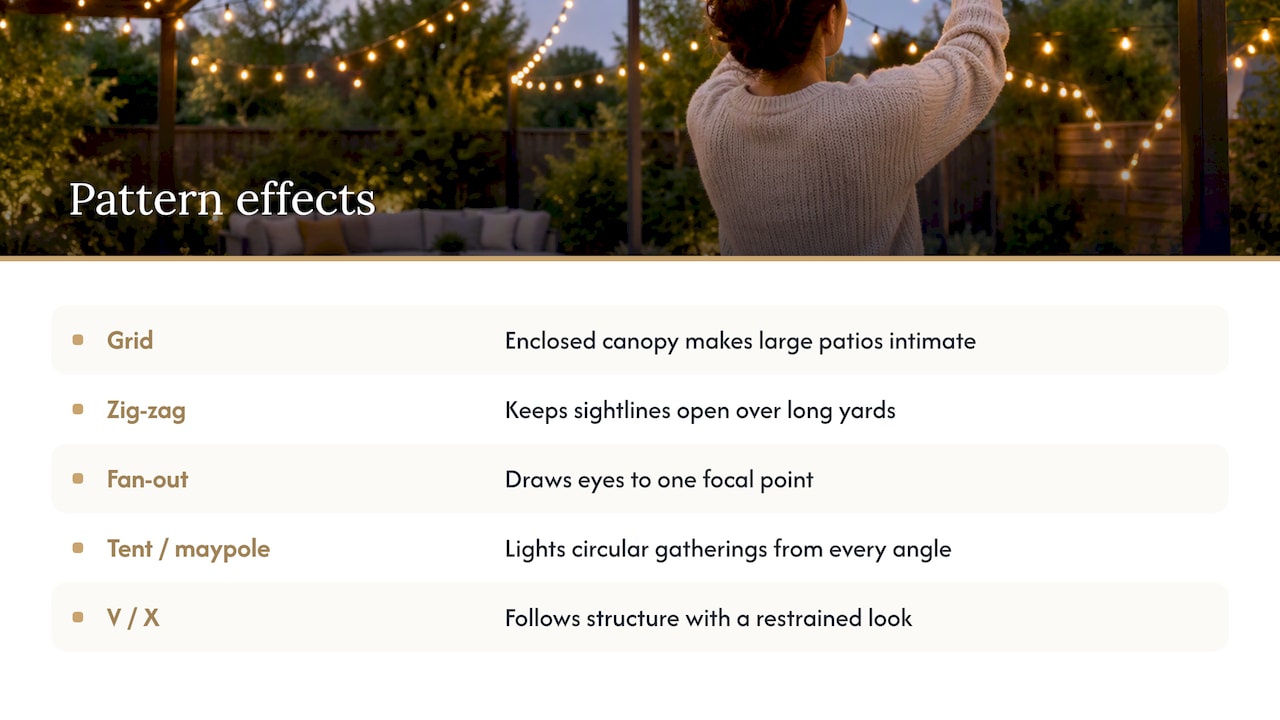
The pattern you choose changes the feeling of a space as much as the bulbs do. A tight grid overhead creates an enclosed, room-like canopy that makes a large patio feel intimate, the effect many covered dining areas aim for. A sparse zig-zag over a long yard does the opposite, keeping sightlines open while still marking the space as lit and lived-in.
A fan-out radiating from one point draws every eye toward whatever sits underneath it, a fire pit, a bar cart, a single table, making it the natural choice when you want a clear focal point rather than even coverage. The tent/maypole pattern pushes that further, wrapping a circular gathering spot in light from every angle and suiting larger parties or multi-use lawns.
V-patterns and X-patterns read as more architectural and restrained, following the lines of the structure itself rather than floating independently above it. They tend to suit patios where the lighting should support the space’s existing design rather than become the main event.
Color temperature shifts the same pattern’s effect again: a grid in warm white feels cozy and low-key, while the same grid in a cooler white feels more modern and open. Matching pattern density to the mood you want, dense for intimacy, sparse for openness, is a faster path to the right atmosphere than chasing a specific bulb brand.
6. Coordinating String Lights With Landscape and Architectural Lighting
String lights rarely sit alone in a well-lit backyard. When they’re layered with ground-level landscape lighting and architectural accents, the whole space reads as planned rather than patched together.
A good rule: let string lights handle the overhead plane while landscape fixtures handle the ground plane. Path lights and uplights on trees or walls fill in shadows that a single overhead layer leaves behind, especially around the edges of a patio where string light coverage naturally thins out. Architectural accent lighting on a roofline or facade can frame the whole backyard so the string light pattern reads as one layer within a bigger composition instead of the only light source fighting against a dark house.
This matters most on multi-zone properties, where a dining patio, a side yard, and a front facade are all visible from the same vantage point at night. Mismatched color temperatures between zones, warm string lights next to stark blue-white landscape spots, tend to look unplanned rather than intentional. Keeping color temperature consistent across string lights and landscape fixtures, or deliberately warm overhead with cooler architectural accents for contrast, reads as a design choice rather than an oversight. Our landscape lighting design work often starts exactly here, coordinating what’s already on the house or in the yard with whatever pattern goes up overhead.
7. Keeping a Pattern Looking Good Season After Season
A pattern that looks sharp on installation day needs upkeep to stay that way, especially through a full year outdoors. Dust, pollen, and spider webs build up on bulbs and cords faster than most people expect, and a simple wipe-down every few months keeps the string looking as bright as the day it went up.
Bulb replacement is easiest when you’ve kept spare bulbs matching the original string’s base type and wattage, since mismatched replacements can throw off both color and brightness within the same run. Check connectors and anchor points each season for loosening, especially after wind events or the added weight of ice in colder climates, since a sagging run puts more strain on the anchors holding it.
Seasonal adjustments matter too. Lights hung tight for a summer pattern may need a slight re-tensioning before winter if cold temperatures cause the cord jacket to contract. For year-round installations, checking that the strings remain correctly rated for continuous outdoor use, not just a few months at a time, protects against premature wire fatigue described in UL’s Supplement SD guidance. A quick seasonal walk-through, checking anchors, wiping bulbs, and swapping any dim or flickering sections, keeps a chosen pattern looking intentional rather than tired.
8. Real-World Patio Patterns Worth Copying
Grid patterns show up most often over covered patios and pergolas, largely because the structure already provides four strong anchor points at even heights, which makes the checkerboard overhead easier to execute cleanly than almost any other pattern. Homeowners with an existing pergola frequently start here before experimenting further.
Zig-zag patterns dominate long, narrow backyards, particularly row-house style lots where the yard runs deep but stays fairly narrow between fences on either side. Two parallel support lines, often strung fence post to fence post, let the zig-zag weave between them without needing a center structure at all.
Fan-out patterns show up most around fire pits and single dining tables, anywhere the goal is to draw the eye to one spot rather than evenly light a whole yard. A single elevated anchor, a tree limb, a pole, or a wall bracket, feeding several strands down to a wide arc covers a surprising amount of ground from one point.
Tent and maypole setups appear most at larger backyard gatherings or wedding-style setups, where a central pole in an open lawn supports a full circle of light overhead. Because the center pole carries the combined pull of every strand, these setups benefit the most from a professional anchor assessment before installation, particularly for taller poles or longer radial spans.
9. Design Principles Behind a Pattern That Actually Looks Right
Balance and symmetry do more work than most people give them credit for. A grid or X-pattern naturally enforces symmetry because the anchor points dictate even spacing, which is part of why those patterns read as calm and intentional rather than busy.
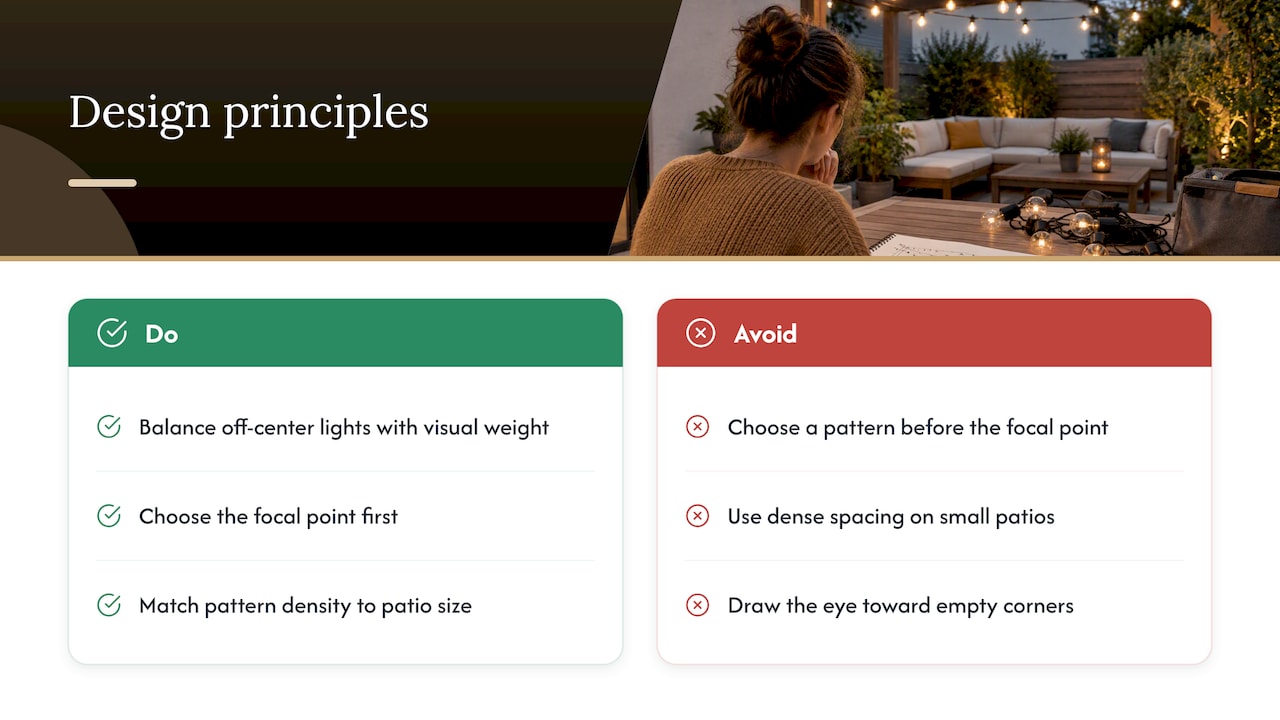
Asymmetrical patterns, like a fan-out anchored off-center, can still look balanced if the visual weight elsewhere in the space, a large planter, a fireplace, a cluster of furniture, offsets the lighting’s pull in the other direction. The goal isn’t identical halves; it’s a composition where nothing feels like it’s dragging the eye to an empty corner.
Focal points deserve deliberate placement rather than happening by accident. Decide first whether the dining table, the fire pit, or the whole patio as a single room is the thing you want lit most intentionally, then let the pattern follow that choice instead of picking a pattern and hoping a focal point emerges. A fan-out or tent pattern naturally creates a focal point; a grid or zig-zag naturally creates even coverage. Choosing between them is really choosing between those two goals.
Scale matters too: a dense, tightly spaced pattern on a small patio can feel cluttered, while the same density across a large yard reads as generous and warm. Matching bulb spacing and pattern density to the actual size of the space keeps the design principle doing its job instead of fighting the room it’s in.
10. Where I Land on Mood vs. Durability
Readers often ask whether to prioritize the prettiest pattern or the sturdiest one. Our honest take: pick the pattern you love first, then build it with hardware rated to survive the seasons you’ll actually use it in, rather than compromising the look to save on wire gauge.
— Dave
How Forever Glow Lighting Makes Any Pattern Permanent
Once you know which pattern fits your patio, we turn it into a fixture you never have to re-hang. Our patio lighting and bistro and string installations use commercial-grade, climate-optimized hardware with HOA-aware design, so the grid, fan, or zig-zag you picked stays put through every season.
- No ladder required once the system is in, including for seasonal bulb or color changes.
- Smartphone controls let you switch color temperature or brightness by zone without touching a wire.
- Our GlowCare maintenance subscription keeps the system running without repeated DIY upkeep.
Reach out for a free estimate on turning your chosen patio lighting pattern into a permanent, code-aware install.
FAQ
How do you set up string lights in your backyard?
Start by measuring anchor-to-anchor distances for your chosen pattern, then confirm each anchor point (posts, beams, or trees) can hold the combined pull of every strand. Hang the lowest bulbs 8 to 10 feet high over seating areas, a height Forever Glow’s installers commonly use, and plug into a GFCI outlet using an outdoor-rated cord.
What are the best string lights for backyards?
For any installation meant to stay up through multiple seasons, choose string lights listed under UL’s Supplement SD for all-year use, which carry heavier wire gauge and more rigorous strain relief testing than standard seasonal lights. Seasonal-only lights work fine for short-term displays but shouldn’t stay up year round.
What are some creative outdoor lighting ideas for patios?
A fan-out pattern over a dining table or fire pit creates a strong single focal point, while a grid under a pergola gives even, room-like coverage. Layering string lights with ground-level landscape lighting, as covered in our landscape lighting design work, adds depth that overhead lighting alone can’t achieve.
How can I make my own outdoor lights?
Building a DIY string light pattern means choosing UL-marked, outdoor-rated strings, planning anchor points strong enough for the pattern’s tension, and avoiding male-to-male extension cords, which the CPSC has specifically warned against due to electrocution and fire risk. For anchors near a pool or water feature, guidance like landscape lighting around a pool covers code considerations specific to wet areas.