
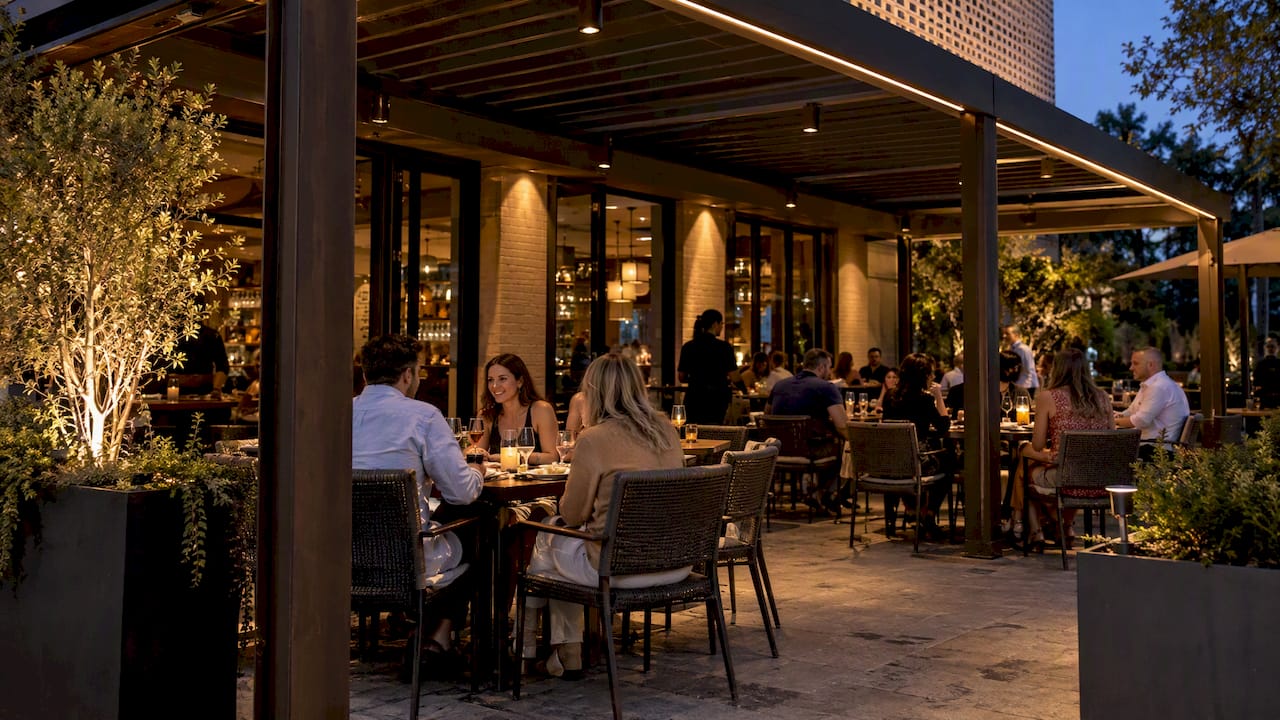
Good restaurant patio lighting is layered, warm and dimmable. Guests can read the menu and see their food, the space feels inviting, and the fixtures stay out of the way. Most patios get there with three things: soft overhead or perimeter light, brighter accents at tables and service points, and controls that let you change the mood as the evening goes on. This guide covers how to plan each layer, which fixtures suit which patio, how bright to go, what to check on the electrical side, and what to settle before a permanent system goes in.
TL;DR
- Build three layers: ambient light for general visibility, task light where guests read and staff work, and accent light for architecture, plants and focal points.
- Aim for warm, dimmable light. The Illuminating Engineering Society (IES) recommends 3 to 6 footcandles at dining tables, and anything under 0.4 is too dark to see food clearly.
- Control glare first: shield sources, keep bulbs out of the guest sightline and put every layer on its own dimmer or scene.
- Use wet-location-rated fixtures and receptacles, and pull the electrical permit before any permanent work.
- Plan circuits, conduit, mounting points and controls on paper before anyone drills a hole.
Table of Contents
- Why the lighting layers matter more than the fixtures
- How bright and how warm
- Fixtures that work on restaurant patios
- Controlling glare
- Safety, code and permits
- Controls, scenes and operating cost
- Planning a permanent patio lighting system
- Our perspective
- Light your patio with Forever Glow
- FAQ
- Sources
Why the lighting layers matter more than the fixtures
Most patio lighting problems come from one source doing every job. A row of bright string lights can set a mood, but it will not light a menu, and a floodlight on the wall will light the menu while flattening the whole space. Layering fixes that by giving each job its own light.
The IES, which sets lighting practice in the United States, describes a restaurant recipe built on this idea: table lighting combined with perimeter and ambient light softens overhead shadows and makes the guest’s view more interesting. The same article notes that computerized controls let you set and repeat precise levels, which matters because small adjustments make a visible difference when combined light sits below 1.5 footcandles. That is exactly the range most patios live in after dark.
The National Restaurant Association gives the same direction in plain terms: warm, soft lighting for a cozy atmosphere, with accent lighting on tables, bars and other focal points so customers can see clearly.
For a patio, that translates into three layers.
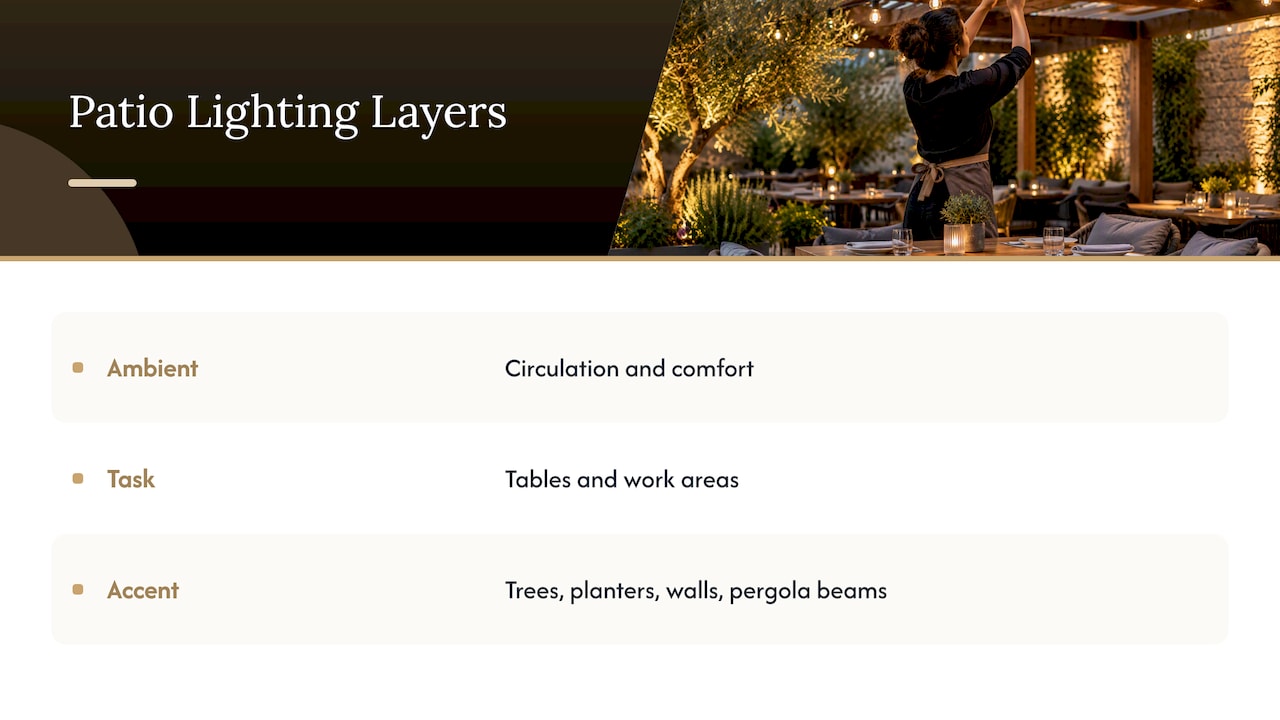
Ambient layer: the glow that holds the space together
Ambient light is the general, low-level light that lets people walk in, find a seat and feel comfortable. On a patio it usually comes from string lights, lanterns, pendants under a pergola, or discreet track and perimeter lighting along the roofline or ceiling edge.
Keep it warm and keep it low. Ambient light that is too bright makes a patio feel like a parking lot, and light that is too dim makes servers guess at what they are carrying.
Task layer: where people read, pour and pay
Task light goes where the work happens: tables, the host stand, the service station, the bar rail and any steps or grade changes. It is the layer that earns the most guest comfort per watt, because it is aimed rather than spread.
For tables, recessed or string lights under a roof, and rechargeable LED table lights, are common choices, according to Restaurant Design + Development. Table-level light also lets you keep the overhead layer dim. If you want flameless candle-style light on tables, outdoor LED candles give you a warm point of light without an open flame to manage.
Accent layer: what makes the patio look designed
Accent light picks out trees, planters, stone walls, pergola beams, signage and the building face. It adds depth, which is what keeps a patio from looking like a flat room with the roof removed. It also defines zones: a bar area, a quiet corner, a walkway.
If your patio borders landscaping, our guide to landscape lighting layering techniques shows how uplighting, path lighting and wall washing work together, and the same logic applies to a commercial frontage.
How bright and how warm
The numbers are modest. IES recommends 3 to 6 footcandles at dining tables, depending on guest age, and it calls anything below 0.4 footcandles a danger zone where even younger diners cannot clearly see their food. Older guests need the higher end of the range, so a patio that suits a 25-year-old at 3 footcandles may frustrate a 65-year-old at the same level.
That gives you a practical target: dim enough to feel like evening, bright enough that nobody leans toward a candle to read the menu.
Color temperature
Warm white is the standard for dining. Most operators and designers work in the 2700K to 3000K range, which reads as soft amber-white. Avoid cool white (4000K and up) on a dining patio. It makes skin and food look flat, and it carries the feel of a loading dock.
IES gives a broader outdoor principle that applies here. Its 2024 position says outdoor light should be useful, targeted, no brighter than necessary, controlled to when it is useful, and warmer where possible. That reads like a good brief for a patio as well.
Dimming through the evening
A patio is used in daylight, at dusk and at 10 p.m., and the right light is different at each point. Put every layer on a dimmer, and group them into scenes such as “lunch,” “dusk,” “dinner” and “late.” With a scene, staff press one button rather than adjusting five circuits, and the patio looks the same on Tuesday as it did on Saturday.
| Time of service | Ambient | Task and tables | Accent |
|---|---|---|---|
| Lunch and daylight | Off or low | Low, for shaded tables | Off |
| Dusk | Rising to medium | Medium | On, low |
| Dinner | Medium to low, warm | Steady, within the 3 to 6 footcandle range | Medium, to hold the space together |
| Late night | Low | Low, at bar and walkways | Low |
Treat the table as a starting point and adjust it to your own patio, since shade, surrounding street light and menu type all shift what feels right.
Fixtures that work on restaurant patios
The right fixture depends on what the patio is built from. Here is how the common choices fit.
String and bistro lights
String lights are the signature look of the outdoor dining space, and they do ambient duty well. The decisions that matter are mounting height, spacing and pattern. Hung too low, bulbs sit in the guest’s sightline and create glare. Hung too tight, they flatten the space. Our guide to patio string light layouts recommends keeping the lowest bulbs 8 to 10 feet high, and the page on string light patterns with code and safety in mind walks through grid, wave and other layouts. For a finished, permanent version, see bistro string lighting.
Pendants and lanterns
Pendants suit covered patios and pergolas, where they hang at a controlled height and give a defined pool of light over a group of tables. They must be rated for the environment: damp or wet location depending on how exposed they are.
Recessed and track lighting
Under a solid roof or soffit, recessed fixtures disappear and leave only the light. A low-profile track along the roofline does the same job on an open patio, with no visible fixture in the guest’s view. This is the thinking behind the smart LED track systems we install: the hardware is color-matched to the building, invisible by day and controlled from a phone or panel at night.
Sconces and wall lights
Wall fixtures add depth near entrances, fences and building faces. Shielded sconces keep the light on the wall and the walkway, rather than in the eyes of guests.
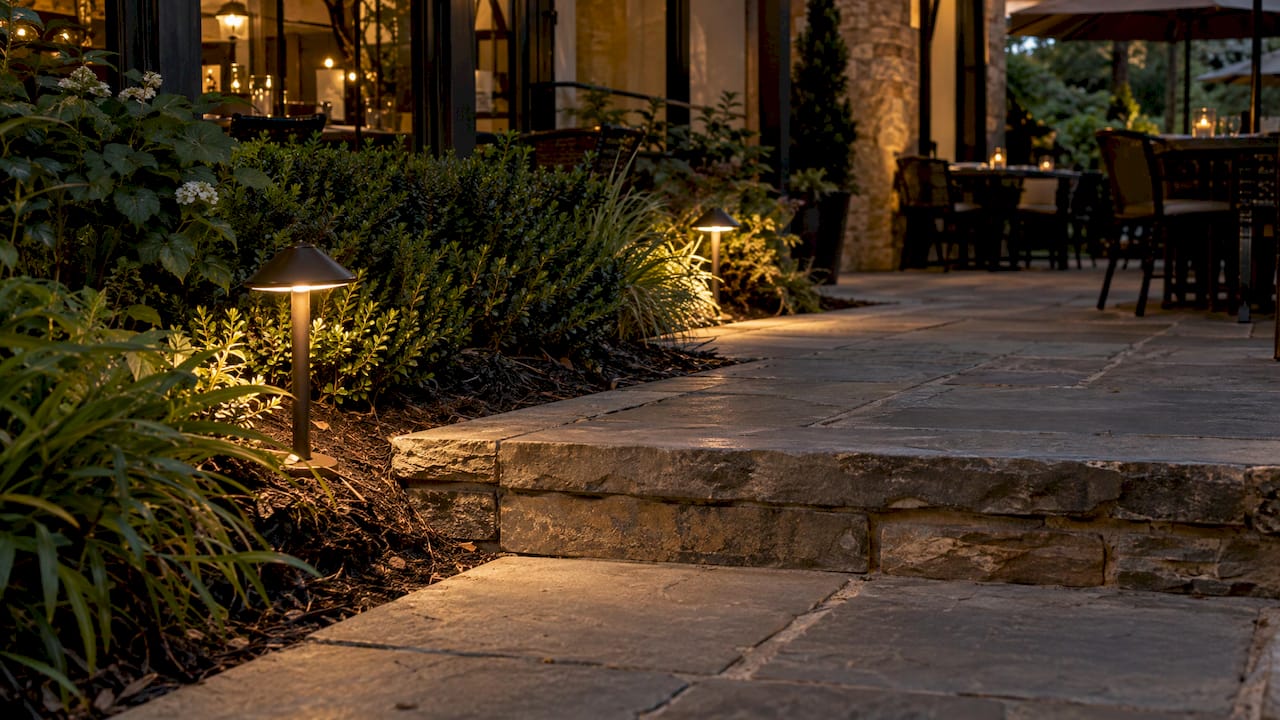
Landscape and path lights
Low fixtures mark paths, steps and planting beds, and help guests move safely without lighting up the whole space. Step and deck lights are especially useful where a patio has a change in level, and our deck and step lighting page shows the options.
Bar and outdoor kitchen areas
Bars and open kitchens are the brightest zones on a patio, since staff handle cash, glassware and food. Keep that light focused and shielded. We cover the specifics in outdoor kitchen and bar lighting.
Controlling glare
Glare is the fastest way to make a nice patio uncomfortable. It happens when a bright source sits in the line of sight, and string-light bulbs hung at eye level are the usual culprit. IES education material on outdoor lighting emphasizes that thoughtful exterior design and attention to glare and spectrum can give pedestrians a sense of reassurance with less light.
In practice:
- Use shielded or recessed fixtures where the source would otherwise be visible.
- Hang bare bulbs high, or choose lower-output bulbs where they hang near eye level.
- Aim accent light at surfaces rather than at seats.
- Use dimmers so the same fixture can run at low output after dark.
- Walk the patio at night from every seat, standing and sitting, before you sign off.
For a deeper look, read how outdoor lighting reduces glare without losing curb appeal.
Safety, code and permits
A restaurant patio is a commercial space with a public load, so electrical work is not a weekend project. This is a general orientation, and your electrician, the local inspector and your insurer have the final word.
Outdoor ratings and wiring
The National Electrical Code (NEC) is the baseline across most of the United States, and NFPA describes its 2026 handbook as a companion to the most widely adopted electrical code in the world. Two points from NFPA committee material matter for patios. In wet locations, 15- and 20-ampere receptacles need weatherproof enclosures, and the nonlocking types must be listed as weather-resistant. The same material describes Article 411 low-voltage lighting as systems operating at no more than 30 V AC or 60 V DC, with tighter limits of 15 V AC or 30 V DC where wet contact is likely.
So check that every fixture, cord, connector and receptacle is listed for the wet or damp location where it sits. Consumer-grade string lights bought for a backyard are not a safe default for a commercial patio.
Permits in Charlotte and Mecklenburg County
If your restaurant is in our area, Mecklenburg County Code Enforcement issues building, electrical, plumbing and mechanical permits, and its permitting page says permits are required for the installation, extension, alteration or general repair of electrical systems. Confirm with them, or with the city for your address, whether your patio lighting project needs a permit before work begins. Your installer should handle permits as part of the job, and you should ask who is doing it up front.
If you plan heaters or enclosures to extend patio season, the National Restaurant Association notes that climatized outdoor dining requires local permissions and permits, safe heater operation, ventilation for enclosed structures, and attention to maintenance, cleaning and insurance. Light the heated area as part of the same plan.
Open flame
Flameless candles and lanterns give the same warm point of light without the fire risk, and they are one less thing to check at closing time.
Controls, scenes and operating cost
Lighting that you cannot control turns into lighting that is left on. A good patio system gives you independent control of each layer, automatic daylight shutoff and a schedule.
California’s energy code offers a useful U.S. example, effective January 1, 2026: it requires nonresidential outdoor lighting to be independently controlled and automatically shut off in daylight, through a photocontrol, astronomical time switch or equivalent, and it sets scheduled reductions for some applications. That rule applies in California, not North Carolina, but the approach is a sound model for any patio. Your own local energy code is the one to check.
For a restaurant, the practical setup looks like this:
- Put ambient, task, accent and path lighting on separate zones.
- Set an astronomical schedule so lights come on at dusk and drop to a low setting after close.
- Save four scenes: lunch, dusk, dinner and late.
- Give the closing manager a single “close” button.
- Make sure someone has the control app or panel for each location, with access that can be revoked when staff change.
Commercial control specifications also stress that controls should be installed per the manufacturer’s instructions and environmental requirements, then tested and adjusted before commissioning. Ask any installer how they commission and test a system, and what you receive afterward.
Planning a permanent patio lighting system
Permanent lighting makes sense when the patio is a revenue space you will use for years. The fixtures are part of the building, the wiring is concealed, and nobody climbs a ladder to swap a strand at the start of every season.
The Association of Outdoor Lighting Professionals’ landscape guidelines say that before installing permanent lighting you should prepare a plan showing equipment quantities and locations, power sources, conduit and sleeve locations, structures and hardscape, focal points and the electrical load for each circuit and transformer, and check applicable codes and permits. Use that as your checklist:
- Walk the patio at dusk. Note where guests sit, where staff walk, where the dark spots are and what reflects.
- Mark the focal points. Trees, a mural, a fountain, the building face.
- Decide on zones. Dining, bar, entry, walkway, service.
- Map power. Where can circuits run, and is there spare capacity?
- Choose mounting. Roofline, pergola, posts, walls, ground.
- Pick the controls. Scenes, schedules, phone access and who administers them.
- Decide on permits and inspections. Who files, and when.
- Plan maintenance. Who inspects, cleans and replaces, and how often.
If your property also has a seasonal display, the same hardware can serve double duty. Our permanent lighting for holidays and events guide shows what that looks like beyond December.
Our perspective
We install permanent lighting across Charlotte, and the restaurant patios we see most often have the same problem: the lighting was added in pieces. A set of string lights in spring, a floodlight after a complaint, a few lanterns for the holidays. Each piece works alone, and together they fight.
Our approach is to treat the patio as one lighting system. We start with the roofline and the zones, because a track system that blends into the building gives you a clean ambient layer with no visible hardware. Then we add the task and accent layers, tie everything to one smart controller, and set scenes that your staff can run from a phone or panel.
For restaurants, we believe the real advantage is consistency. Commercial-grade, weather-resistant hardware that is color-matched to your building looks the same every night, handles Carolina heat, humidity and storms, and does not need hanging, taking down and replacing. Add multi-color capability and the same installation can carry your seasonal look, which is why our commercial and holiday work often overlaps.
We also design with compliance in mind, including HOA and municipal requirements, and our GlowCare maintenance subscription exists so that the system stays as good as the day it was installed.
Dave
Light your patio with Forever Glow
Forever Glow Lighting designs and installs permanent outdoor lighting for Charlotte properties, from smart LED roofline tracks to bistro and string lighting, landscape illumination, deck and step lighting and commercial exterior lighting, all controlled from your smartphone. We build around your building, your zones and your hours of service.
See our patio lighting installation services, or ask about GlowCare maintenance and permanent lighting for ongoing care. For a free estimate, contact us through Forever Glow Lighting.
FAQ
What color light is best for a restaurant patio?
Warm white, generally in the 2700K to 3000K range, suits dining best because it flatters skin and food and feels relaxed. IES also advises that outdoor light be warmer where possible. Put it on a dimmer so you can lower it as the evening goes on.
How bright should patio tables be?
IES recommends 3 to 6 footcandles at dining tables, with the higher end for older guests. Anything below 0.4 footcandles is too dark to see food clearly. A light meter or a lighting designer’s site visit takes the guesswork out.
Do I need a permit to add patio lighting?
Often yes. In Mecklenburg County, electrical installation and alteration work needs a permit, and commercial work is treated more strictly than home projects. Ask your installer to confirm requirements for your address and to handle the filing.
Are string lights enough for a restaurant patio?
They can provide the ambient layer, but they rarely light tables or walkways on their own. Pair them with table-level light, shielded accents and a path layer, and hang the lowest bulbs high enough to stay out of the guest’s sightline. Our patio string light layout guide covers heights and spacing.
Can permanent lighting handle holiday and event looks too?
Yes. Smart multi-color track systems can run a warm white dinner scene most nights and switch to seasonal or event colors from a phone. Our page on commercial and municipal holiday displays describes how we approach that.
Sources
- The Secret Recipe for Restaurant Lighting, IES
- Resource Library, National Restaurant Association
- Embracing the Great Outdoors, Restaurant Design + Development
- IES Position on Legislation and Ordinances for Outdoor Light at Night
- IES Learning: RP-43, Lighting for People in Outdoor Environments
- NFPA 70, National Electrical Code Handbook (2026)
- NFPA 70 Report on Proposals, 2022 NEC
- Mecklenburg County Code Enforcement: Permitting
- Winter woes: What’s the plan when it’s too cold to dine outdoors, National Restaurant Association
- California Energy Code 130.2, Outdoor Lighting Controls and Equipment
- Commercial controls system specification, 2024
- AOLP Landscape Lighting Guidelines
- 3er-Set LED-Kerzen Outdoor