
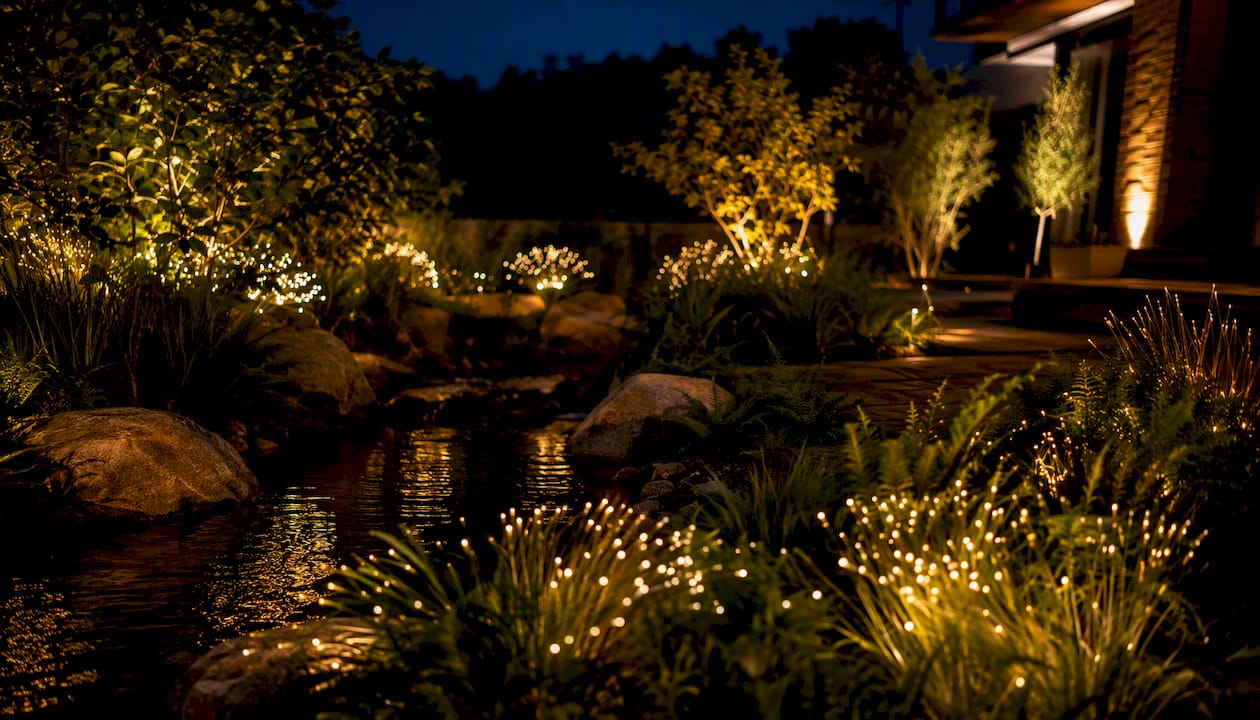
Fiber-optic lighting delivers cold, nonconductive light from a remote illuminator through thin cables, creating accents that are safe near water and gentle on plants. The technique, formally known as Plastic Optical Fiber (POF) lighting, moves the electrical source away from the point of illumination entirely. That single design choice is why Forever Glow Lighting and other professional installers reach for fiber optics when a project calls for something delicate, invisible by day, or submerged.
Three qualities decide whether fiber optics fits your landscape:
- Wet-area safety — no electrical current reaches the illuminated point
- Zero-heat output — fibers can sit inches from foliage without scorching it
- Minimalist integration — cables disappear into stone, concrete, or paving until dusk
Key Takeaways
Fiber-optic landscape lighting works because it separates electricity and heat from the point of illumination, making it the safer, more minimal choice for water features, plant beds, and embedded hardscape accents.
| Point | Details |
|---|---|
| Safety near water | The remote illuminator keeps electrical current away from the illuminated point, cutting waterproofing complexity. |
| Zero heat at terminations | Fiber can sit directly against foliage without scorching it, unlike hot fixtures placed at close range. |
| Plan run lengths carefully | Keep runs roughly 15 to 40 feet for even brightness, or upsize fiber and add illuminators for longer distances. |
| Fiber vs. LED tradeoffs | Choose fiber for invisibility and water safety, LED for raw brightness and lower upfront cost. |
| Hire for proven experience | Forever Glow Lighting designs illuminator placement, fiber routing, and GlowCare maintenance plans for lasting results. |
Table of Contents
- The Role of Fiber Optics in Landscapes: How the System Works
- Primary Benefits of Fiber Optics in Landscape Lighting
- Where Fiber Optics Shows Up in Real Landscapes
- Planning an Installation: Checklist, Timeline, and Cost Factors
- Fiber Optics vs. LED and Halogen: Which One Fits Your Project?
- How to Hire a Pro for Fiber-Optic Landscape Lighting
- Impact of Fiber Optic Lighting on Local Wildlife and Plants
- Get a Professional Fiber-Optic Design From Forever Glow Lighting
- Frequently Asked Questions
- Sources
The Role of Fiber Optics in Landscapes: How the System Works
A central illuminator, sometimes called a light engine, generates light and feeds it into bundles of optical fiber. The fiber carries that light to its termination point without carrying electricity or heat along with it. That separation is the whole reason fiber earns a place in landscape design work.
Three components define most systems:
- Illuminator: an LED or metal halide lamp housed in a dry, accessible enclosure
- Fiber type: Poly-Optical Fiber (POF) dominates outdoor work over glass fiber because it bends without cracking and shrugs off impact
- Termination style: end-glow fiber produces pinpoint “star” effects, while side-glow fiber emits light along its length like a thin neon tube
Both termination styles typically run off the same illuminator, which keeps hardware simple. The tradeoff is distance. Light dims as it travels through fiber, so run length and fiber diameter both need planning before installation, not after. Color comes from a filter wheel or an RGB LED illuminator, which is also how a system shifts from warm white pathway lighting to a saturated color scheme for an event. A labeled diagram showing illuminator, fiber bundle, and terminations helps most homeowners grasp the layout faster than any paragraph can.
Primary Benefits of Fiber Optics in Landscape Lighting
Homeowners and property managers usually land on fiber optics for one of three reasons: water safety, plant protection, or a look that vanishes in daylight. Each reason has a mechanical explanation behind it, not just a marketing claim.
Safety near water is the clearest case. Because the illuminator sits away from the water feature, the point where light actually appears carries no electrical current, removing the need for the complex waterproofing traditional underwater fixtures require. For pools, spas, and fountains, that changes the entire risk profile of the installation.
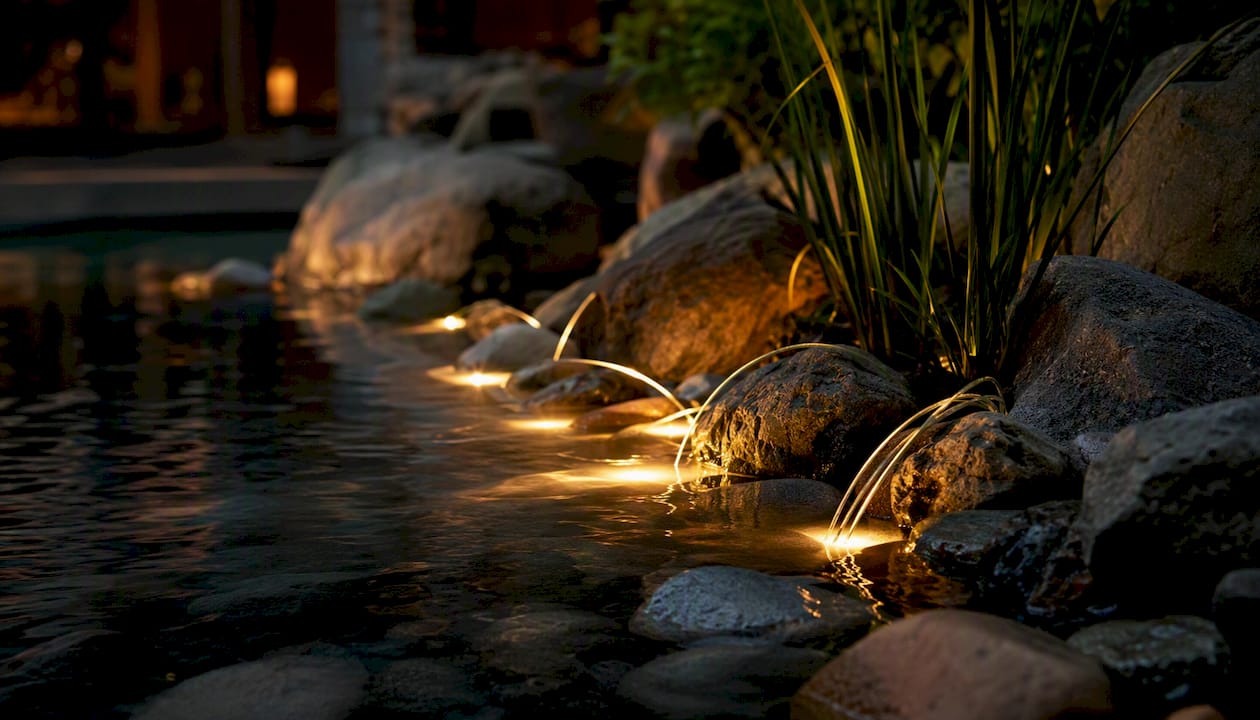
Thermal safety matters just as much for planting beds. Fiber delivers light without heat at the termination, which means designers can tuck a fiber point directly against delicate foliage without scorching it, something a high-wattage fixture can’t do at close range.
Aesthetic control is where fiber optics earns its reputation among landscape architects. Cables embed into paving, stone, and concrete for a profile that’s nearly invisible during the day, and color-changing illuminators let a single system shift from a quiet warm-white pathway to a full-color event scene.
Maintenance benefits follow naturally from the same design. Because the illuminator sits in a dry, serviceable location, swapping a lamp or LED module doesn’t require draining a pool or digging up a bed.
- No live current at the illuminated point
- No heat transfer to nearby plants
- Nearly invisible hardware by daylight
- Centralized maintenance access
Pro Tip: Don’t think of fiber optics as a one-to-one fixture swap. The strongest designs use it to sculpt light across a space, grazing a stone wall, tracing steps, or scattering a starfield, rather than replacing a single floodlight with a single fiber point.
Where Fiber Optics Shows Up in Real Landscapes
Fiber optics performs best in spots where traditional wiring is awkward, risky, or visually clunky. Pathways lit with end-glow fiber embedded in stone create a scattered starlight effect underfoot. Pool perimeters use side-glow fiber run along the waterline for a continuous glow without a single powered fixture near the water.
A few applications come up again and again in professional installs:
- Pergola weaves, where fiber threads through the structure for backlit vines
- Embedded starfields set into poured concrete patios or driveways
- Step and deck outlines, often using rigid acrylic light sticks for a clean edge
- Grazing accents across textured stone walls, which reveal depth once light hits the surface
Color choice matters more than most homeowners expect, especially if you want a distinctive Coastal look for your shore house. Warm white suits a year-round residential scene, while synchronized color palettes work well for event lighting or seasonal themes. Saturated color near dense planting beds can look artificial fast, so most designers reserve it for hardscape and water features. Fiber optics also pairs well with LED area lighting in hybrid designs, where fiber handles fine detail and LEDs cover broader floodlighting needs, an approach we cover in more depth in our landscape lighting layering guide.
Planning an Installation: Checklist, Timeline, and Cost Factors
Good fiber-optic design starts with illuminator placement, not fixture selection. Everything else, run lengths, routing, and access, gets planned around where that light engine sits.
A contractor should walk through these steps during a site visit:
- Survey the site and confirm desired effects (starfield, pathway, water feature accent)
- Determine run lengths, keeping most runs between roughly 15 and 40 feet for even output
- Choose end-glow or side-glow fiber based on the effect
- Match fiber diameter and illuminator capacity to the number of fiber runs needed
- Plan routing and protection through hardscape, soil, or structural elements
Timelines and costs shift based on a handful of variables:
- Number of illuminators required for the property’s layout
- Run length and fiber diameter, since longer runs may need upsized fiber or a second illuminator
- Embedded work, such as cutting concrete or stone for terminations, which adds labor time
- Control complexity, including DMX or Bluetooth systems for color synchronization
Centralizing the illuminator and planning conduit runs early keeps costs down; multiple illuminators, long unplanned runs, and embedded concrete work push them up. On the maintenance side, expect the illuminator’s lamp or LED module to need periodic replacement, while the fiber itself, being impact-resistant POF, holds up well over the long term with minimal attention.
Before signing off on any project, ask for a written plan showing illuminator location, fiber runs and terminations, a basic bill of materials, and a clear maintenance access point.
Fiber Optics vs. LED and Halogen: Which One Fits Your Project?
Choose fiber optics when water safety, zero-heat placement near plants, invisible daytime hardware, or fine embedded detail matter most. Choose LED or halogen fixtures when raw brightness, fixture flexibility, or lower upfront cost is the priority, since our guide to LED’s role in landscape lighting covers that territory well.
- Safety near water: fiber optics wins outright, no current at the light point
- Heat near plants: fiber optics produces none; LEDs and halogen generate some
- Brightness per dollar: LED and halogen generally deliver more raw lumens for less money
- Color control: both can sync colors, but fiber’s centralized illuminator simplifies coordination
- Visible hardware: fiber nearly disappears by day; LED fixtures remain visible
Most well-designed properties use both. Fiber optics handles perimeter accents and embedded starfields, while LEDs uplight trees and flood larger areas. Ask yourself three questions before deciding: Do you need underwater or embedded, invisible light? Do you need strong foot-candles directly on plants? Is heat near foliage or structures a real concern? Your answers point you toward the right technology fast.
How to Hire a Pro for Fiber-Optic Landscape Lighting
Hire an installer who can show real experience with centralized illuminators, correct fiber sizing, and embedded terminations, ideally with portfolio photos of past starfields or water feature work. Anyone can talk about fiber optics; fewer contractors have actually run the numbers on illuminator capacity and fiber diameter for a real property.
Before signing a contract, run through this checklist:
- Ask for a portfolio of completed fiber-optic projects and references
- Request a clear bill of materials
- Confirm warranty terms for both the illuminator and the fiber
- Get a written maintenance plan, something comparable to our own GlowCare service
During the interview, ask directly:
- Which illuminator model and lamp or LED type do you use?
- How many fibers can that illuminator drive at once?
- What’s your maximum recommended run length before you’d add a booster or second illuminator?
- How do you protect fiber runs through hardscape cuts, and where’s the maintenance access panel?
Watch for red flags: no fiber-optic portfolio, vague answers about run-length limits, a recommendation to use powered underwater fixtures instead of fiber near water, or no written maintenance plan at all.
Pro Tip: If color synchronization or smart scene control matters to you, ask for a written integration plan before installation starts. A verbal promise about “smart color control” means nothing once the illuminator is already in the ground.
Impact of Fiber Optic Lighting on Local Wildlife and Plants
Fiber optics tends to be gentler on the surrounding ecosystem than most alternatives, largely because of what it doesn’t do. There’s no heat at the point of illumination, so plant tissue near a fiber termination doesn’t dry out or scorch the way it might under a hot halogen fixture pressed close to foliage.
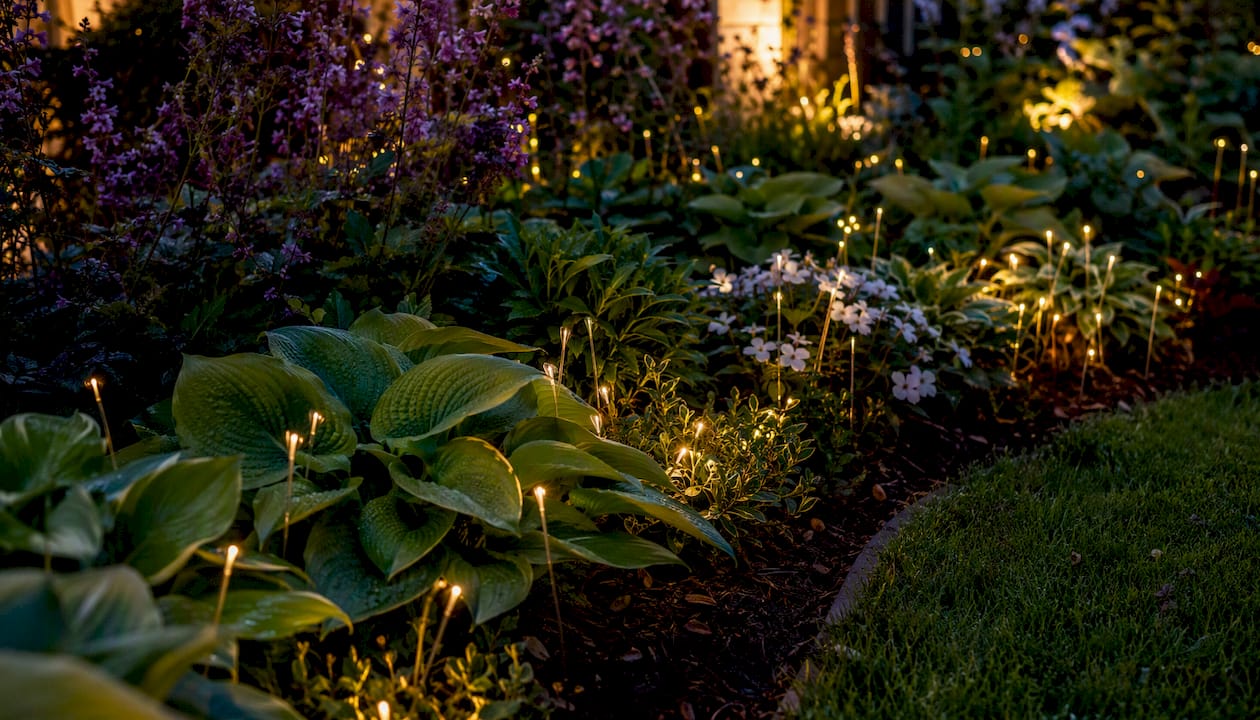
Light pollution is a separate concern, and it applies to fiber just as it does to any other lighting choice. Nocturnal insects, birds, and small mammals respond to brightness and color temperature, not to the delivery mechanism behind the light. Warm white output and lower intensity settings tend to disturb nighttime wildlife less than bright white or heavily saturated color schemes left running all night. Because a single illuminator can dim or shift color across an entire fiber network at once, property owners have an easier time scaling back brightness during peak wildlife activity hours than they would with dozens of individually wired fixtures.
Water features deserve a specific note. Traditional underwater lighting introduces both heat and, in poorly sealed installations, electrical risk into aquatic habitats. Fiber’s remote illuminator sidesteps both issues, which makes it a reasonable choice for koi ponds or garden water features where fish and aquatic plants are part of the design. For broader guidance on choosing brightness and color that respects nocturnal wildlife, our night sky friendly lighting guide walks through the specifics.
A practical take from Forever Glow Lighting
Fiber optics earns its premium price in specific situations: wet areas, embedded starfields, and minimalist architectural accents where visible hardware would ruin the effect. Outside those cases, LED often does the job for less. Our installers have seen how much a professionally sized illuminator and correctly placed terminations change the final result, which is exactly why design expertise matters more here than with a simple fixture swap.
Get a Professional Fiber-Optic Design From Forever Glow Lighting
Forever Glow Lighting designs and installs permanent fiber-optic and LED landscape systems throughout the Charlotte area, handling illuminator selection, fiber routing, and long-term maintenance so you don’t have to guess at sizing or run lengths yourself.
Our process starts with an on-site assessment where we map out illuminator placement, walk through effect options like embedded starfields or waterline accents, and put together a bill of materials specific to your property. From there, you’ll get a clear installation timeline before any work begins, along with maintenance options through our GlowCare program for ongoing lamp and fiber upkeep. If you manage a commercial property, our commercial lighting guide covers venue-specific considerations like phased installs and access planning.
Ready to see what fiber optics could do for your property? Request a free design consult and we’ll walk your site with you, in person, before you commit to anything.
Frequently Asked Questions
Is fiber-optic landscape lighting safe near swimming pools?
Yes. The illuminator that generates the light sits away from the water, so the illuminated point itself carries no electrical current, which is why it’s a common choice for pool and water feature accents.
Does fiber-optic lighting damage nearby plants?
No. Because fiber delivers light without heat at the termination, it can sit close to foliage without the scorching risk that comes with high-wattage fixtures.
How long do fiber-optic landscape lighting systems last?
Properly specified systems in demanding outdoor conditions can last 10 to 15 years, with the illuminator’s lamp or LED module typically needing replacement well before the fiber itself.
Is fiber optics more expensive than LED landscape lighting?
Generally, yes, on a per-fixture basis, mainly due to the illuminator and embedded installation work. LEDs usually deliver more brightness per dollar, while fiber earns its cost in safety and invisible integration.
Can fiber-optic lighting change colors?
Yes. Most systems use a color wheel or RGB LED illuminator to shift the entire fiber network’s color from a single point, which is useful for seasonal themes or event lighting.
Sources
- Fiber Optic Lighting Dries Out | EC&M
- Fiber‑Optic landscape lighting | Landscape Architect
- Illuminating Outdoor Spaces: How POF Lighting Revolutionizes Landscape and Garden Design – Daishing POF
- Garden and Landscape Fibre Optics in Jeddah: The 2026 Professional Guide – Fibrepros