
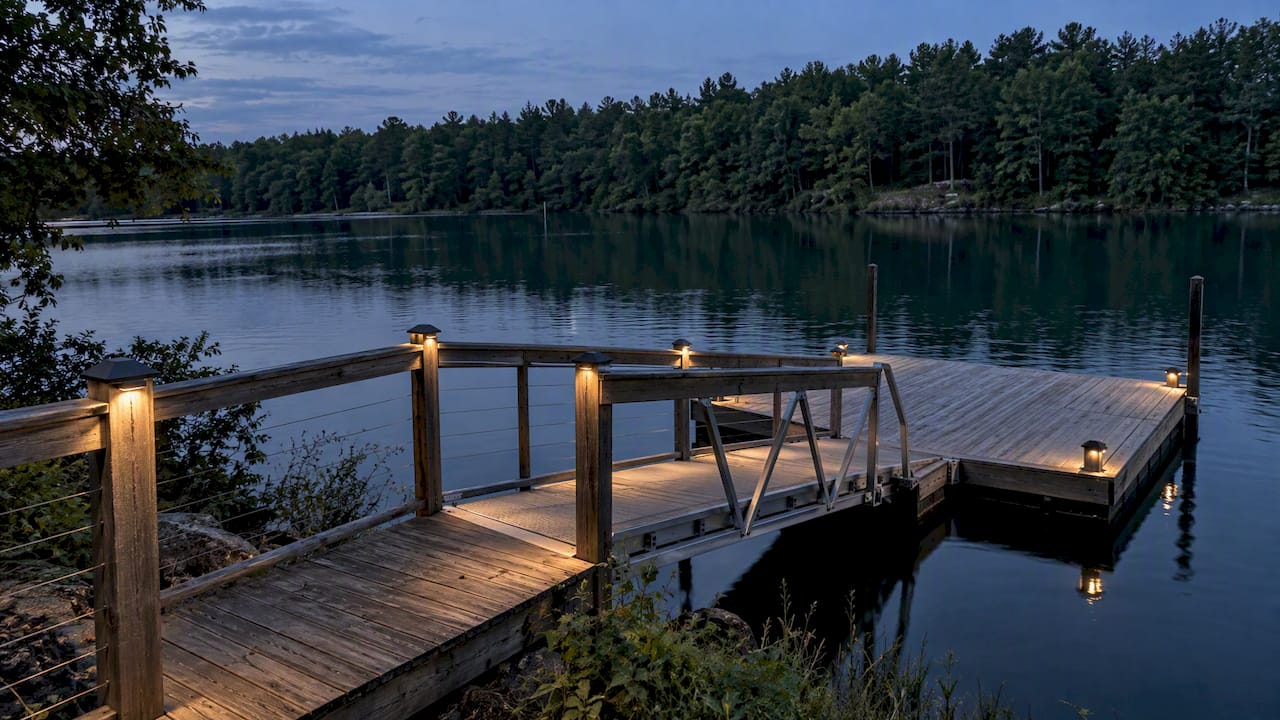
Safe dock lighting does three things: it shows people where the edge, steps and tie-offs are, it gives boat operators a clear reference point on approach, and it keeps glare and electrical risk low. The rest is detail. Where fixtures go, how bright they are, how they are wired and how they are protected from water decide whether a dock is safer after dark or only brighter.
This guide covers each of those decisions for private residential docks and lake or waterfront properties, with the electrical rules that matter and the mistakes we see most often.
TL;DR
- Light the walking path, the edges, steps, cleats and the boat-side approach. Aim for even, low-glare coverage with no dark patches.
- Use marine-grade, wet-location fixtures with shielding and warm color temperatures so light does not blind boaters or spill onto neighbors.
- Dock electrical work is its own category. Ground-fault protection, bonding and fixture height above the water are safety items, and a licensed electrician should handle them.
- Do not let shore lighting mask navigation aids or imitate required boat lights.
- Smart controls and a maintenance plan keep lights working, which is what actually protects people.
Table of Contents
- Why dock lighting is a safety issue, not a styling choice
- What to light on a residential dock
- Control glare so lighting helps rather than blinds
- Keep shore lighting from interfering with navigation
- Are dock lights required, and what rules apply?
- Electrical safety: where dock lighting goes wrong
- A practical dock lighting safety checklist
- Our perspective: reliability is the safety feature
- Professional dock lighting from Forever Glow
- Common dock lighting mistakes
- FAQ
Why dock lighting is a safety issue, not a styling choice
A dock combines wet surfaces, changes in height, ropes, cleats and open water. Take away daylight and each of those becomes harder to judge. Darkness reduces depth perception, peripheral awareness and color recognition, so misjudged edges and tripped-over lines become more likely, as Maricorp’s nighttime dock safety overview explains.
The typical night-time incidents on a private dock are ordinary ones:
- A guest steps off the edge or misses the last step.
- Someone trips on a dock line or cleat while carrying a cooler.
- A boater misjudges distance and alignment on approach and hits a piling.
- Nobody notices a person on the dock because the area is dark.
Good lighting addresses all four. It also helps with security: a lit dock is easier to watch, and cameras record more usable footage when there is something to record by.
What to light on a residential dock
Start with the route a person walks, then add the boat. A simple way to plan is to walk the dock at dusk with a flashlight and note every spot where your foot placement depends on guessing.
The walkway and its edges
The path from shore to the end of the dock is the first priority. Aim for uniform, low-glare light that eliminates dark patches, and highlight edges, steps and drop-offs, which is the approach Maricorp recommends. Evenly spaced fixtures work better than a few bright ones, because bright spots next to dark spots make your eyes adjust badly and hide hazards in the shadows.
Steps, ramps and transitions
Every change in height needs its own light. Low-level step and riser lighting shows the edge of each tread without shining up into a person’s eyes. Where a gangway meets a floating section, the transition point should be the best-lit spot on the dock. Our deck and step lighting approach uses the same principle on land: light the surface where the foot lands, not the viewer’s face.
Cleats, lines and gear storage
Regular fixture spacing keeps shadows from hiding rope coils and gear. Mark cleats and box corners with a light source close enough that a person sees them before stepping.
The boat slip and approach
Well-lit docks give boaters visual reference points, which helps them judge distance and alignment as they come in. Light the end of the dock and the pilings or posts that define the slip. Pilings with cap lights are a common answer, because they mark the corners without throwing light across the water.
The water beside the dock
If you entertain on the dock, some owners add underwater lights to make the water visible. Treat these with care. Underwater fixtures are the highest-risk electrical item on a dock, and they should be listed for the use and installed by a licensed electrician. More on that below.
Control glare so lighting helps rather than blinds
More light is not safer light. Glare from badly aimed fixtures makes it harder to see the dock, the water and other boats. On a lake, your neighbors are also looking at your dock from the water and from their own yards.
Three practical rules:
- Shield and aim down. Upland fixtures, which sit at higher elevations, should be marine-grade and include cutoffs so light does not interfere with navigation or reach neighboring properties, according to the Alaska Department of Transportation’s design guidance for ports.
- Choose warm color temperatures. Maricorp reports the International Dark-Sky Association recommends 2700 K or lower to improve night vision and reduce glare. Cool blue-white light scatters more over water.
- Use many modest sources, not a few floodlights. Low, shielded fixtures at walking height keep the light on the surface you need to see.
If you boat at night, glare control also affects your eyes. A dock that is too bright makes the water around it look black, and your eyes need time to recover once you leave the lit area. We cover this in more detail in our guide for boat owners on low-glare dock lighting, and our outdoor lighting glare guide explains how the same fixtures can look good and stay comfortable.
Wildlife and neighbors
Lake and coastal shorelines are habitat. Shielded, warm, low-output lighting is better for animals and for neighbors. If wildlife is a concern on your water, see our piece on wildlife-friendly dock lighting.
Keep shore lighting from interfering with navigation
Boaters rely on required lights and official markers to read the water at night. The U.S. Coast Guard’s aids-to-navigation training material stresses clear separation between shore-based light sources and official navigational aids, and warns against lighting that could distract operators or mask buoys and markers (Coast Guard Auxiliary study guide).
For a homeowner, that means:
- Do not aim bright fixtures out across open water or toward a channel.
- Avoid red, green and flashing patterns that could be mistaken for navigation lights.
- Keep fixtures shielded so the lit area stops at the dock.
Boat lighting rules are set state by state. Pennsylvania, for example, prohibits docking lights underway except while docking at slow, no-wake speed within 100 feet of a dock, mooring buoy or shoreline, and says other lights may not be mistaken for required lights or impair their visibility. That is one state’s rule, not a national one. Check with your state’s boating agency and, on a managed lake, your utility or lake authority.
Are dock lights required, and what rules apply?
People ask whether dock lights are required by OSHA. The answer depends on the kind of dock.
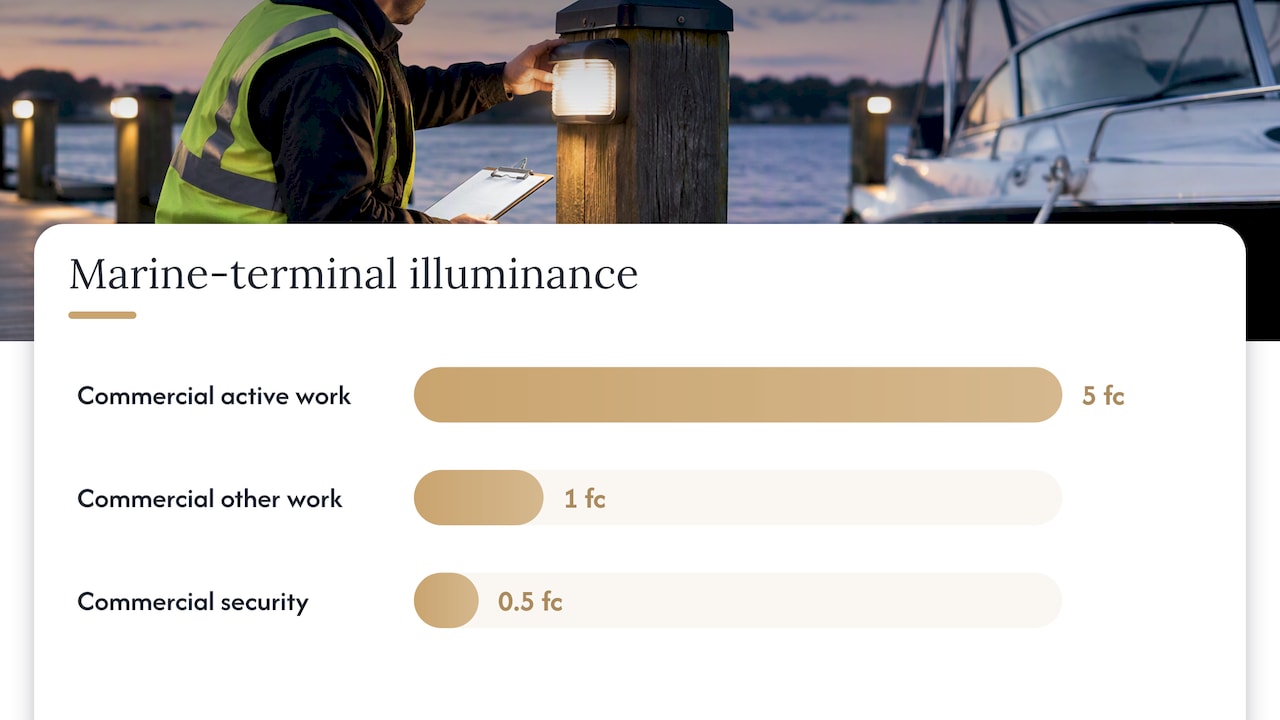
Commercial marine terminals. OSHA’s 29 CFR 1917.123 requires working and walking areas to be illuminated. It sets average minimums of 5 foot-candles for active work areas, 1 foot-candle for other work areas and 1/2 foot-candle for security areas, and says lights should, so far as possible, not shine in employees’ eyes. That is a workplace rule for marine terminals. It is not a rule for your private lakefront dock, though it gives a sense of what “enough light to see hazards” looks like at the working end of the scale.
Private residential docks. There is no single national lighting requirement for a private dock. What does apply is local: your utility, lake or shoreline authority, HOA, county permits and the electrical code. We keep a separate page on dock lighting regulations for property owners for the details.
The electrical code. NFPA 70, the National Electrical Code, has a dedicated article for marinas and docks. A revision proposal for the 2020 edition describes Article 555 as covering wiring and equipment at marinas, boatyards and docking facilities, including those associated with residential dwellings and condominiums. Your local jurisdiction decides which edition it enforces, so ask your electrical inspector.
Electrical safety: where dock lighting goes wrong
The most serious dock lighting risk is not tripping. It is electricity near water. This is the part you should not treat as a weekend project.
Wet-location fixtures and weatherproof connections
Utility dock requirements give a feel for the standard. Ameren’s dock electrical installation requirements for Lake of the Ozarks call for wet-location equipment within eight feet of the dock surface or exposed to weather, and damp-location equipment only in specified roofed areas. They also call for GFCI protection on receptacles (with a stated exception), bonding of non-current-carrying metal parts, and receptacles and switches at least 36 inches above the finished dock surface unless the authority having jurisdiction approves otherwise. Those are one utility’s rules for one lake, so use them as an example of what to expect, and confirm the rules for your own water.
If you are unsure what separates wet from damp, our explainer on wet versus damp locations under the NEC walks through it in plain terms.
Height above the water and clearance
The NEC revision proposal cited above sets the electrical datum plane 2 feet (606 mm) above the highest tide or highest water level, and places service equipment adjacent to the structure, not on or in it. Everything electrical should sit above that plane unless it is listed for submersion. Overhead conductors also matter: Alaska’s guidelines call for vessels to be moored away from contact with overhead lighting conductors and at least 10 feet of clearance to the float at extreme high tide. Those figures come from a port design standard, but the point carries over to a residential dock with a boat lift or a tall sailboat mast.
Underwater lights
Poor insulation in underwater dock lights can expose swimmers to electric shock, and Apex Lighting’s fixture FAQ recommends professional installation by licensed, insured electricians working to electrical code. We agree. Do not allow swimming around a dock with underwater lights unless a licensed electrician has confirmed ground-fault protection and bonding and tested them.
Materials and corrosion
Metal housings that are not marine rated corrode quickly in lake and coastal conditions, and corrosion breaks seals. Choose marine-grade housings and stainless or otherwise corrosion-resistant hardware, and use sealed, watertight connections.
A practical dock lighting safety checklist
Use this before you hire anyone, and again when you review a proposal.
| Area | What to check |
|---|---|
| Walkway | Even light along the full length, no dark gaps between fixtures |
| Edges and steps | Each step and drop-off visible from the approach side |
| Cleats and lines | Light close enough to show them before a foot lands |
| Boat slip | End and pilings lit for approach judgment, no light aimed across the water |
| Glare | Fixtures shielded and aimed down, 2700 K or lower |
| Electrical | Wet-location rated, GFCI protection, bonded metal parts, licensed electrician |
| Navigation | No red, green or flashing lights visible from the water |
| Controls | Timer or smart schedule so the lights are on when you need them |
| Maintenance | Seals, connections and fixtures inspected at least once a year |
If you want more planning prompts, our guide to dock lighting ideas for homeowners covers the DIY versus professional decision and the mistakes that cost the most to fix.
Our perspective: reliability is the safety feature
Most dock lighting problems we are asked to fix are not design problems. They are reliability problems. A fixture fails, a connection corrodes, a timer is unplugged after a storm, and the dock is dark on the one night a guest walks out.
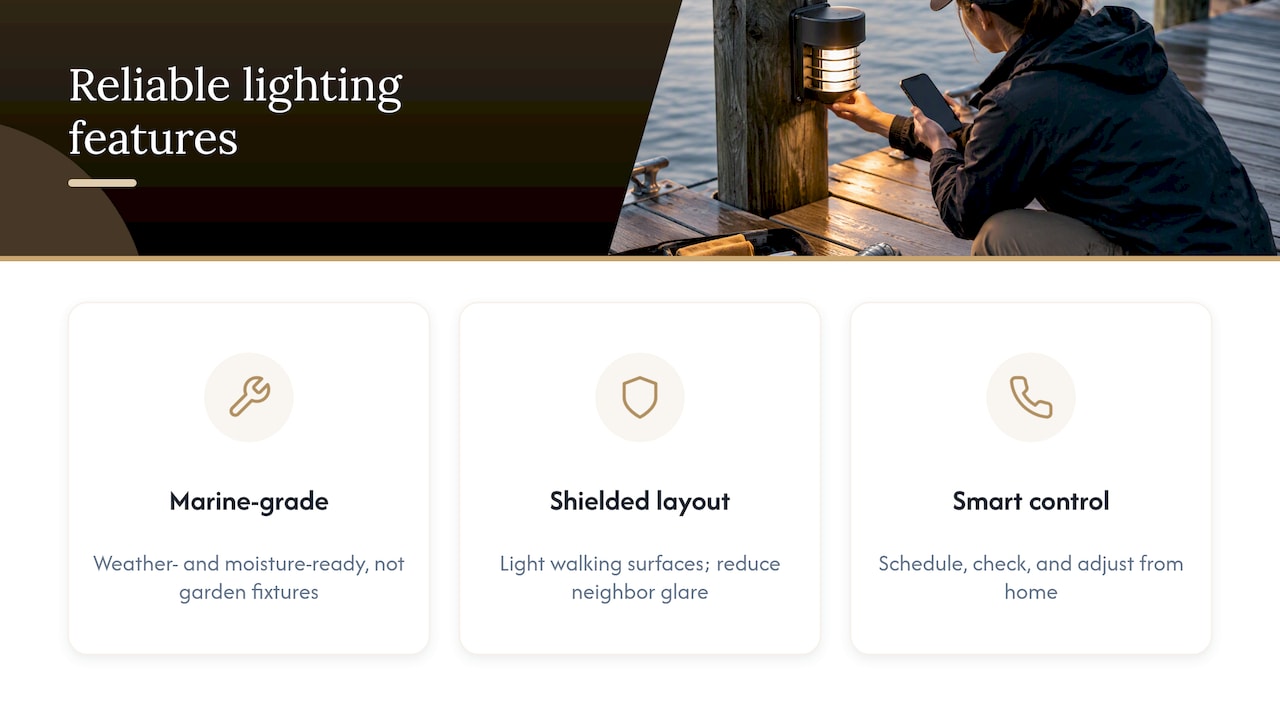
That is why we build dock and waterfront systems around three ideas. First, marine-grade hardware chosen for weather and moisture, not repurposed garden fixtures. Second, shielded, low-glare layouts that light the surface where people walk and stop, so the dock is easy to read and neighbors are not bothered. Third, smartphone control, so lights follow a schedule and you can check and adjust them from the house, rather than relying on a switch at the end of a wet dock.
We also think the maintenance plan matters as much as the installation. Lights that are inspected on a schedule stay safe. Lights that are installed and forgotten do not. Our work on the Carolinas’ lakes and waterfront properties has to handle heat, humidity, storms and the regulations that come with each shoreline, and we plan for that up front.
For anything involving water contact or ground-fault protection, we bring in the licensed electrical work the job requires. We would rather tell you that plainly than let a dock be wired casually.
— Dave
Professional dock lighting from Forever Glow
If you want a dock that is safe to walk at night and quiet on the water, our dock and waterfront lighting service designs the layout, installs marine-grade fixtures and sets up smartphone control. The GlowCare maintenance subscription keeps the system inspected afterward. You can request a free estimate from our dock and waterfront page, and we will walk the dock with you before proposing anything.
Docks are often one part of a larger property plan. The same crew can handle landscape lighting along the path from the house to the water, so the route is lit from the back door to the end of the slip. Our guide on landscape lighting safety benefits explains how that layering works.
Common dock lighting mistakes
- Too bright, too cool. Floodlights and blue-white LEDs wash out night vision and annoy neighbors.
- Lights only at the shore end. The end of the dock, where people stand and boats arrive, is the most important area.
- Non-marine hardware. Metal fixtures and cheap seals fail early in moisture.
- Cords and plug-in extensions. Temporary power on a wet dock is a shock and trip risk.
- No plan for maintenance. Without checks, a dark section appears and no one notices until someone is hurt.
- Treating the electrical as DIY. Bonding, grounding and ground-fault protection are code items for a reason.
FAQ
Are dock lights required by OSHA?
OSHA’s marine terminal rule, 29 CFR 1917.123, requires illumination of working and walking areas at those commercial facilities. It does not set a lighting requirement for a private residential dock. Your local code, utility and lake authority govern a home dock.
Are dock lights illegal?
No, but some lighting is restricted. Lights that could be mistaken for required boat lights or navigation aids, or that impair a boater’s visibility, can be unlawful under state boating rules, as Pennsylvania’s code shows. Shielded, downward-aimed dock lighting is the safe approach. Check your state’s rules and any HOA or lake authority requirements.
What is the best type of lighting for a dock?
For most residential docks, low-level, shielded, marine-grade LED fixtures in a warm color temperature work best. They light the walkway, edges, steps and slip evenly without glare. Piling cap lights and step lights are common choices.
Can I install dock lights myself?
Simple low-voltage fixtures on land are within reach of some homeowners, but anything on or over the water raises ground-fault, bonding and clearance questions. A licensed electrician should handle the wiring, and underwater lights in particular should never be a DIY job.