
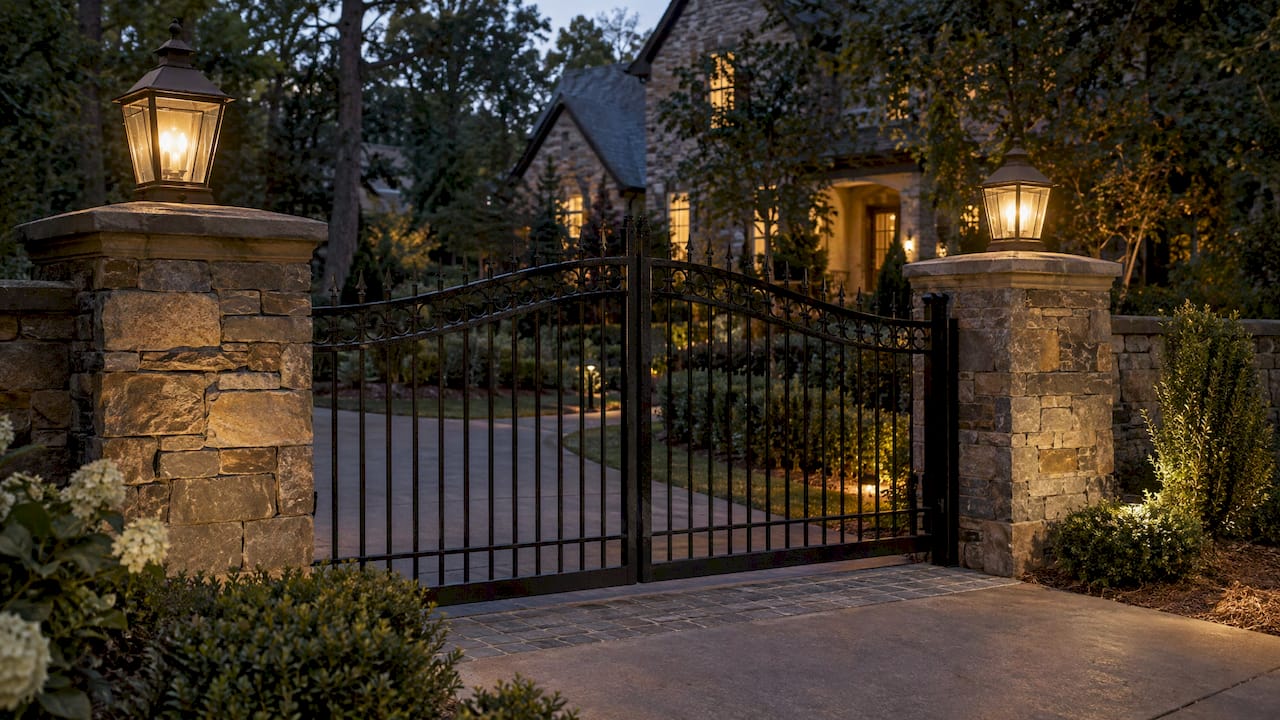
The best driveway pillar lighting is a wet-location-listed, hardwired fixture sized to the column and placed so it lights the drive without glare. Solar caps and boxed lanterns work for simple jobs. A professionally designed system gives you matched color, smart control and a warranty behind the wiring. Below we compare the real options, with prices, so you can match a fixture to your gate, your columns and the power you already have.
TL;DR
- Pick the power source first: hardwired fixtures give the most consistent output, while solar suits columns with no conduit and a sunny exposure.
- Size the fixture to the column. A common guide is a width of 25 to 33% of the column face and 400 to 800 lumens per fixture.
- In the U.S., choose a fixture marked for wet locations. An IP rating alone does not satisfy the electrical code.
- Retail fixtures in this comparison run from $119.99 to $399.00 each, before trenching and wiring.
- For matched columns, smart control and one warranty, we design and install the whole entrance for Charlotte homes.
Table of Contents
- Driveway pillar lighting options at a glance
- Fixture styles for different entrances
- Hardwired or solar: how they differ
- What to check before you buy
- Where to place lights on columns and gateposts
- Wiring, permits and safety
- Tying the entrance into the rest of the property
- Our perspective
- Professional installation for Charlotte entrances
- FAQ
- Sources
Driveway pillar lighting options at a glance
Prices below are as listed by each seller in the research for this article. They change often, so confirm on the product page before you order.
| Option | Power | Listed price | Best for |
|---|---|---|---|
| Gatestone Pillar Light | Solar, dusk-to-dawn sensor | $119.99 (was $149.95) | Columns with no wiring |
| Quankoach 11.8 in Column Light | Hardwired 85-240V | $129.90 | Flat-top masonry columns on a budget |
| Lighom Black Square Pier Mount | Hardwired 110-220V or solar | $195.95 | Modern square columns |
| Dazuma European Crown | Hardwired 110V | $279.99 | Traditional and estate entrances |
| Asbury 18 in Post Light | Hardwired | $399.00 | Taller lantern look |
| Forever Glow Lighting custom design | Professionally wired, smart control | Free estimate | Whole-entrance lighting that matches the house |
The fixture is only part of the cost. A retail light still needs power at the column, a wet-location listing you can verify, and someone to mount it level and seal it.
Fixture styles for different entrances
Style should follow the architecture of the entrance. One buying guide describes five common styles: pillar caps, lanterns, globes, wall-mounted pier lights and post-top lights. Here is how each tends to fit.
- Pillar caps: a clean, modern look that sits flush on a flat-topped column.
- Lanterns: the traditional choice for brick and stone entrances and estate homes.
- Globes: common on modern homes and commercial entrances.
- Wall-mounted pier lights: mounted on the face of a pier and aimed down at the drive.
- Post-top lights: for gates hung on separate timber or steel posts.
If you are searching for porch column lights or front porch column lighting, the same logic applies. A lantern or cap that matches the porch hardware usually reads best, and a wet-location rating matters as much on a porch column as on a gate pier.
A separate 2026 buying guide groups products by how they are powered: hardwired 120V pier lanterns, post-cap fixtures that retrofit existing columns, 12V low-voltage landscape column fixtures, solar column lamps, and smart Wi-Fi units with adjustable color temperature.
Traditional lanterns
The Dazuma crown model has an ornate top, clear glass panels and a black metal frame. Its die-cast aluminum body is rated IP65 and it takes a standard E27 bulb at 3000K warm white. It comes in small and large sizes, and sets of 2 to 10 for paired columns or longer estate walls. The Asbury hexagonal lantern is UL Wet Rated and takes three E12 candelabra bulbs of up to 60W each.
Modern square fixtures
The Lighom square pier mount uses a stainless-steel housing with a white diffuser and throws warm 3000K light. It can be wired for 110-220V or run on the included 5W solar panel. The Quankoach column light is a black die-cast aluminum and glass fixture that includes a dimmable 12W bulb with 3000K, 4000K and 6000K options. It is rated IP54, a lower rating than the IP65 on the other fixtures here, so check the listing against where the column sits.
The range is wide at the high end too. One 2026 roundup lists pier-mount lights from $99.99 to $759.99, with the hand-paddled glass model at the top.
Hardwired or solar: how they differ
This is the choice that shapes everything else, so settle it before you shop for looks.
Hardwired fixtures give the most consistent performance and support the full range of brightness levels. The same buying guide says trenching and electrical work typically add $200 to $600 per column when conduit is not already in place. If your columns were built with conduit, that cost drops away.
Solar avoids wiring. Modern units can hold 400 to 600 lumens for 6 to 8 hours after a full charging day, but the same guide notes panel output drops 20 to 40% in winter above 40 degrees latitude. The Gatestone model delivers up to 500 lumens, is rated IP65 and has a 3-step color temperature setting. Charlotte sits below that latitude, but a column shaded by trees or the house will still charge less.
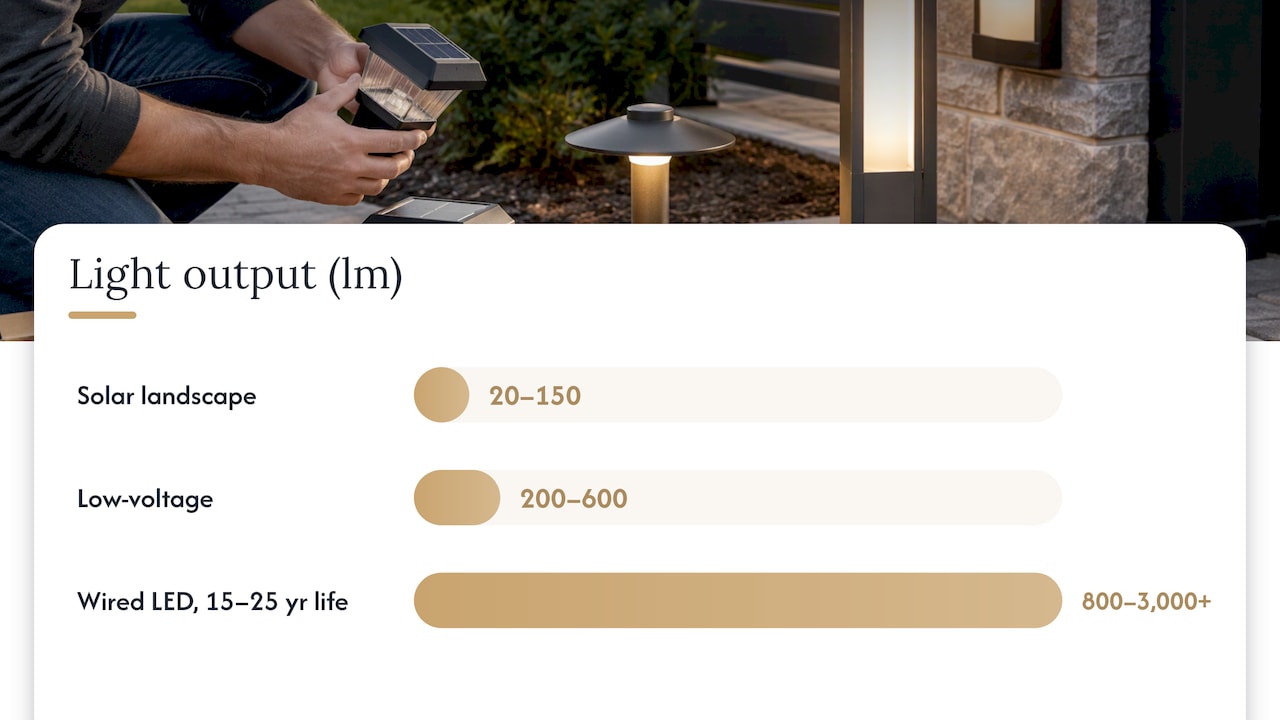
Output also differs by category. Another cost guide reports solar landscape lights typically produce 20 to 150 lumens per fixture against 200 to 600 for low-voltage equivalents. A wired permanent LED system is described in one comparison as running 800 to 3,000+ lumens with a 15 to 25 year lifespan, so the reach of the light and the lifespan both favor wiring on a main entrance.
For the whole-property view, see our guides to driveway lighting ideas and benefits and the best type of lighting for outdoor use.
What to check before you buy
Size against the column
A fixture that is too small gets lost in the design and may not give enough light, as one gate installer notes in driveway gate lighting tips. A simple starting point is a width of 25 to 33% of the column face. A sizing guide suggests:
| Pier size | Suggested fixture |
|---|---|
| 10-12 inch masonry | 8-10 inches square |
| 14-16 inch | 10-12 inches |
| 18-24 inch gate pier | 12-16 inches square, or a 16-20 inch tall lantern |
On wide masonry piers, height carries the scale more than footprint width. On wood posts, a cap on a 4×4 or 6×6 should match the post or overhang it slightly, because it also sheds water off the end grain.
Brightness and color
For a typical residential driveway, a guide recommends 400 to 800 lumens per fixture. Warm white around 3000K suits brick, stone and bronze finishes. A 3-way setting such as 3000K, 4000K and 6000K lets you adjust once the fixture is up.
Weather rating and listing
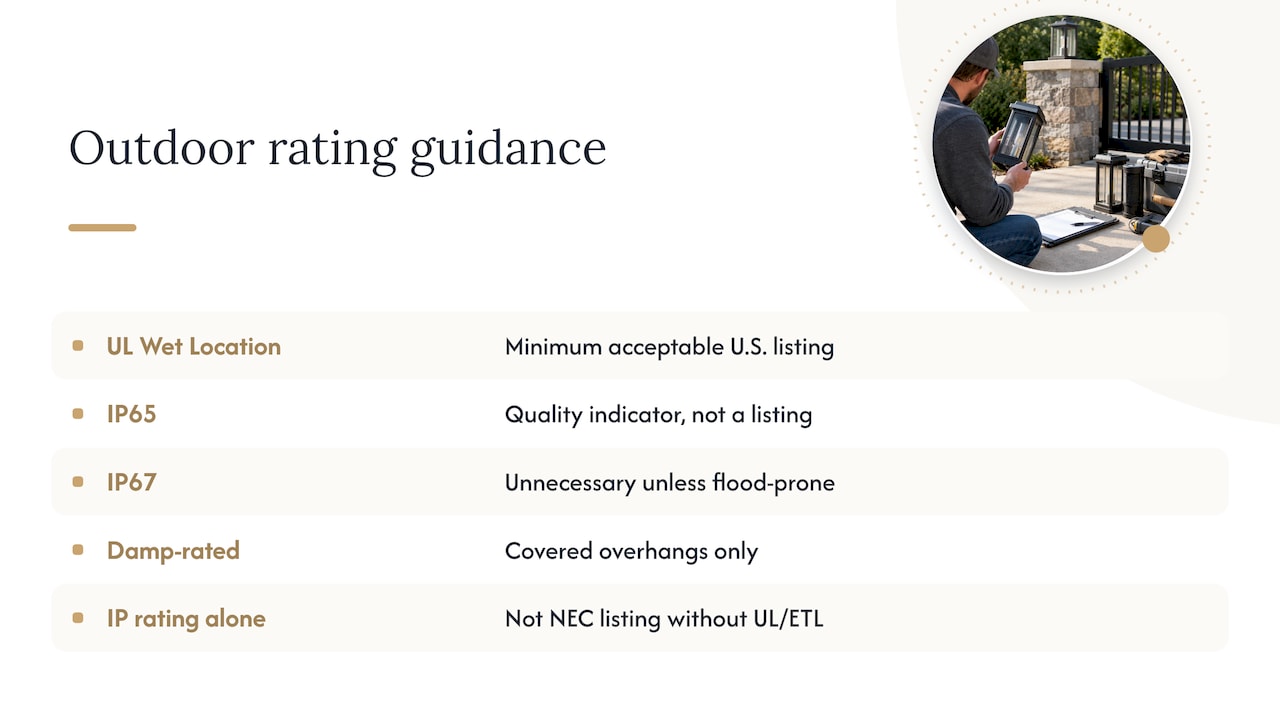
The same guide calls UL Wet Location the minimum acceptable U.S. listing for outdoor pillar lights, and treats IP65 as a quality indicator. It sees IP67 as unnecessary unless the fixture sits in a flood-prone spot. Damp-rated fixtures are suitable only under covered overhangs.
The code language backs this up. The National Electrical Code requires luminaires in wet locations to be marked Suitable for Wet Locations and installed so water cannot enter or collect in electrical parts. One code explainer adds that IP ratings from non-listing laboratories do not count as a listing under NEC 410.10(A), so an IP65 fixture without a UL or ETL mark does not meet it. When in doubt about the classification, a wet-location fixture removes the question.
We cover the classification in detail in our guide to wet versus damp locations. Near the coast or a lake, also read why IP ratings do not cover salt air. The buying guide recommends marine-grade aluminum or brass in salt-air environments.
Where to place lights on columns and gateposts
There are three common positions, as one gate company describes: on top of the post or pillar, hung on the front face of the pillar, and uplighting from ground level.
- Top-mounted gives a visible landmark at the entrance and a soft pool of light on the gate.
- Face-mounted aims light down at the drive and keeps the column top clean.
- Ground uplighting washes the column texture and works well on stone or brick.
For the run of the drive past the gate, the same source suggests spacing lights at least 10 feet apart to avoid a runway look. An installation guide recommends spacing post lights every 8 to 12 feet on alternating sides. Paired columns should carry matching fixtures at the same height so the entrance reads as symmetrical. For gate entrance lighting, keep light off the camera and keypad faces so you do not create glare there.
Wiring, permits and safety
Electrical work is where entrance lighting most often goes wrong, so plan it before you pick a fixture.
- Check for conduit. Many columns are built without it. Adding it later is what drives the $200 to $600 per column figure above.
- Call 811 before digging. An installation guide advises contacting the national dig-safe line at least three business days ahead and using GFCI protection on outdoor circuits.
- Confirm permits. One lighting contractor’s guide states that 120V line-voltage outdoor lighting requires a permit and that fixtures must be listed for their location. Your local building department sets the rules for your address.
- Use a licensed electrician or lighting installer for line-voltage connections, and hold the fixture’s listing paperwork.
On cost, wired systems are not cheap but they last. One 2026 analysis puts a 20-fixture hardwired landscape system at $4,500 to $9,500 upfront. For our own range of project types, see what outdoor lighting costs.
Tying the entrance into the rest of the property
A column light looks best when it belongs to the same plan as the house. One product description puts the idea well: the fixture shows as a solid metal silhouette by day and at night softly connects the column top with the space around it.
Practical ways to coordinate:
- Match color temperature across the gate, path and facade lights.
- Repeat the finish of the fixtures with house hardware, such as bronze or black.
- Add path lighting along the drive. See our guide to path lighting.
- Layer accent light on the entrance wall, as in our layering techniques and curb appeal ideas.
- If the drive ends at a patio or pergola, integrated LED lighting in bioclimatic aluminum pergolas can carry the same warm tone through to the back of the property.
Our perspective
Most entrance lighting problems we see in the Carolinas are not about the fixture. They are about the system around it: mismatched color temperatures, power added as an afterthought, and hardware that was not built for our humidity and storms.
That is why we design the entrance as part of the whole property. Our installations use commercial-grade, climate-optimized hardware with color-matched tracks and smart controls, designed for HOA and municipal compliance. You control color and brightness from your phone, so the gate lights can be warm white most nights and change for a holiday.
A well-lit entrance also supports the sense of safety homeowners want. Consistent visibility at the gate and drive helps suspicious activity get noticed and gives guests a clear, welcoming approach. Doing it once, correctly, with a maintenance plan behind it, is the reassurance we want every homeowner to have.
Dave
Professional installation for Charlotte entrances
If you want the columns, drive and house to work as one lighting plan, Forever Glow Lighting designs and installs custom landscape and architectural lighting for homeowners and property managers in the Charlotte area. Our systems are smart, energy-efficient and controlled from your smartphone, and our GlowCare maintenance subscription keeps them running.

Start with our landscape lighting design service or see how architectural lighting can frame a gate and facade. Then contact Forever Glow Lighting for a free estimate.
FAQ
How bright should a driveway pillar light be?
For a typical residential driveway, a buying guide suggests 400 to 800 lumens per fixture. Go toward the top of that range for long drives and dark, tree-covered entrances. A dimmable or multi-color-temperature fixture lets you fine-tune the result after installation.
Can I put lights on columns that have no wiring?
Yes. Solar fixtures need no conduit, though they depend on sun exposure. For consistent output, a hardwired or low-voltage system is the usual route, and adding conduit can cost $200 to $600 per column. A lighting professional can assess the columns and recommend the cleanest path for the power.
What rating should an outdoor pillar light have in the U.S.?
Look for a wet-location listing from a recognized testing lab, such as UL or ETL, on the fixture. The code requires luminaires in wet locations to be marked for wet locations. An IP65 rating is a useful quality sign but does not replace that listing.
Where should I mount the light on a gate pillar?
Top-mounted fixtures give a landmark glow, face-mounted fixtures aim light down at the drive, and ground uplights wash the column texture. Match fixtures on paired columns at the same height. Avoid aiming light into the camera or keypad.
Sources
- Gate Post Lights: Pillar Caps, Lanterns and Solar Options
- Outdoor pillar light buying guide: what to look for in 2026
- Gatestone Pillar Light, Solar Gate and Driveway Lantern
- Quankoach Outdoor Column Light 11.8 in
- Lighom Black Square Outdoor LED Pier Mount Post Light
- Dazuma European Crown Waterproof Light
- Asbury Outdoor 18 in Post Light
- The 7 Best Outdoor Pillar Lights
- Landscape Lighting Installation Costs 2026
- Permanent Outdoor Lights vs Solar Lights
- Driveway Gate Lighting Tips, Tri State Gate
- Pillar Lights for Gate Piers and Driveways: Sizing
- The Apprentice’s Guide to Article 410, EC&M
- Outdoor Lighting Wet Location Listing Requirements: NEC
- Landscape Lighting Insurance and Liability Guide
- How to Install Hardwired Outdoor Post Lights
- Custom bioclimatic aluminum pergolas