
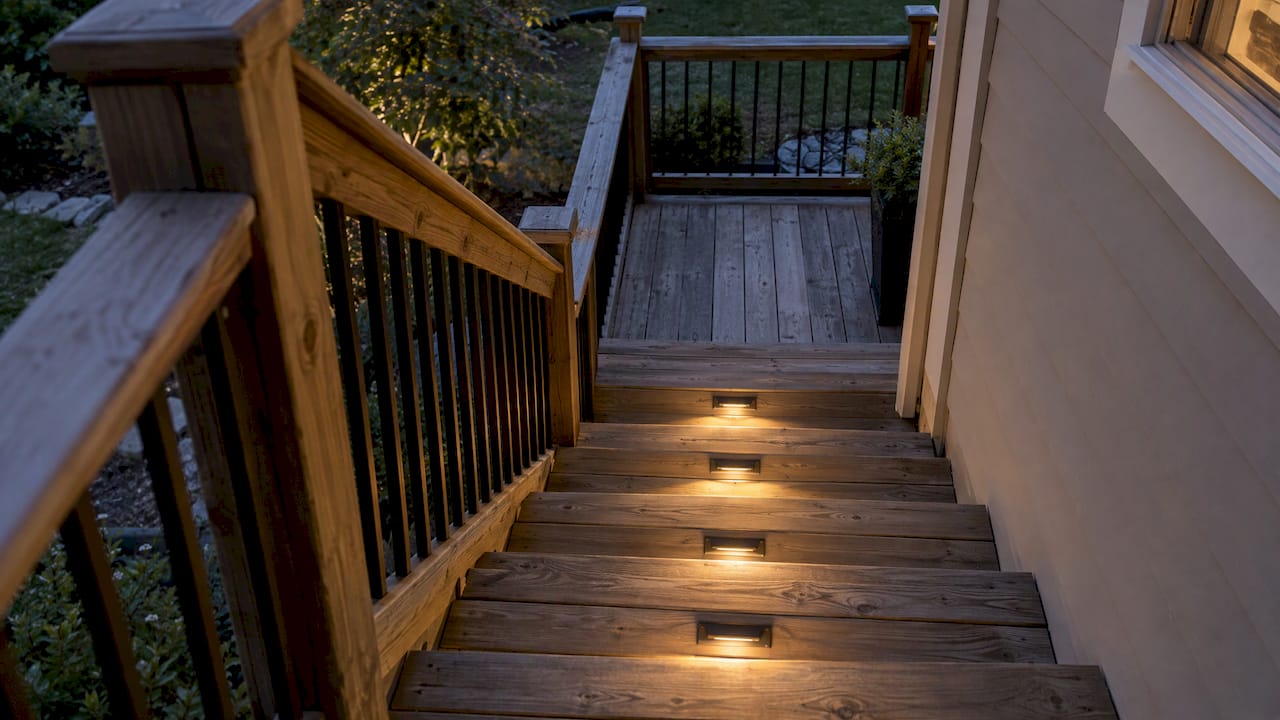
The best outdoor step lighting puts one low-glare light on every step, runs on a properly sized low-voltage or wired system, and carries a wet-location rating. Fixtures range from about $15 for a solar four-pack to $129 for a single cast-brass unit. Which one fits depends on how the steps are used, how much light you need and whether you want the system to last for years without maintenance. This guide compares real products with current listed prices, then covers placement, weather ratings and safety, so you can decide what to buy and what to hand to a professional.
TL;DR
- Hardwired low-voltage step lights give the most consistent light. Solar kits are the cheapest to start, with lower brightness.
- Choose a wet-location rating (IP65 or higher) for any step that gets rain, snow or hose spray.
- Put one light on each step riser, aimed across the tread and out of the eyeline of someone walking down.
- Compare lumens, color temperature, beam angle, dimming and warranty, not just price.
- For permanent, smart-controlled step lighting in the Charlotte area, we design and install complete systems.
Table of Contents
- Step light options compared, with current prices
- Wired, low-voltage or solar: which type fits your steps
- What to compare before you buy
- Where to place step lights so every tread is visible
- Safety and code: what to check locally
- Perspective: why we install step lighting as part of a system
- Our deck and step lighting service
- FAQ
- Sources
Step light options compared, with current prices
The table below pulls from manufacturer and retailer product pages. Prices are the listed prices in November 2026 and change often, so confirm them on the product page before you order.
| Product | Power | Output | Listed price | Notable specs |
|---|---|---|---|---|
| Luna Coastal Environment Step Light | 120V | 240 lumens, 2700K, CRI 90 | $129.00 | Solid cast brass, 40,000-hour LED, dimmable |
| Nuvi Coastal Deck Sconce, rectangular | 12V, transformer required | 220 lumens, 2700K | $95.00 | ETL rated, ADA compliant, lifetime limited warranty on the series |
| VOLT Thin Louvered Step Light | Low voltage, transformer sold separately | 20 lumens, 2700K | $89.99 | UL and cUL listed, IP65, lifetime warranty |
| Armacost 4" Surface Mount Step Rail Light | Low voltage | 3000K | $34.99 | Made for deck stair illumination |
| Ring Solar Motion Activated Step Light | Solar | 50 lumens, neutral white | $29.99 | Motion sensing, dusk-to-dawn mode needs a Ring Bridge |
| Varmtalys RGBCW Smart Step Light | Low voltage | Color-changing | $28.50 | Smart color control |
| Hampton Bay Low Voltage Deck and Step Light | Low voltage, hardwired | 100 lumens, 3000K | $22.44 | IP65, cast aluminum, 5-year limited warranty |
| Armacost 1" Recessed Step Light | Low voltage | 3000K | $19.99 | Recessed into the surface |
| DEKOR Recessed Stair LED Lights | Low voltage | 30-degree downward angle | From $18.76 | Made in the USA, limited lifetime warranty |
| Hampton Bay Solar Deck and Step Light, 4-pack | Solar | 10 lumens each, 3000K | $14.99 | Dusk-to-dawn, up to 8 hours on a full charge |
The spread is wide because these products solve different problems. A $14.99 solar pack marks the edge of a step. A cast-brass or louvered fixture is built as permanent architecture. Brightness also varies a lot: 10 lumens at the low end, 240 at the top of this list.
How to read the price gap
Fixture price is only part of the cost. Low-voltage fixtures need a transformer, and some listings say so plainly: the VOLT fixture’s transformer is sold separately, and the Nuvi sconce requires one. Add the cable, connectors, a wiring kit where needed and labor, and the real project cost depends on the number of steps and the run from the power source.
Wired, low-voltage or solar: which type fits your steps
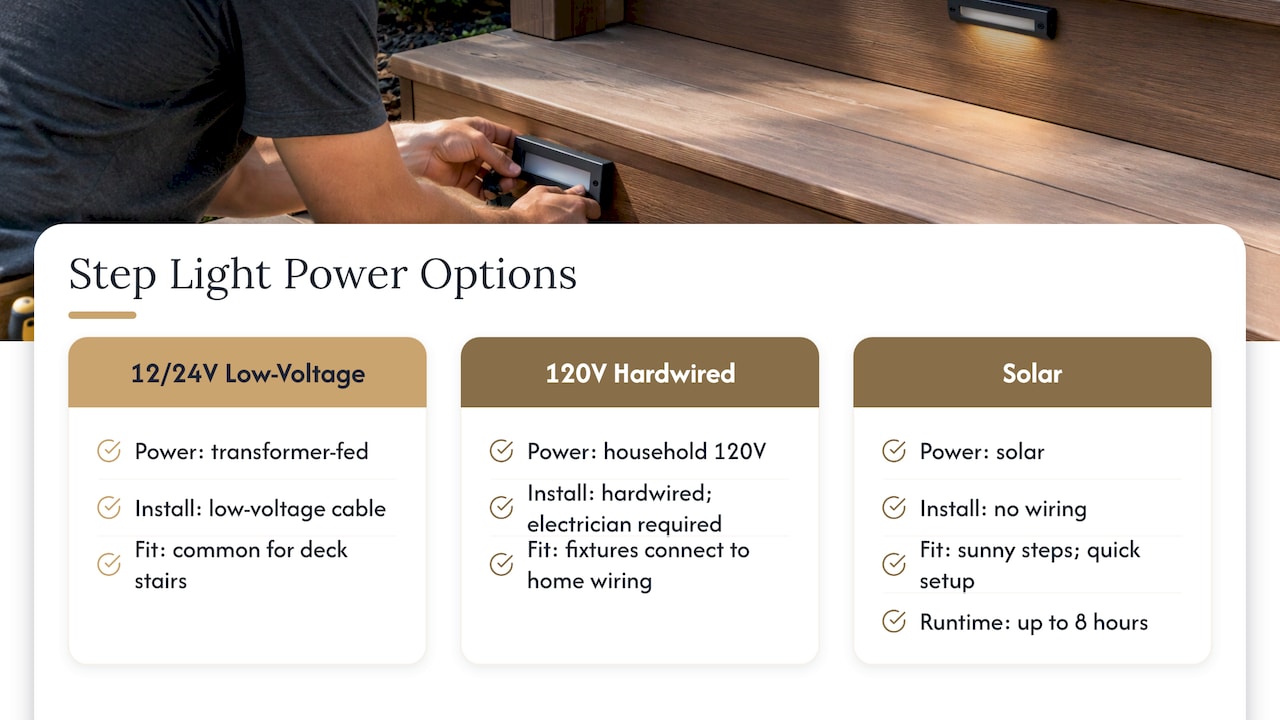
There are three practical routes, and each suits a different situation.
Low voltage (12V or 24V). A transformer steps household 120V power down, and the fixtures connect to a low-voltage cable. This is the most common route for deck stairs. InspectandTest’s guide notes that these systems typically run at 12 or 24 volts from a transformer or LED driver on a 120-volt circuit. It also says the transformer must be listed, protected, correctly connected and sized for the fixture load, with voltage drop in mind. We cover the sizing math in our guide to sizing a landscape lighting transformer, and the case for this approach in why low-voltage landscape lighting is the smart choice.
120V step lights. Some fixtures, like the Luna above, run on line voltage and are installed within the home’s wiring. Varmtalys’s product notes say its 120V step lights do not come with a plug and must be hardwired, which is a job for a licensed electrician. Our wiring best practices for homeowners explain what a clean, safe run looks like.
Solar. Solar step lights need no wiring, and the Hampton Bay pack lists automatic dusk-to-dawn operation with up to 8 hours of runtime on a full charge. Ring’s solar light adds motion activation. They suit a quick, no-trench setup where the steps get sun during the day. Since solar units list 10 to 50 lumens in the products above, they work best as edge markers, so match the output to how much light you want on the tread.
What to compare before you buy
Brightness and beam angle
Lumens tell you how much light the fixture puts out, and beam angle tells you where it goes. The Kings Outdoor Lighting STAH04 lists 300 lumens with a 30-degree beam and an anti-glare design. The DLA04 package lists 250 lumens with a wide 120-degree beam. A narrow, downward beam places light on the tread. A wide beam spreads more evenly but can spill toward the eyes if the fixture sits high. DEKOR’s recessed lights use a 30-degree downward angle specifically to prevent glare.
Glare is the most common reason a good step light feels wrong at night. We explain how fixtures avoid it in how outdoor lighting reduces glare without losing curb appeal.
Color temperature and dimming
Most step lights in the table sit at 2700K to 3000K, a warm white that suits wood decks and brick. Some, like the Kings STAH04, offer 2700K, 3000K and 4000K options in one fixture, and list dimming from 10% to 100% with most LED dimmers. Dimming matters on steps: bright enough to see the edge on a rainy night, low enough that the deck still looks inviting at a dinner party. Color rendering matters too. The Luna lists a CRI of 90, which keeps materials looking natural.
Weather rating and materials
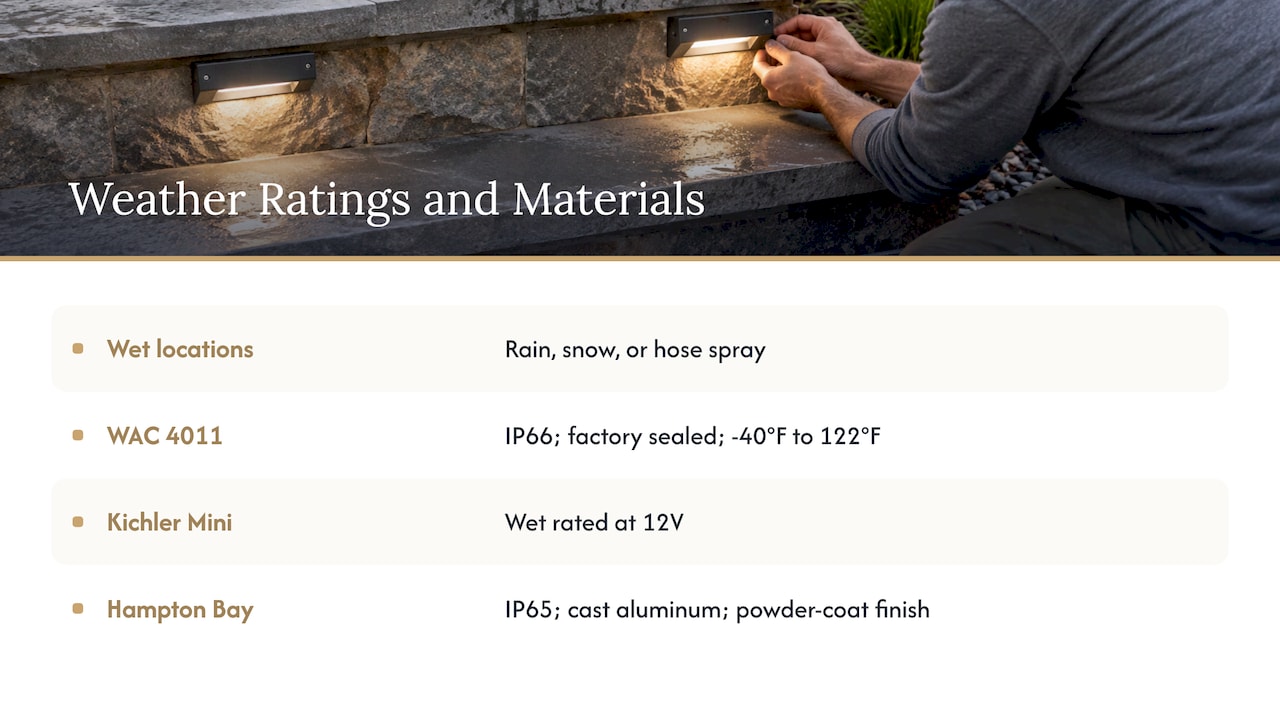
For steps that take rain, look for a wet-location listing. The InspectandTest guide explains that dry locations are interior, damp locations cover humidity but not direct water, such as the underside of a roofed deck, and wet locations are those exposed to rain, snow or hose spray. It places deck stairs and exposed patio steps in the wet category.
Spec sheets show the difference in practice. The WAC Lighting 4011 is factory sealed and IP66 rated for wet locations, with an operating range of -40°F to 122°F. The Kichler 2700K Mini Step Light is listed as wet rated at 12V. The Hampton Bay low-voltage light is IP65 with cast aluminum construction and a powder-coat finish.
On the coast or near a lake, ratings alone are not the full story. Salt air and constant humidity are a separate challenge, which we cover in why IP ratings don’t cover salt air. For our region’s heat, storms and humidity, see what holds up in Charlotte.
Warranty
Warranties in this group range from 5 years on the Hampton Bay fixture to 10 years on the LED components of the Nuvi, plus lifetime warranties from VOLT and DEKOR. Read what is covered: the finish, the LED or the whole fixture.
Where to place step lights so every tread is visible
Placement matters as much as the fixture. A great light in the wrong spot leaves dark gaps or shines into your eyes.
- One light per step. Sconce & Socket recommends one light per step on the riser, aimed across the tread. One light at the top leaves the rest of the stairs in the dark.
- Keep the source out of the eyeline. The same guide advises mounting lights so they stay out of your eyeline, because a bright fixture in view makes it hard to see the step edges.
- Mount low and centered. Bees Lighting advises centering lights on the riser, mounting them no higher than 18 to 24 inches above the tread, and using downward-facing eyelid shields or louvers to put light on the walking surface.
- Light the landings. Turns and landings are where people hesitate. Treat them as steps in the layout.
- Plan for the stair itself. If you are building or replacing treads, decide on lighting at the same time. This guide to stair landings, nosing and flooring covers code basics and under-tread lighting preparation, which is easiest to build in before the stairs are finished.
For longer routes from the driveway to the door, step lights work alongside path lights. Our guide to path lighting shows how to carry the same light level across the walk, and landscape lighting layering techniques explain how to blend them with the rest of the yard.
Safety and code: what to check locally
Step lighting is a fall-prevention measure first and a design feature second. Lighting that puts light where people step and land, and reduces shadows along the stair path, supports that goal, and Seus Lighting’s staircase guide describes the code intent in the same terms.
Requirements differ by state, county and city, and they depend on the code edition your jurisdiction has adopted. Exact light levels for stairs and landings, and rules on GFCI protection for outdoor circuits, are set in the adopted building and electrical codes. Before you start a project, ask your local building department which edition applies. Have a licensed electrician handle any line-voltage connection, and ask them to confirm GFCI protection on the circuit that feeds your transformer. If your property is in an HOA, check its rules on fixture color and brightness as well.
For the broader picture, our article on landscape lighting safety benefits for homeowners explains how consistent visibility, balanced coverage and fewer hiding spots work together.
Perspective: why we install step lighting as part of a system
We see the same pattern on stair projects around Charlotte. A homeowner buys a handful of fixtures, runs into questions about transformers, voltage drop and aiming, and the steps end up with bright spots and dark gaps.
Our approach is to treat step lighting as part of the whole outdoor plan. We choose commercial-grade, climate-optimized hardware, color-match the fixtures to your deck or stonework, and lay out the lighting so each tread is visible and glare stays out of the eyeline. The system is designed to run from your smartphone, so you can set steps to a soft level in the evening and raise them when guests arrive.
We design for the Carolinas’ weather and for HOA and municipal requirements, and our work is backed by a climate-specific warranty and the GlowCare maintenance program. A step light is a small fixture doing a serious job, and we think it deserves a proper design.
Dave
Our deck and step lighting service
If you would rather have the steps, deck and walkways lit as one designed system, we handle it from layout to installation. Our deck and step lighting service uses smart LED systems that you control from your phone, with multi-color options where you want them. We also tie step lights into landscape lighting design and patio lighting, so the whole space reads as one plan.
We offer a free estimate. Contact Forever Glow Lighting to talk through your stairs, and see the landscape lighting checklist for homeowners if you want to prepare questions first.
FAQ
How many step lights do I need for deck stairs?
Plan on one light per step, mounted on the riser and aimed across the tread. A single light at the top leaves lower steps dark. Add lighting at landings and at the bottom of the stairs where people step onto the ground.
What is the best color temperature for outdoor step lights?
Warm white, between 2700K and 3000K, is the most common choice on wood decks and brick or stone, and most products in the comparison above sit in that range. If you want flexibility, some fixtures offer several color temperatures and dimming from 10% to 100%.
Are solar step lights enough for outdoor stairs?
Solar lights suit simple, no-wiring setups, and the products listed here range from 10 to 50 lumens. They work well for marking step edges where the stairs get daylight. If you want a consistent level of light on every tread, or smart control, a low-voltage system is designed for that.
Do outdoor step lights need to be wet rated?
Yes, if the steps are exposed to rain, snow or hose spray. Deck stairs and exposed patio steps fall in the wet category, and a covered porch may only need damp-rated fixtures. Check the product listing for the location rating, and for IP65 or higher.
Does my outdoor stair lighting need to meet a code?
Local codes can apply to stair lighting and outdoor electrical work, and they vary by jurisdiction. Ask your building department which code edition applies, and use a licensed electrician for line-voltage work and GFCI protection.
Sources
- Luna Coastal Environment Step Light, Coastal Lighting
- Nuvi Coastal Outdoor Deck Sconce, Coastal Lighting
- Thin Louvered Integrated Step Light, VOLT Lighting
- Deck Stairs & Step Lights, Armacost Lighting
- Ring Solar Motion Activated Deck Step Light, Home Depot
- Step & Deck Lights, Varmtalys
- Hampton Bay Low Voltage Deck and Step Light, Home Depot
- Outdoor Stair Lighting, DEKOR Lighting
- Hampton Bay Solar Deck and Step Light 4-Pack, Home Depot
- LED Step Lights: Stair Safety, Wiring and Outdoor Ratings, InspectandTest
- STAH04 Outdoor Step Lights, Kings Outdoor Lighting
- DLA04 12-Pack Low Voltage Deck Lights, Kings Outdoor Lighting
- 4011 9-15V Spec Sheet, WAC Lighting
- 2700K LED Mini Step Light, Kichler
- Best Deck and Step Lights, Sconce & Socket
- Outdoor Step Lights & Deck Lighting Layout, Bees Lighting
- Staircase Lighting Guide, Seus Lighting