
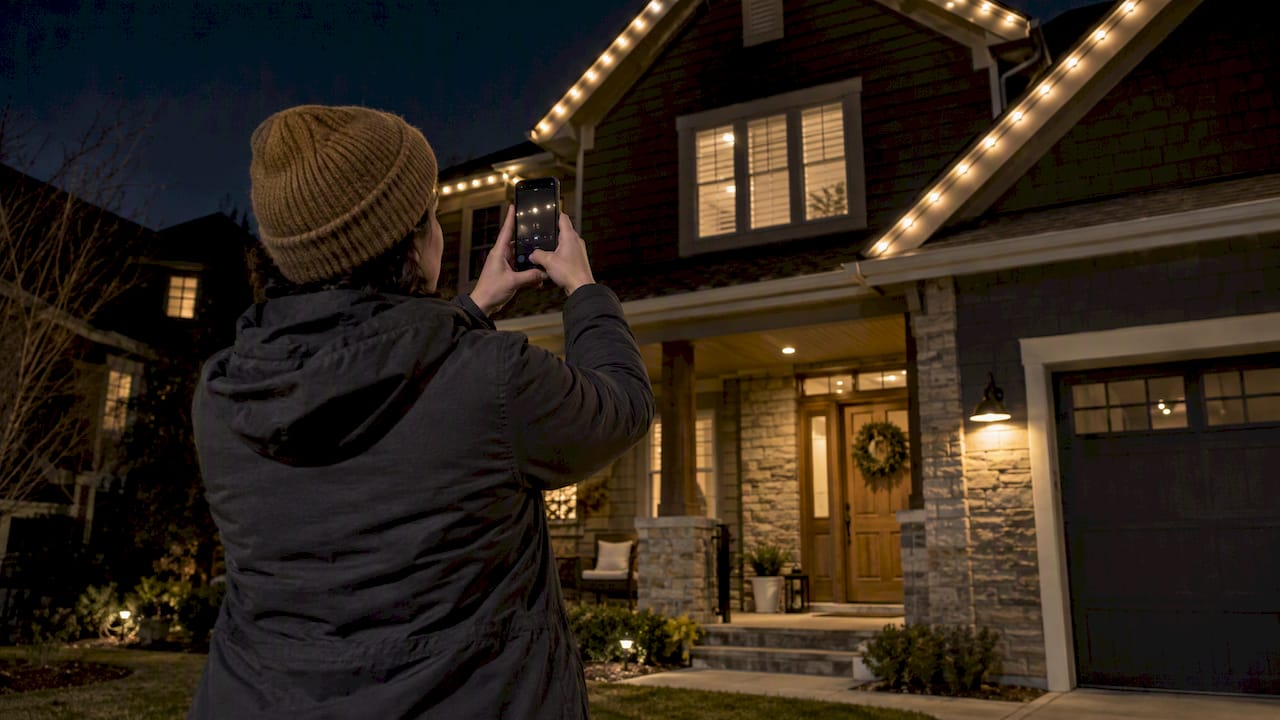
Keep permanent roofline LEDs bright and reliable by combining monthly cleaning, seasonal seal checks, and an annual professional inspection. In many systems, dirt and moisture cause more visible dimming than the LEDs themselves losing output over time. For homeowners who prefer a hands-off approach, we offer a maintenance subscription as a professional option.
TL;DR:
- Before cleaning, shut off power, verify it with a noncontact tester, use a stable ladder with a spotter, and dry the track before restoring power.
- In fall, clear gutters and reseal gaps; after the last spring freeze, test every segment, and use deicers only on hardware rated for them.
- Dirt alone cut LED output about 4% after roughly 5,000 hours and approached 12% by 20,300 hours, so clean dim sections before replacing parts.
- Schedule an annual professional inspection alongside monthly checks; warranties cover defects, while routine cleaning and seal wear require separate upkeep.
- Coastal homes need more frequent seal and connector checks because salt speeds corrosion; use hardware rated for marine environments near open water.
Table of Contents
- Monthly maintenance checklist homeowners can do safely
- Seasonal checks and winterizing for reliable year-round performance
- Diagnosing common faults: flicker, dim sections, and intermittent power
- Electrical safety, driver and controller care, and recommended service intervals
- Cleaning materials, sealants, and special care for coastal properties
- How Forever Glow Lighting approaches permanent roofline maintenance
- Battery and backup power maintenance if your system includes it
- Warranty coverage and what GlowCare adds on top of it
- Prioritizing maintenance: homeowners versus property managers
- Get a free estimate for custom roofline lighting and GlowCare maintenance
- FAQ
- Sources
Monthly maintenance checklist homeowners can do safely
A simple monthly routine catches small problems before they become expensive ones. Here’s the order that keeps you safe and makes the biggest difference in visible brightness.
- Shut off power at the breaker or the dedicated circuit before touching any fixture, track, or junction box.
- Test the circuit with a non-contact voltage tester to confirm power is actually off, not just switched at the controller.
- Use a stable ladder on level ground, have someone spot you, and wear safety glasses when working near eaves or gutters.
- Clear leaves, pollen, and nesting debris from the track and surrounding gutter line by hand or with a soft brush.
- Wipe lenses and housings with a microfiber cloth and mild soap and water, following homeowner guidance from recent lighting maintenance advice that recommends avoiding abrasive pads.
- Dry the track and lenses fully before restoring power, since residual moisture at connection points invites corrosion.
- Check every fastener and clip for looseness, and re-seat any clip that has slipped rather than forcing it, which can crack fascia or trim.
- Inspect visible wiring runs for cracking, fraying, or rodent damage, and test the GFCI outlet feeding the system by pressing the test button.
- Confirm the controller is current on firmware, that scheduled on and off times are correct, and that the app or remote still connects without dropouts.
- Restore power and run the system twice, once in daylight to spot uneven brightness across segments, and once after dark to confirm color accuracy and full coverage.
This sequence takes most homeowners under thirty minutes once it becomes routine. A full step-by-step walkthrough of the cleaning portion, including the right cloth weight and soap dilution, is in our roofline track system cleaning guide.
Clips and tracks are not one universal part across every installation. Reviewing the hardware types common to permanent systems, covered in our guide to roofline lighting types, helps you recognize what you’re working with before you attempt a repair.
Pro Tip: Photograph each section of your roofline at night once a month. Comparing photos side by side makes gradual dimming or color drift far easier to spot than relying on memory.
Seasonal checks and winterizing for reliable year-round performance
Permanent LED systems face different stress points depending on the season, and a seasonal rhythm prevents most weather-related failures before they start.
- Fall: Clear gutters and roofline debris before leaves pile up, reseal any junction boxes showing gaps, and test controllers and timers before the first hard freeze.
- Winter: Watch for ice buildup pressing against tracks, since cold makes some plastics and clips more brittle and prone to cracking under load.
- Winter (power components): Only use anti-freeze or de-icing products on hardware specifically rated for it, since the wrong product can degrade seals and void coverage.
- Spring: Wipe away pollen and tree sap buildup, which dulls lenses faster than dust alone, and check for wasp or bird nesting inside tracks or housings over winter.
- Spring (full test): Run a complete daytime and nighttime test after the last freeze to confirm every segment survived winter at full output.
If your roofline runs close to gutters, clearing debris safely without damaging either system matters year round. Our guide on installing roofline lights near gutters covers safe clearance and mounting distance. Roof condition itself affects how well a track system holds up season after season, and general guidance on preventive roof maintenance from a licensed roofing contractor is a useful companion check before storm season.
Diagnosing common faults: flicker, dim sections, and intermittent power
Most roofline lighting problems fall into a small set of patterns, and working through them in order saves time.
- Isolate the controller first. Swap the suspect segment to a different output or controller zone to rule out a controller fault before touching the wiring.
- Swap segments to narrow the cause. If a working segment dims when moved to the suspicious spot, the problem is upstream, in the driver or wiring, not the LED strip itself.
- Test power at the driver with a multimeter to confirm it’s delivering its rated output before replacing any part.
- Run a cleaning test before assuming the LEDs have failed. Clean the lens and track on the dim section, dry it fully, and re-measure. Field testing on LED luminaires found dirt accumulation alone reduced light output by about 4% after roughly 5,000 hours of use and climbing toward 12% by around 20,300 hours, which means a thorough cleaning often recovers more brightness than a part swap.
- Watch for water ingress signs, including condensation inside a lens or corrosion at a connector. If you see either, stop running that circuit, dry the area fully, and reseal before restoring power.
Many dimming complaints are a dirt problem, not an LED problem. Cleaning a suspicious section before replacing it is the cheaper first step and often the correct one.
When a fix turns out to be more than a cleaning or a clip adjustment, small part swaps are usually enough. Our breakdown of common repair options walks through what tends to be a modest fix versus what calls for a technician.
Electrical safety, driver and controller care, and recommended service intervals
The electrical side of a roofline system deserves the same attention as the visible track.
- GFCI protection on a dedicated outdoor circuit is standard practice, and testing it monthly confirms it will trip correctly if moisture reaches a connection.
- Surge protection matters most in areas prone to lightning or grid fluctuations, since a single surge can take out a driver that otherwise had years of life left.
- Watch drivers for heat, discoloration, or bulging capacitors. DOE guidance on LED luminaire lifetime notes that driver failure is often a separate mechanism from LED lumen depreciation, and thermal stress signs usually show up before total failure.
- Replace drivers based on symptoms, not age alone. A driver showing heat damage or visible swelling should be swapped regardless of how new the system is.
- Combine monthly visual checks with one annual professional inspection to catch issues a homeowner walkthrough might miss, particularly at hard-to-reach rooflines.
Cleaning materials, sealants, and special care for coastal properties
The materials you use for cleaning and resealing affect how long a system holds up, especially near the coast.
Stick to a microfiber cloth and mild soap diluted in water, which is the combination recent homeowner maintenance guidance recommends for lenses and housings. Avoid solvents, ammonia-based cleaners, and abrasive pads, which can cloud lenses or strip protective coatings over time.
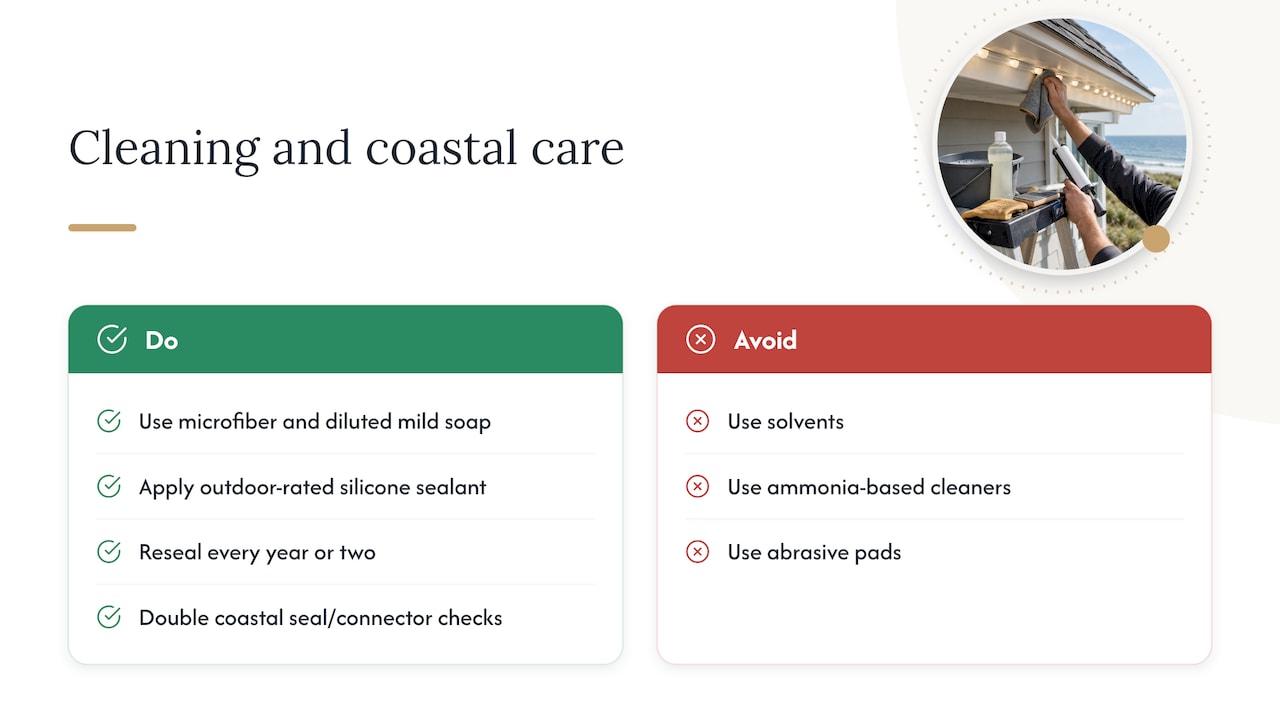
For seals, an outdoor-rated silicone gasket sealant applied at junction boxes and track ends holds up well, and a periodic reseal every year or two keeps moisture out even as the material ages.
Coastal properties need a higher standard of care. Salt-spray corrosion guidance for perimeter lighting recommends more frequent cleaning and closer seal inspection, since salt accelerates corrosion on fasteners and can compromise seals faster than inland exposure. Marine-grade stainless hardware and more frequent connector checks are worth the extra effort if your roofline faces open water.
Pro Tip: If you’re near the coast, double your inspection frequency on seals and connectors compared to an inland property. Salt works faster than most homeowners expect.
How Forever Glow Lighting approaches permanent roofline maintenance
Every roofline track system uses commercial-grade, climate-optimized hardware and color-matched tracks built for the local climate. That foundation is what makes long-term maintenance manageable rather than reactive.
We estimate a well-maintained permanent system can last around 22 years at six hours of daily use, a figure we break down in detail in our guide to permanent roofline lighting lifespan. That kind of lifespan assumes the maintenance basics, cleaning and seal checks, happen on schedule.
A maintenance subscription can cover parts of upkeep most homeowners would rather not handle themselves:
- Seal and gasket inspection at every junction box and track end.
- Driver testing to catch heat stress before it causes a failure.
- Firmware and controller checks to keep smartphone control responsive.
- Full track cleaning to prevent dirt depreciation from dulling output.
- Minor repairs, including clip replacement and connector resealing, handled during the same visit.
Battery and backup power maintenance if your system includes it
Some permanent roofline setups include battery backup for the controller or for accent zones that need to hold a schedule through a brief outage. If your installation includes this, a few checks keep it dependable.
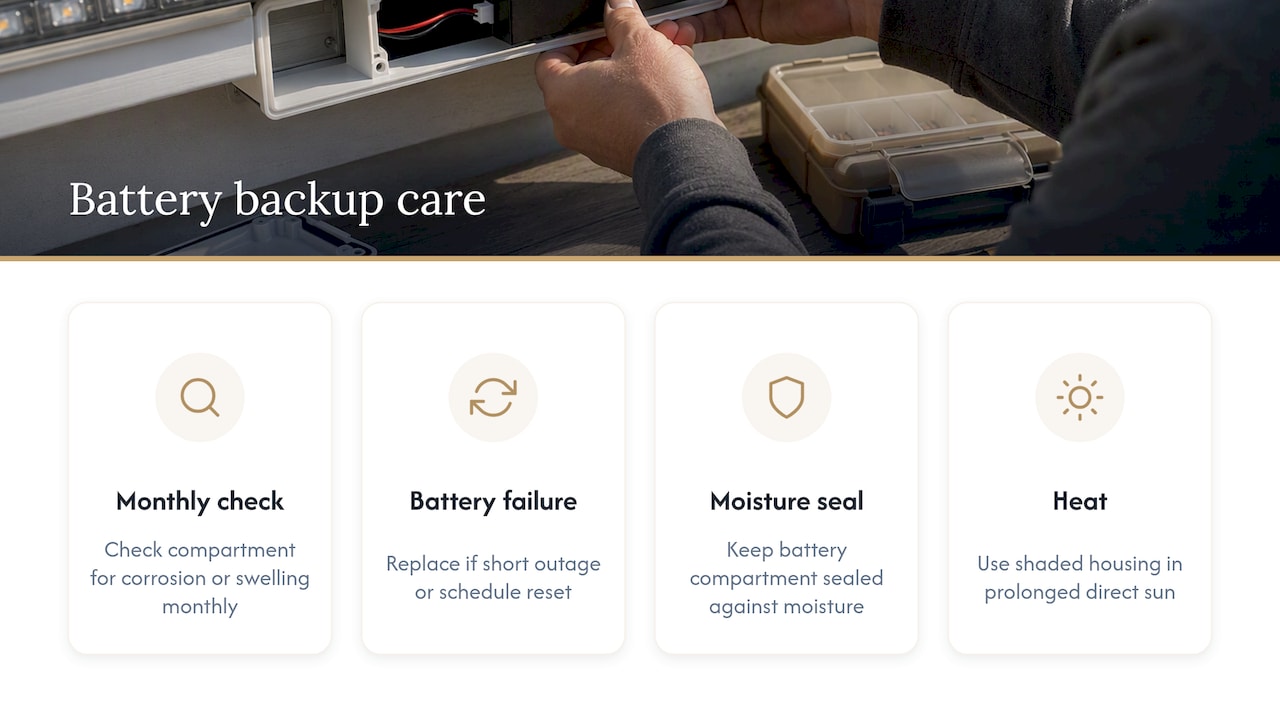
Check the battery compartment for corrosion or swelling at the same time you do your monthly cleaning walkthrough, since heat and humidity both shorten battery life faster than age alone. A battery that no longer holds a charge through a short outage, or that causes the controller to reset its schedule after a brief power blip, is usually due for replacement rather than repair.
Keep the battery compartment sealed against moisture the same way you treat junction boxes elsewhere in the system. If your roofline faces direct sun for long stretches, locating backup batteries in a shaded housing extends their working life, since heat is the primary factor that degrades rechargeable battery capacity over time.
Not every permanent system includes battery backup, since many rely entirely on the home’s wired circuit with no standby power. If yours doesn’t, this section simply doesn’t apply, and your maintenance routine can stay focused on the track, driver, and seal checks covered earlier.
Warranty coverage and what GlowCare adds on top of it
A manufacturer or installer warranty typically covers defects in the LED hardware and driver for a defined period, and it’s worth knowing what yours covers before you assume a repair is out of pocket.
Warranty coverage protects against defects, but it doesn’t replace routine upkeep. Dirt accumulation, seasonal debris, and gradual seal wear aren’t manufacturing defects, they’re normal wear that routine maintenance addresses. That’s the gap a service plan like our GlowCare Maintenance Subscription is built to close.
Where a warranty is reactive, covering a failure after it happens, GlowCare is scheduled and preventive: cleaning, seal checks, and driver testing happen on a calendar rather than waiting for a symptom. For homeowners who want both layers of protection, pairing manufacturer warranty coverage with a maintenance subscription is the more complete approach, since one handles defects and the other handles the wear that accumulates regardless of build quality. Details on what’s included are on our permanent Christmas lighting and GlowCare page.
Prioritizing maintenance: homeowners versus property managers
If you own the home, start with safety: power off before touching anything, then a monthly clean, then a seasonal check. That order prevents most problems.
If you manage a property, prioritize differently: keep written maintenance logs, schedule a professional visit annually rather than relying on staff availability, and have an emergency response plan ready for storm damage or sudden outages. A simple printed checklist handed to any contractor keeps the routine consistent across properties.
Get a free estimate for custom roofline lighting and GlowCare maintenance
We built our roofline track systems to blend into your home by day and light it precisely the way you want at night, controlled entirely from your phone. Combined with GlowCare, the maintenance side stops being something you have to think about: seal checks, driver testing, firmware updates, and track cleaning happen on schedule instead of after something goes wrong.

Beyond rooflines, we also handle landscape illumination, patio and bistro lighting, dock and waterfront fixtures, and commercial exterior displays, all built with the same climate-specific hardware and backed by the same maintenance program. If you’re ready to see what a properly maintained system looks like on your own roofline, request a free estimate through our permanent Christmas lighting and GlowCare page and we’ll walk you through design, installation, and ongoing care.
FAQ
What are some common problems with landscape lighting?
The most frequent issues are dimming from dirt and debris buildup, loose connections at clips or junction boxes, and driver failures that cause flickering or dead segments. Moisture intrusion at seals is another common culprit, especially after storms or during winter freeze and thaw cycles.
How do you line a roofline with permanent lights?
Permanent roofline lighting uses a custom-fitted track system mounted along the fascia or roofline, color-matched to the home and installed to stay hidden during the day. The track houses individually addressable LEDs controlled through a smartphone app, which is how these installations are often designed from the start.
Are permanent roofline lights worth the investment?
For homeowners who want consistent, maintenance-friendly lighting without climbing a ladder every season, permanent systems tend to pay off over the years through durability and smartphone control. We estimate a well-maintained system can last around 22 years at six hours of daily use, which spreads the upfront cost over a long service life.
Should you leave permanent or solar outdoor lights on all the time?
Running lights continuously is generally fine for permanent LED systems designed for daily use, but scheduling them through a controller extends component life and saves energy. For solar accent lights specifically, manufacturers typically recommend letting them run through their full charge and discharge cycle rather than switching them off mid-cycle.
Sources
- Long-term Testing of LED Luminaires (I-35W Phase II)
- Lighting Maintenance Tips for Homeowners in 2026 – Hammerton