
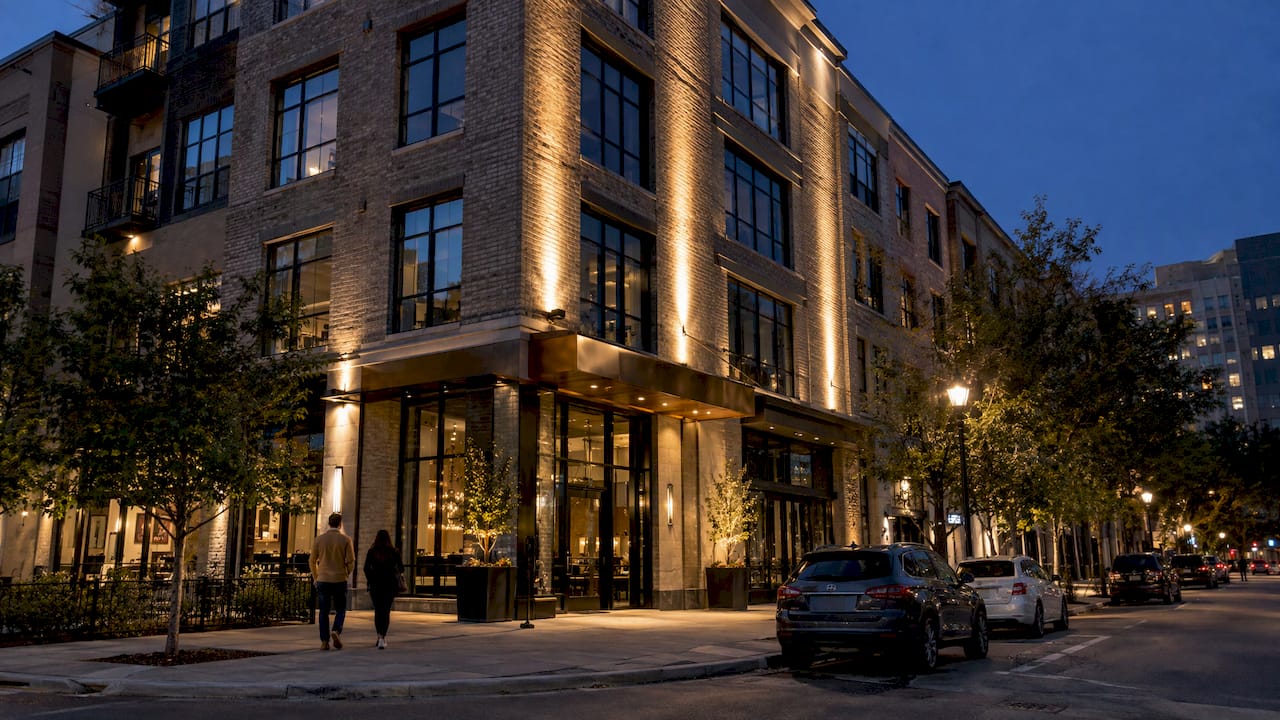
Commercial building uplighting places fixtures at or near the base of a wall, column, or canopy and aims them upward, so the building itself becomes the light source people see at night. Done well, it shows off texture and structure, gives entrances a clear read, and adds balanced coverage without pole-mounted glare. Done badly, it throws light into the sky, into tenants’ windows, and into drivers’ eyes. This guide covers where uplights work, how to aim them, what to specify, and what to settle before you sign a contract.
TL;DR
- Uplighting works best on textured walls, columns, canopies, and tall entries, where a tight beam or a wide wash shows off the surface.
- Fixture distance and beam spread decide the look: close and tight for texture, farther back and wide for an even wash.
- Warm color temperatures (2,700 to 3,000 K) read as welcoming; controls let you dim, schedule, and save energy.
- Aim and shielding matter as much as brightness. Poor aiming creates glare, sky glow, and light trespass.
- Cost depends on access, wiring, controls, and who must install it, so get a site-specific quote rather than a per-fixture guess.
Table of Contents
- What uplighting does for a commercial building
- Where uplights work best on a façade
- Choosing fixtures and light sources
- Aiming and positioning: grazing vs. washing
- Brightness, color temperature, and controls
- Glare, sky glow, and being a good neighbor
- Energy, maintenance, and electrical safety
- What affects the cost
- Uplighting for Charlotte commercial properties
- Our perspective on uplighting
- A short brief to prepare before you call
- FAQ
- Sources
What uplighting does for a commercial building
Uplighting is simply light that shines upward. Indoors, designers use it to highlight beams, pipes, and other distinctive ceiling features, as lighting designers interviewed by ArchDaily describe. The same logic carries outside: you light a surface, and the surface carries the light to the viewer.
That is the key difference from a flood or a wall pack. A wall pack lights the ground near the door. An uplight lights the building. The façade gets depth, the entrance becomes easy to find, and the property reads as maintained and occupied after dark.
Indoors, the same technique has its own benefits. According to the same designers, uplighting reduces dark spots and shadows on ceilings, gives glare-free indirect light, and can make a room feel larger. ArchDaily also notes that uplighting can showcase structural ceiling features such as steel beams while limiting glare. That matters for lobbies, covered walkways, atriums, and open-air breezeways, where the line between interior and exterior blurs.
For property managers and owners, three practical goals usually drive an uplighting project:
- Identity: the building looks finished and intentional at night.
- Wayfinding: entries, canopies, and signage are visible from the street and the parking area.
- Visibility and comfort: vertical surfaces are lit, which helps people see and be seen without harsh overhead glare.
Where uplights work best on a façade
Not every wall deserves an uplight. The strongest candidates share a few traits.
Textured surfaces
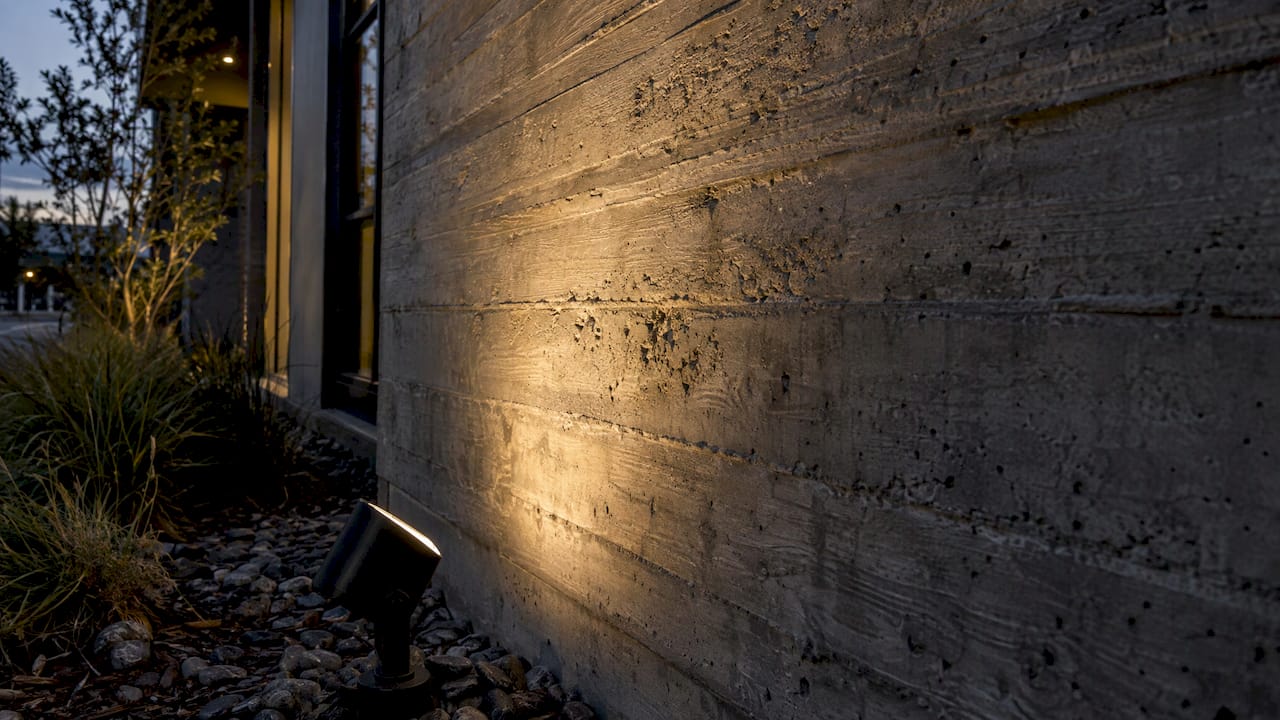
Brick, stacked stone, board-formed concrete, and metal panels all show depth when light skims across them. The Alcon Lighting façade guide explains that placing a source close to a surface with a tight beam can reveal its texture. Smooth stucco or glass will not give you the same effect, and glass may simply reflect the fixture back at the viewer.
Columns, piers, and vertical fins
Repeated vertical elements create rhythm when each one is lit from below. Spacing matters: fixtures need to match the rhythm of the architecture, not be placed wherever the power is convenient.
Canopies and overhangs
Exterior uplights can illuminate the underside of a canopy, according to the same Alcon guide. That is a useful trick at entrances, drive-throughs, and covered patios, because it adds soft, indirect light exactly where people gather, with no fixture hanging in their sight line.
Patterns on a plain wall
In-ground uplights can also create patterned light against a façade. If your building has a large blank elevation, a pattern or a gradient can give it character without signage.
Where to think twice
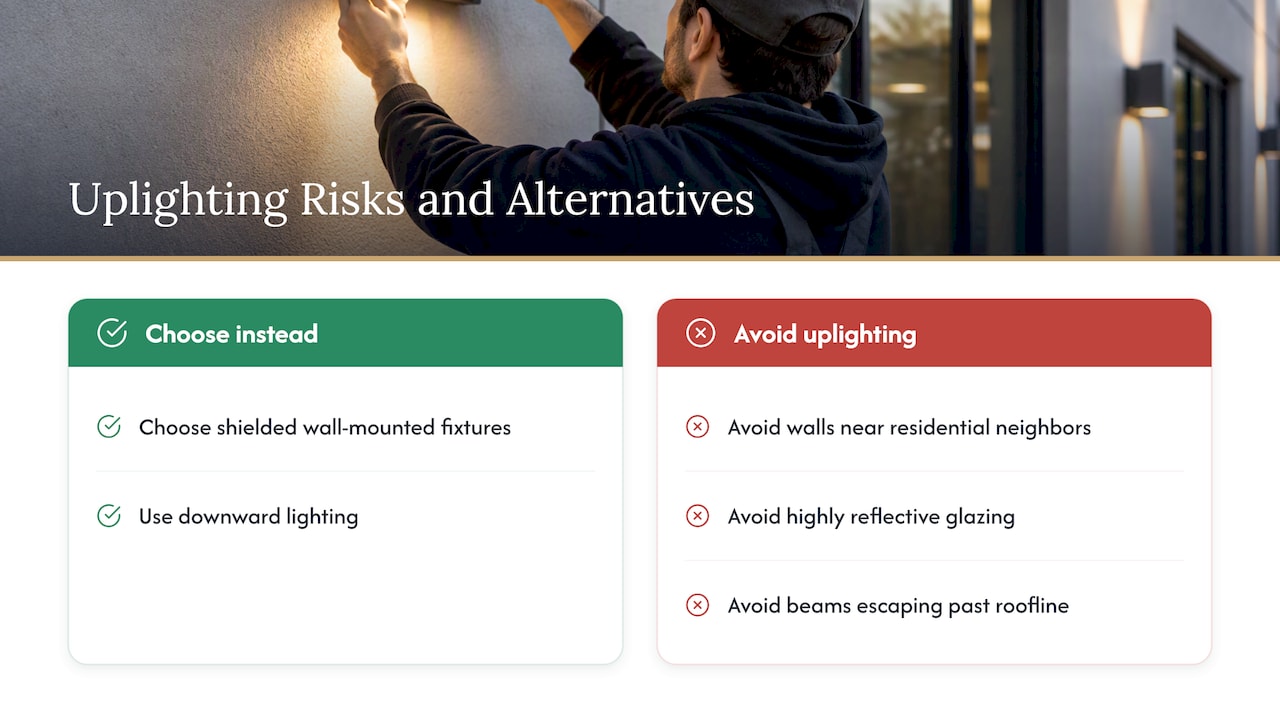
Skip uplighting on walls close to residential neighbors, on highly reflective glazing, or anywhere an upward beam will escape past the roofline. In those cases, look at shielded wall-mounted fixtures or a downward approach instead. Our guide to commercial façade lighting ideas that work at night walks through several of these alternatives.
Choosing fixtures and light sources
The fixture family you pick depends on the architecture and how the light needs to travel.
- In-ground or grade-mounted uplights: good for columns, trees beside the building, and canopy undersides.
- Wall-mounted luminaires: common for accent lighting. The UC Davis California Lighting Technology Center guide lists track lighting, cove lighting, and wall-mounted luminaires as common accent-lighting fixtures.
- Linear and cove lighting: continuous lines of light that wash a soffit, a parapet, or a ceiling plane.
- Wall washers and pendant or linear uplights: Ledvance lists pendant uplights, linear uplight fixtures, cove lighting, and wall washers among indirect-lighting options, which suits covered entries and interior lobbies.
On light source, LED is the default for good reason. The same UC Davis guide notes that LEDs can emit colored, white, or spectrally tunable light, and that long-life LED luminaires can reduce maintenance costs. For a building where reaching a fixture means renting a lift, a long service life is not a nice-to-have. It is part of the budget.
For exterior work, also look at how the fixture is housed and sealed. Charlotte-area weather means summer humidity, heavy thunderstorms, pollen, and the occasional ice event. Fixtures and drivers should be rated for wet locations and installed so water drains away from connections.
Aiming and positioning: grazing vs. washing
Two techniques account for most façade uplighting. They look different and need different placement.
| Technique | Fixture placement | Beam | Best for | Result |
|---|---|---|---|---|
| Grazing | Close to the wall | Tight | Brick, stone, textured panels | Dramatic shadows that reveal texture |
| Wall washing | Farther from the wall | Wide, spread along the surface | Smooth or evenly finished walls | Even, soft glow across the surface |
The placement guidance comes from the Alcon Lighting façade guide: for grazing, put the source close to the façade and use a tight beam; for wall washing, put the fixture farther from the surface and spread the light along it.
A few practical notes from the field:
- Mock it up at night. Photos on a plan do not show how a beam lands on real masonry. Test a few fixtures before you commit to the full layout.
- Watch the top edge. A hard cutoff at the parapet looks deliberate. Light spilling over the roofline looks like waste.
- Check sight lines. Stand at the sidewalk, the parking lot, and the entry door. Any fixture you can see directly is a glare source.
- Use aimable fixtures with shielding. In a lighting design case at a Utah resort, designers mounted aimable narrow-distribution spotlights high and aimed them toward pool areas, then specified large snoots to address glare. The same idea applies to a commercial façade: narrow beams plus shielding keep the light where you want it.
Brightness, color temperature, and controls
More light is not better light. Lumens measure output, but the UC Davis guide points out that contrast, color, and fixture distribution also affect visibility and perceived brightness. A dim accent on a dark wall can read as brighter than a strong one on a pale wall surrounded by bright parking lights.
Color temperature
Lower correlated color temperature (CCT) values, such as 2,700 to 3,000 K, appear warm, per the same guide. Warm white tends to flatter brick, wood, and stone and feels inviting at hospitality, medical, and mixed-use entrances. Cooler white can suit modern metal and glass, but test it against your actual materials before you specify it across a whole elevation.
Color-changing options
Because LEDs can emit colored or tunable light, some owners add a color option for seasonal moments, branding, or events. We recommend a restrained default: a warm white scene for everyday use, with color reserved for scheduled occasions.
Controls
Controls are where an uplighting system earns its keep. Useful features include:
- Dusk-to-dawn scheduling with dimming after closing hours
- Scenes for weekdays, weekends, and events
- Smartphone or web control so staff can adjust without a service call
- Photocells or timers that respond to actual conditions
The U.S. Department of Energy’s toplighting report notes that photocells and a controller can dim or turn off luminaires in response to available daylight, reducing lighting energy use. The study concerns skylights, but the control principle applies to any lighting that should respond to ambient light.
Glare, sky glow, and being a good neighbor
Uplighting has a particular responsibility: light aimed upward can escape. Aim and shielding are not cosmetic details.
An IES article on DarkSky’s updated program explains that light above 80 degrees from nadir is restricted in most categories, and that such high-angle light is not useful for the intended pathway or street and can contribute to glare, sky glow, and light trespass. Even where your project is not seeking certification, that is a sound design rule: every fixture should have a job, and any light that does not serve it is a nuisance.
What that means in practice:
- Keep beams on the building surface and stop them at the roofline.
- Add snoots, louvers, or shields where a fixture is visible from the street.
- Think about pedestrians. The Alcon guide recommends that façade design consider pedestrian safety and effects on people and the environment.
- Review adjacent residential windows and tenant spaces before final aiming.
We cover related ideas in how outdoor lighting reduces glare without losing curb appeal and what night sky friendly lighting means. Both are written with homeowners in mind, but the principles carry over to commercial frontages.
If your property sits in a managed community, mixed-use district, or near residences, also confirm local ordinance and association requirements before design starts. Our systems are designed with HOA and municipal compliance in mind, but your specific site rules are always worth checking with the jurisdiction.
Energy, maintenance, and electrical safety
The North Carolina Department of Administration’s energy-efficient solid-state lighting guidance gives owners three useful reminders:
- Clean or replace luminaire lenses that have degraded, because dirty or yellowed lenses lower output and change appearance.
- Use controls to improve energy efficiency.
- Make sure outdoor fixtures and drivers have surge protection and are grounded.
The third one deserves emphasis. Outdoor fixtures sit in the path of lightning-driven surges and moisture. A system with proper grounding and surge protection is safer for occupants and more likely to survive storm season. Electrical work on commercial properties should be done by qualified, licensed professionals and inspected where local code requires it.
For a maintenance plan, build in:
- A scheduled lens and fixture cleaning, especially where pollen and road dust collect.
- An annual check of aim, since landscaping, ground settling, and ladder work can shift fixtures.
- A review of controls and schedules after any tenant change or signage update.
- A clear repair path for parts, so a single failed component does not mean replacing a whole run. Our article on swapping parts for permanent light repairs shows how that approach works in practice.
What affects the cost
We do not publish a flat price for commercial uplighting, because two buildings that look similar can need very different work. These are the factors that move a quote:
- Access: scaffolding or lifts for upper elevations add time and equipment.
- Wiring and routing: long conduit runs, trenching through paving, or complex controller routing take more labor.
- Fixture and component ratings: higher weather ratings and pixel-level control cost more than basic fixtures.
- Licensing and inspection: permanent public-facing installations may require certified electricians.
- Commissioning: aiming, programming, and nighttime adjustment take real hours on site.
A reliable quote comes from a site visit, a fixture schedule, and a clear scope for controls and maintenance. If a number arrives without any of those, ask what it leaves out. If you are comparing a new install with a retrofit, these eight photometrics questions for commercial LED retrofits are a good checklist for vetting any bid.
Uplighting for Charlotte commercial properties
Forever Glow Lighting designs and installs permanent LED lighting systems for residential and commercial properties in the Charlotte area. Our systems are controlled from a smartphone, offer multi-color options, are designed to meet HOA and municipal requirements, and use commercial-grade hardware chosen for Carolinas weather. Our GlowCare maintenance subscription keeps installed systems checked and serviced.
If you are planning accent lighting for an office, retail center, restaurant, or hospitality property, start with our architectural lighting service. For a wider look at commercial exteriors, see our guide to permanent lighting for commercial buildings.
Ready to see what your building could look like after dark? Request a free estimate from Forever Glow Lighting and we will review your property, your goals, and your local requirements with you.
Our perspective on uplighting
Most commercial owners come to us after a bad experience: fixtures aimed at the wrong spot, a wall that looks flat at night, or a system that nobody on staff knows how to change. In nearly every case, the problem was not the fixture. It was the plan.
We start with the building, not the catalog. What does the façade look like at dusk? Where do customers arrive? Which surfaces carry texture, and which will only reflect glare? Once we know that, fixture choice, beam spread, and placement follow naturally.
We favor permanent, track-style and fixed accent systems with smart controls because they remove the usual failure points: hanging, re-hanging, and re-aiming every season. Your team gets scenes and schedules on a phone, and the building looks consistent every night. We design for the Carolinas’ weather and for local compliance from day one, and our GlowCare plan keeps the system checked after the install is done.
Good uplighting should be easy to live with. If it takes a ladder and a weekend to change, it is not finished.
Dave
A short brief to prepare before you call
You will get better, faster quotes if you bring this to the first conversation:
- Photos at dusk and at night of every elevation you want to light.
- Surface materials for each wall, column, and canopy.
- Neighbors and sight lines: nearby residences, roadways, and tenant windows.
- Operating hours and when lighting should dim or turn off.
- Control needs: who adjusts the lights, from where, and how often.
- Association or municipal rules that apply to the site.
- Maintenance expectations: who will clean, inspect, and re-aim.
FAQ
What is the difference between uplighting and downlighting on a commercial building?
Uplighting aims light upward from the base of a wall, column, or canopy, so the building surface becomes the visible glow. Downlighting aims light down from above, which is better for lighting the ground, entries, and walkways. Many buildings use both: downlight for function and uplight for character.
Which walls look best with uplighting?
Textured surfaces such as brick, stone, and board-formed concrete respond best, because a close, tight beam reveals their depth. Smooth walls look better with a wider wash from farther away. Highly reflective glass is usually a poor candidate, since the fixture can reflect back toward viewers.
Does uplighting cause light pollution?
It can if beams are aimed carelessly. Light that escapes above the roofline or at high angles adds to glare, sky glow, and light trespass, according to IES coverage of DarkSky’s program. Narrow beams, shielding, and careful aiming keep the light on the building.
What color temperature should I choose?
Warm white in the 2,700 to 3,000 K range appears warm and works well on brick, wood, and stone. Cooler tones can suit modern glass and metal. We suggest testing samples on your actual wall at night before specifying a full run.
How do I get a price for commercial uplighting?
Price depends on access, wiring, fixture ratings, controls, and commissioning, so it comes from a site visit rather than a rate card. Contact Forever Glow Lighting for a free estimate on a Charlotte-area property.
Sources
- An Interview with Lighting Designers on the Role of Uplighting, ArchDaily
- When Light Tells a Building’s Story: What Is Architectural Lighting, ArchDaily
- The Art of Facade Lighting for Commercial and Public Spaces, Alcon Lighting
- Nonresidential Lighting guide, UC Davis California Lighting Technology Center
- Direct vs Indirect Lighting, Ledvance
- Down to Earth and Reaching for the Sky, IES
- Let There Be Night, IES
- Energy Efficient Solid State Lighting Guidance, North Carolina Department of Administration
- Commercial Building Toplighting: Energy Saving Potential, U.S. Department of Energy