
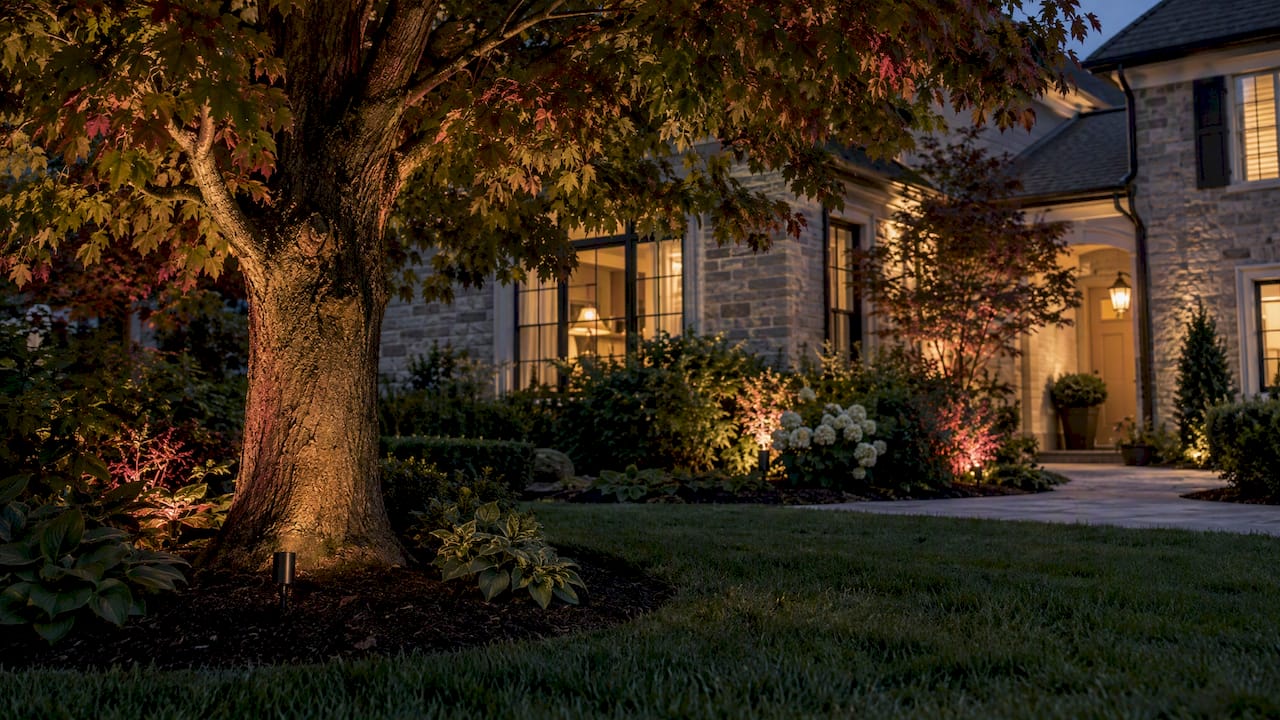
The best color changing landscape lighting ideas start with a warm white base and add color in a few chosen places: a tree, a front wall, a patio, a water feature. Color is then a setting you change from your phone, not a fixture you replace. Done well, the same system gives you a calm everyday look, a party mode, and holiday scenes without a ladder.
This guide covers where to put color-changing fixtures, which colors suit which jobs, how to program seasonal scenes, and what to check so the result is durable and comfortable to look at.
TL;DR
- Use warm white as your everyday default and treat color as an accent on one or two focal points, not on the whole yard.
- Pick RGBW fixtures when you want both color and clean, natural whites. Match each fixture’s weather rating to where it sits.
- Highlight trees, house walls, steps, patios and water features separately so you can control them in zones and scenes.
- Save the bold colors for holidays and events. Build them as scenes in an app and schedule them to run on their own.
- Check HOA and neighborhood expectations before you pick a color palette, and keep light shielded to avoid glare.
Table of Contents
- Why color changing lighting beats fixed-color fixtures
- Where to place color changing lights
- Ten color changing landscape lighting ideas
- Which colors do what
- Choosing fixtures and controls
- Holiday and seasonal scenes, without the ladder
- Comfort, glare and neighbors
- Our perspective: color is a tool, not the design
- Plan your color changing lighting with Forever Glow
- Before you hire: a short checklist
- FAQ
- Sources
Why color changing lighting beats fixed-color fixtures
A single-color fixture commits you to one mood. A color-changing fixture lets one installation do several jobs: soft white for dinner on the patio, green and red in December, orange for Halloween, red, white and blue for patriotic holidays. Color-changing landscape lighting is described as a permanent answer for holidays, events and year-round use, and that matches what we see on Charlotte-area homes: owners who go with color rarely want to give up the white setting, so they want both in the same fixture.
The tradeoff is design discipline. More color options make it easy to overdo. We cover that below, because it is the most common reason a color-changing yard ends up looking busy instead of polished.
Where to place color changing lights
Placement matters more than the color itself. A well-aimed fixture in a modest color looks better than a bright wash from the wrong angle. Professional guides generally describe a mix of techniques: uplighting from ground level, downlighting from high in trees or structures, path lights, spotlights and wash lights. Here is how those apply to color.
Trees
Trees are the best place to start. Uplighting a mature oak, maple or crape myrtle from the base adds height and texture. Use a neutral or warm tone on the trunk and canopy for everyday viewing, and keep color for scenes. If you want a softer, moonlit look, mount a fixture high in the tree and aim it down. Color works well here for seasonal changes: a cool blue or green on a canopy in summer, amber in fall.
Two practical tips. Aim fixtures so the beam stays on the tree and does not shine into neighbors’ windows. And light the two or three best trees rather than every tree on the lot.
Pathways and walkways
Path lights should be low-output and comfortable. Guidance for walkway fixtures is to use smooth dimming and slow transitions so the light is never harsh or distracting at eye level. Fixtures are commonly 12 to 24 inches tall and staggered 6 to 8 feet apart. For paths, we recommend white or very soft warm tones by default. Color on a walkway is best kept to a party scene, not a nightly setting, since you want people to see steps and edges clearly.
Patios, decks and steps
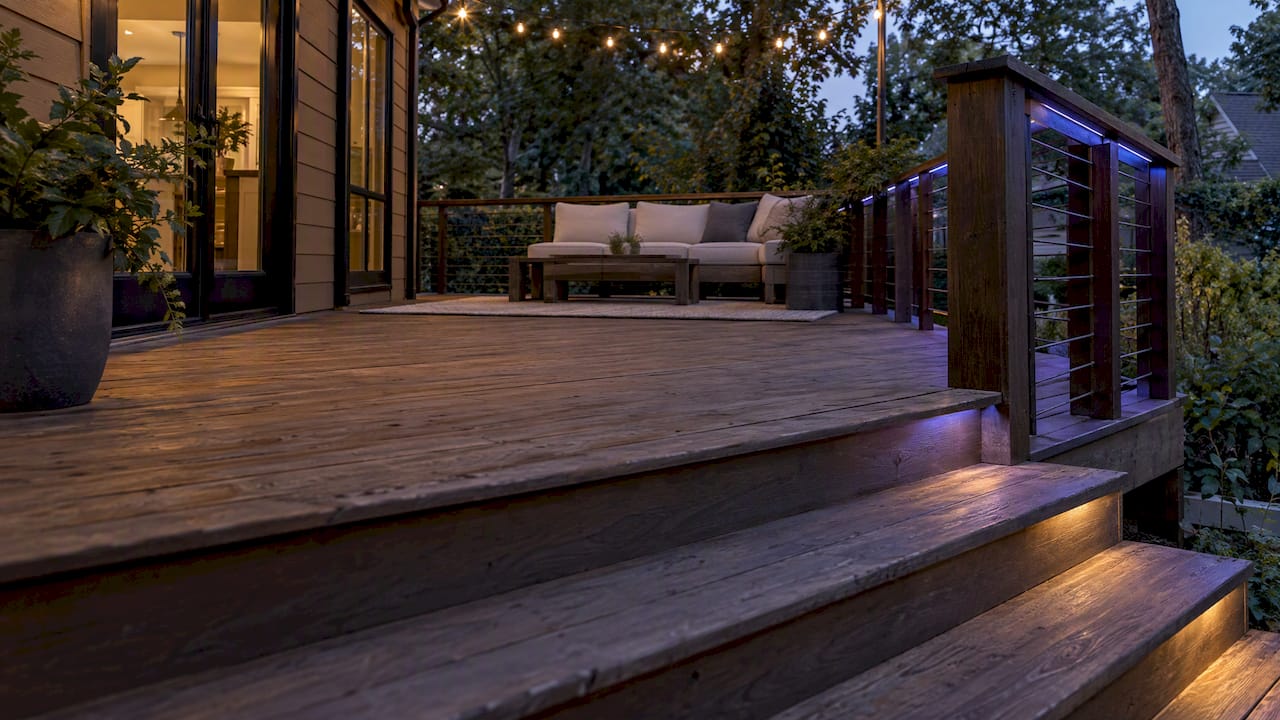
This is where color earns its keep. Under-rail and step lights in soft color give a deck a finished look, and string or bistro lighting overhead sets the mood. Keep the output low near seating so no one is looking straight into a bright diode. If you entertain, plan one scene for dinner (warm and dim), one for gatherings (richer color, brighter), and one for late evening (very low). Our Deck & Step Lighting and patio lighting pages show the fixtures we install for these spaces, and our guide to outdoor lighting for entertaining spaces goes deeper on layout.
Water features and docks
Water and color pair naturally. Blue or teal near a fountain, pond or waterfall reads as calm; submerged fixtures need the right protection. Match the fixture’s ingress rating to its location: IP68 is the rating to look for on anything submerged. For lake homes around Charlotte, marine-grade dock and waterfront lighting is a separate category of hardware, which we cover on our Dock & Waterfront page.
House walls, rooflines and architectural details
Brick, stone, columns, gables and rooflines take color well because they are large, uniform surfaces. Washing a wall in a soft color or grazing light up a stone column adds depth. Under-eave systems are another route: American Lighting’s Spektrum+ Twilight Trim uses discreet under-eave modules with RGBW control and smooth 0 to 100% dimming for architectural accents. Our own approach on rooflines is a track that is nearly invisible by day and carries the colors at night; see our architectural lighting service and the guide to exterior architectural lighting ideas.
Ten color changing landscape lighting ideas
- Warm white base, one color accent. Leave the yard warm white and put color on a single tree or the front elevation.
- Cool blue on water features. Blue or aqua around a fountain or pond for a restful look.
- Amber and orange for fall. Warm tones on trees and brick during October and November.
- Seasonal holiday scenes. Green and red for Christmas, purple and orange for Halloween, red, white and blue for summer holidays.
- Team colors for game days. Save a Panthers-style scene for the weekend and switch back on Monday.
- Slow color-cycle on the back patio. A gentle fade between a few related tones for parties.
- Colored steps with white paths. Color on risers and rails, clean white on the walking surface.
- Gable and roofline accents. Track lighting along the roofline in white for everyday use and color for events.
- Pergola or arbor downlighting. Warm white from above, color washing the posts below.
- Zone-based scenes. Trees, walkways and front elevation on separate zones so you can change one without the others.
The last idea is more important than it sounds. Some systems let you control up to 250 separate zones over the same low-voltage cable, so trees, walkways and the front of the house can each have their own color and brightness. Zoning is what turns a yard of colored lights into a designed scene.
Which colors do what
Color choice follows a few reliable rules from landscape design. Warm colors such as red, orange and yellow advance visually and feel active, while cool colors such as blue and green recede and feel restful. That gives you a simple toolkit:
| Goal | Color direction | Where it works |
|---|---|---|
| Calm, relaxed evening | Soft blue, green, warm white | Patios, water features, back canopy trees |
| Energy, entertaining | Amber, orange, red | Decks, entertaining zones, brick walls |
| Welcoming everyday look | Warm white (2700K) | Front entry, paths, steps |
| Holiday | Green and red; purple and orange; red, white and blue | Rooflines, trees, facade |
| Seasonal shift | Amber in fall, cool tones in summer | Canopy trees, stone and brick |
Keep a base and an accent
One academic review suggests pairing large areas of harmonious base colors with small-area contrast accents to improve spatial legibility and prevent visual fatigue. The same review notes that adding more colors without a coherent order can lower how people rate a scene. In practice: pick one base tone for the whole yard and one or two accent colors, and resist the rainbow.
Match the plants and exterior
Your lighting color should work with what is already there. The design principles that govern plantings also apply at night: green foliage against red brick in summer, or berries creating an analogous scheme in fall. If you are choosing siding or paint, it helps to think about the exterior palette at the same time; this siding color trends test is a useful way to check how a color reads on a facade before you light it.
Choosing fixtures and controls
RGB or RGBW
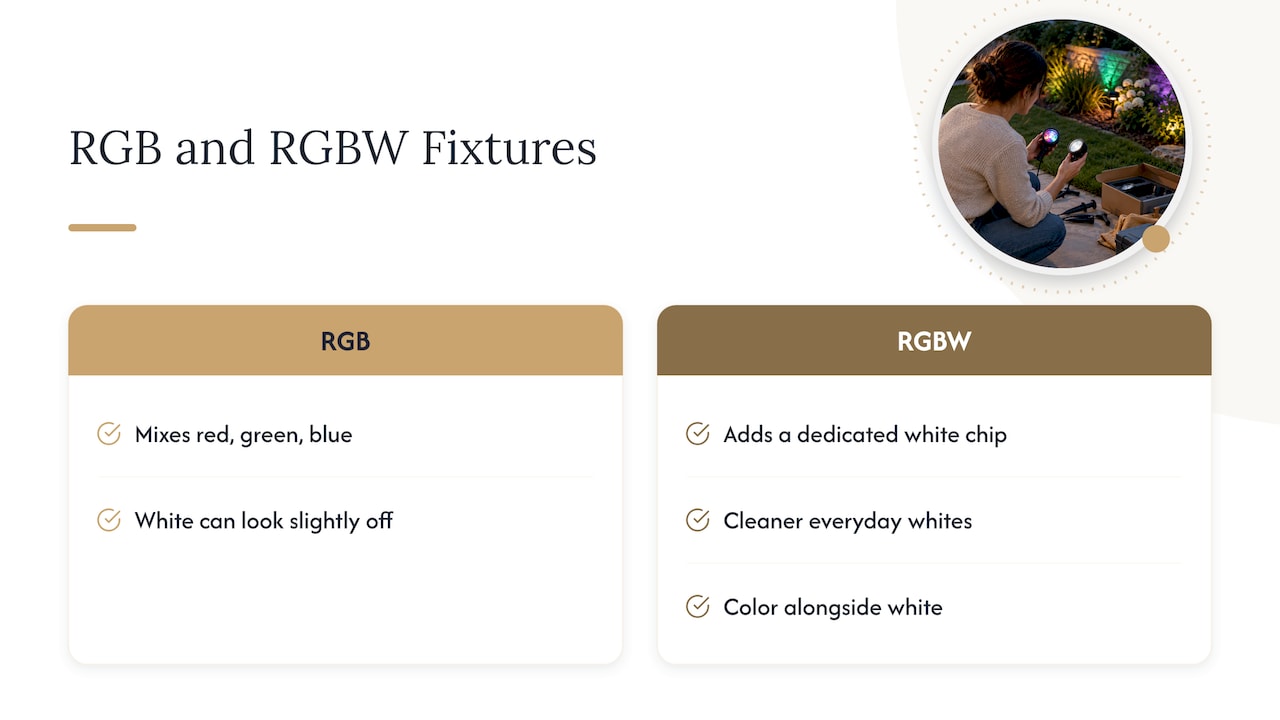
Basic RGB fixtures mix red, green and blue to make white, and the white often looks slightly off. RGBW fixtures add a dedicated white chip, giving cleaner, more natural whites for everyday use alongside color. If your yard will be white most nights, RGBW is the better choice. We explain the difference in more detail in How RGBW Lighting Works Outdoors.
Dimming and color temperature
Dimming is not optional. It is what keeps color from looking harsh. For a sense of what good controls offer, Alliance’s bt fixtures support 1 to 100% dimming, adjustable color temperature from 2700K to 4000K, and RGB color, with an app for grouping fixtures, creating scenes and adjusting color-cycle times. Whatever brand you use, ask whether it can dim down to a low level and whether color cycles can be slowed.
App control and security
Most modern systems run from a phone. Scenes let you adjust fixture color and dimming for activities, moods or events. Ask whether the system can be locked down; Alliance’s app, for example, can create secured networks to keep unauthorized users out. Our smart landscape lighting app control guide covers what to expect day to day.
Low voltage is the usual route
For landscape fixtures, low-voltage wiring is the standard approach because it is safer to work with and flexible for future changes. See why low voltage landscape lighting is the smart choice.
Holiday and seasonal scenes, without the ladder
The strongest argument for color-changing lighting in Charlotte is the calendar. One installation covers Christmas, Halloween, Fourth of July, game days and a plain warm-white evening. Build each as a saved scene, then schedule them so they switch on and off automatically. Our guides to seasonal lighting automation and landscape lighting seasonal adjustments explain how to set that up, and why permanent holiday lights beat seasonal ones lays out the case for roofline systems.
A few scene-building habits that work well:
- Name scenes by occasion, not by color, so anyone in the household can find them.
- Keep holiday scenes to two or three colors.
- Set a default white scene as the fallback, so the yard looks right if a schedule is interrupted.
- Re-check plantings each season. Trees leaf out and fixtures that were clear in winter can be partly blocked by summer.
Comfort, glare and neighbors
Color changing lights can irritate if they are too bright or poorly aimed. Shield fixtures and aim them at the feature, not outward. Research on outdoor lighting guidelines treats shielding luminaires as critical for reducing widespread glare. Our post on how outdoor lighting reduces glare without losing curb appeal gives practical fixes.
If you live in an HOA, read the covenants before you commit to a palette. Some communities limit color or require shielded fixtures; we design systems to meet HOA and municipal requirements, but you should confirm your own community’s rules. Subtle, shielded, white-by-default designs are the easiest to approve.
Our perspective: color is a tool, not the design
We install permanent lighting across the Charlotte area, and the most common mistake we see is starting with the color instead of the layout. A yard needs layers first: path and step lights for safe movement, accent lighting on the features worth seeing, and soft light where people gather. Color is added on top of that, in the places where it helps.
Our advice is simple. Have the system installed so it looks right in white. Then use color for a few well-chosen moments: holidays, parties, a seasonal change on the front elevation. If a design only looks good in color, it is not finished. And choose hardware built for the Carolinas: humidity, summer storms and occasional ice are real conditions, which is why we focus on commercial-grade, weather-engineered components and a maintenance plan. For more on layering, read our landscape lighting layering techniques.
— Dave
Plan your color changing lighting with Forever Glow
If you want a system designed once and used all year, our Landscape Lighting Design service covers layout, fixtures, smart controls and installation, and our permanent holiday lighting gives you roofline color for every season. We offer a free estimate and a GlowCare maintenance subscription to keep the system running. Contact us to start.
Before you hire: a short checklist
- Does the plan show zones, so trees, paths and the facade can be controlled separately?
- Are fixtures RGBW, with a dependable warm white?
- Is every fixture rated for its location, including IP68 where submerged?
- Can you dim to a low level and slow the transitions?
- Is there a warranty and a maintenance plan that covers local weather?
- Is the design shielded and HOA-ready?
For broader inspiration, our landscape lighting for curb appeal ideas and the homeowner’s landscape lighting guide are good next reads.
FAQ
Can color changing landscape lights be dimmed?
Yes, on quality systems. Fixtures such as Alliance’s bt line dim from 1 to 100%, and smooth dimming is worth asking about for any brand. It keeps color from looking harsh and lets you set a very low level near seating and paths.
What colors are best for landscape lighting?
Warm white is the best everyday choice. Add blue or green for a restful look near water and seating, and amber or red for warmth on brick and decks. Keep bold colors for holidays and events.
What is the difference between RGB and RGBW?
RGB mixes three colors to approximate white. RGBW adds a dedicated white chip, so everyday whites look cleaner and more natural. For a yard that is white most of the time, RGBW is the better fit.
Do color changing lights work for holidays?
Yes. You can program green and red for Christmas, purple and orange for Halloween, and red, white and blue for patriotic holidays, then schedule them to run automatically. That is the main reason many Charlotte homeowners choose them over seasonal strings.
Sources
- Color-Changing Landscape Lighting | VOLT Lighting
- Landscape Lighting Guide: Planning, Placement, and Installation
- How to Choose Color Changing Landscape Lighting
- Spektrum+ Twilight Trim: Stylish HOA-Friendly Home Lighting
- Best Landscape Lighting Brands | Lawn Panther
- Basic Principles of Landscape Design
- Review on Psychological and Behavioral Impact of Landscape Color
- Alliance bt How-to Guide
- Alliance BT System Training Handbook
- Guidelines for Outdoor Lighting (RASC)
- 7 Step Test for Siding Color Trends