
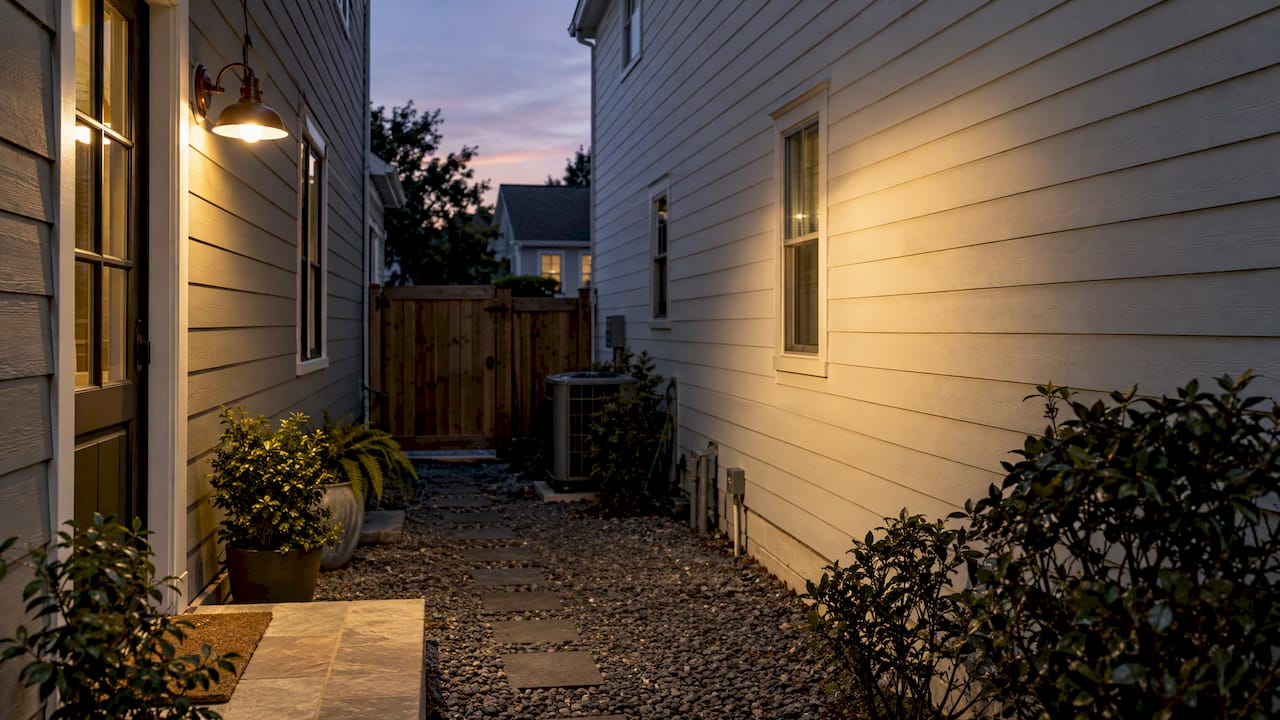
There is no single federal law on light trespass in the United States. The rules come from city and county ordinances, a few state statutes and general nuisance law, so what is allowed on your street can differ from what is allowed 20 miles away. The practical answer is the same almost everywhere: aim light down, shield the source, keep it at a modest brightness and keep it on your own property.
This guide explains what light trespass is, where the rules actually come from, what typical limits look like, how Charlotte, North Carolina handles it, and what to do whether you are the one installing lights or the one receiving them.
TL;DR
- Light trespass is light that falls where it is not wanted or needed, such as a floodlight shining into a neighbor’s bedroom window.
- US rules are local. Cities and counties set the limits, often measured in foot-candles at the property line, and the numbers vary by jurisdiction.
- Charlotte’s zoning ordinance requires outdoor lighting to be shielded and directed so it does not cast glare or direct light onto neighboring properties.
- Fully shielded, downward-aimed, warm-toned fixtures with controls solve most problems before a neighbor ever complains.
- Check your own city or county code and any HOA rules before you install.
Table of Contents
- What light trespass means
- Where the rules actually come from
- What typical limits look like
- How Charlotte, NC handles it
- Why brighter is not safer
- Our perspective
- If you are the one installing lights
- If a neighbor’s light is bothering you
- Permanent lighting and trespass
- Planning compliant lighting in Charlotte
- FAQ
- Sources
What light trespass means
The Federal Highway Administration’s lighting handbook describes light trespass, also called obtrusive lighting, as having several related elements. One is spill light, meaning light that falls outside the area you meant to light. Glare and sky glow are the others. In everyday terms, it is the porch floodlight that lights up the house next door, or the landscape fixture aimed so that you see the bulb from the street.
Law and engineering measure it differently. Engineers measure illuminance, in foot-candles or lux, at a boundary. A court or code officer asks something simpler: is the light causing a nuisance or breaking a written standard?
Three features of the problem matter for homeowners:
- Direction. Light aimed outward or upward travels farther than light aimed down.
- Visibility of the source. An exposed bulb causes glare even at a low total output.
- Duration. A light that stays on all night bothers neighbors more than one that comes on when someone walks by.
Where the rules actually come from
Because no national statute exists, expect four layers.
Local ordinances
This is where almost all enforceable rules live. Many towns have an outdoor lighting chapter in their zoning or development code. A model many communities borrow from is DarkSky International’s municipal ordinance template, which opens by requiring outdoor luminaires to comply with federal and state law and with county or municipal codes.
State statutes
States rarely regulate residential light spill directly. North Carolina’s G.S. 136-32.2 is a good example of what they do regulate: lights that blind or distract motorists on public highways. Enforcement runs through a notice period for the owner to fix the problem before a warrant for a Class 3 misdemeanor can be sought. It is a road-safety law, not a neighbor-dispute law.
Nuisance law
Where no ordinance covers your situation, a neighbor may still argue that your lighting is a private nuisance. That is a civil claim, slow and costly for everyone, and outcomes depend on the state and the facts. If you are in this position, talk to a local real estate or property attorney. Nothing in this article is legal advice.
HOA covenants
Homeowners associations often add their own limits on fixture type, color and brightness. These bind you by contract, whatever the city allows. If you live in an HOA, read the architectural guidelines before you order anything.
What typical limits look like
Most ordinances do one or more of the following:
- Require full cutoff or fully shielded fixtures, so no light is emitted above the horizontal.
- Set a maximum illuminance at the property line, in foot-candles.
- Cap brightness or color temperature, often in warm tones.
- Require timers, dimming or motion sensors for some uses.
The numbers differ widely. San Bernardino County, California uses a maximum of 0.5 foot-candle at the line of an adjacent residential property in its valley region and a stricter 0.1 foot-candle in its mountain and desert regions. A town in South Carolina, Travelers Rest, has its own outdoor lighting chapter with its own standards. Neither number is a national rule. They show why you must read your own code.
The DarkSky assessment guide describes fully shielded as emitting no light above a 90-degree angle, the baseline that most modern ordinances build on.
The Illuminating Engineering Society takes a measured view of this trend. Its position statement on lighting legislation favors rules built around controllable design factors such as shielding and appropriate intensity, not blanket bans. That matches what we see in good ordinances: they regulate how light is delivered, not whether you may light your home.
How Charlotte, NC handles it
Charlotte’s zoning ordinance requires outdoor lighting to be designed, located, shielded and directed so it does not cast glare or direct light onto surrounding properties and rights-of-way. Its definitions call for no light emitted at or above the horizontal plane and limited intensity at near-horizontal angles.
For a homeowner in Charlotte, Mecklenburg County or nearby towns, that means:
- Fixtures should be fully shielded, with the light source hidden from neighbors and the street.
- Floodlights aimed at a wall or lawn should point down, not out toward the lot line.
- Roofline and accent lighting should be placed and aimed so it stays on your own structure.
Neighboring towns such as Huntersville, Matthews or Denver may have their own chapters, so confirm with the planning office that covers your address. If you are in an HOA, add its guidelines on top.
Why brighter is not safer
Many homeowners assume more light means more security. The reverse can be true. DarkSky International points out that excessive, unshielded light creates glare that reduces visibility for people and cameras alike. A bare floodlight in your eyes makes the area beyond it harder to see, and it can leave deep shadows that hide movement.
Security lighting works better when it is consistent and balanced:
- Even coverage of doors, walkways and driveways, with no harsh hot spots.
- Motion sensors on the areas where a sudden change should be noticed.
- Warm color tones that are easier on the eyes and less intrusive next door.
- Camera-friendly placement, with light aimed at the scene and away from the lens.
The Department of Energy’s lighting guidance summarizes the Five Principles for Responsible Outdoor Lighting: lighting should be useful, targeted, low-level, controlled and warm-colored. If your design follows those five words, you are very unlikely to cause trespass.
We cover the brightness side in more detail in our landscape lighting brightness guide and the glare side in how outdoor lighting reduces glare.
Our perspective
We install permanent outdoor lighting around Charlotte, and light trespass is a design question we raise before any fixture goes up. Our systems rely on smart LED tracks and low-profile accent fixtures that sit on the roofline or in the landscape, and we design them to meet strict HOA and municipal requirements.
Here is how we think about it:
- Aim before output. A well-aimed, modest light does more than a powerful one pointed in the wrong direction.
- Control is the safeguard. Because our systems run from a smartphone, brightness, color and schedules can be adjusted after installation. If a neighbor mentions glare, the fix is often a setting, not a ladder.
- Color and timing matter. Bright multicolor holiday scenes belong on a schedule. Warm white suits late-evening hours.
- Check the code first. Compliance is part of design, not an afterthought, especially for HOA communities and commercial properties.
The best lighting is the kind your neighbors never have to think about.
— Dave
If you are the one installing lights
Use this checklist before you buy or hire.
- Find your code. Search your city or county’s municipal code for “outdoor lighting” and read the definitions of shielding and any property-line limits. Ask the planning department if the wording is unclear.
- Read HOA rules. Look for limits on color, brightness, hours and fixture visibility.
- Choose shielded fixtures. Look for full cutoff or fully shielded ratings, as the FHWA handbook notes that cut-off optics are central to limiting trespass.
- Aim and test at night. Walk your property line after dark. Stand where the neighbor’s windows are and look back at your fixtures. If you see a bulb or a bright patch, adjust it.
- Add controls. Timers, dimming and motion sensing reduce hours of exposure. Our guide to smart outdoor lighting explains what these controls do.
- Keep the glow low. Low-voltage systems make it easier to use small, directed fixtures. See why low voltage landscape lighting is a practical choice.
If you want a broader lens on reducing impact, our page on night sky friendly lighting covers the same principles in plain terms.
Common mistakes that cause complaints
- Floodlights mounted high and angled outward instead of down.
- Landscape uplights placed near a property line, with the beam passing the fence.
- Holiday or accent colors left on all night.
- Unshielded fixtures replaced with brighter LEDs. LEDs can look much more intense than the bulb they replace.
- Lights installed without a nighttime check from the neighbor’s side.
If a neighbor’s light is bothering you
Start with a conversation, not a threat. According to DarkSky International, neighbors causing trespass are often unaware of it, and offering practical fixes such as shielding, redirecting the light or adding a motion sensor tends to work better than going straight to legal action.
A sensible sequence:
- Document it. Take photos from inside your home at night, with dates.
- Talk to the neighbor. Be specific about which fixture and what time, and suggest a simple fix.
- Offer a screen. Sometimes planting or a fence solves what a fixture adjustment cannot. Ideas on backyard privacy landscaping can help you break the sightline to a light.
- Check the code. If the light appears to violate your city’s ordinance, contact the code enforcement office or your HOA.
- Consult an attorney only if the problem continues, since nuisance claims depend on your state’s law and facts.
If the light is aimed at a public road and blinding drivers, that can touch state law. In North Carolina, G.S. 136-32.2 addresses lights that hamper motorists’ vision, and it involves a notice period before any criminal process.
Permanent lighting and trespass
Permanent roofline lighting raises a fair question: if the lights stay up all year, how do you keep them from bothering anyone? The answer is that a track system is mounted close to the roofline and produces a soft, low-intensity wash directed at your own home, and it can be dimmed, scheduled or switched to a subdued color. Compared with a floodlight on a pole, the light source is small and mostly hidden.
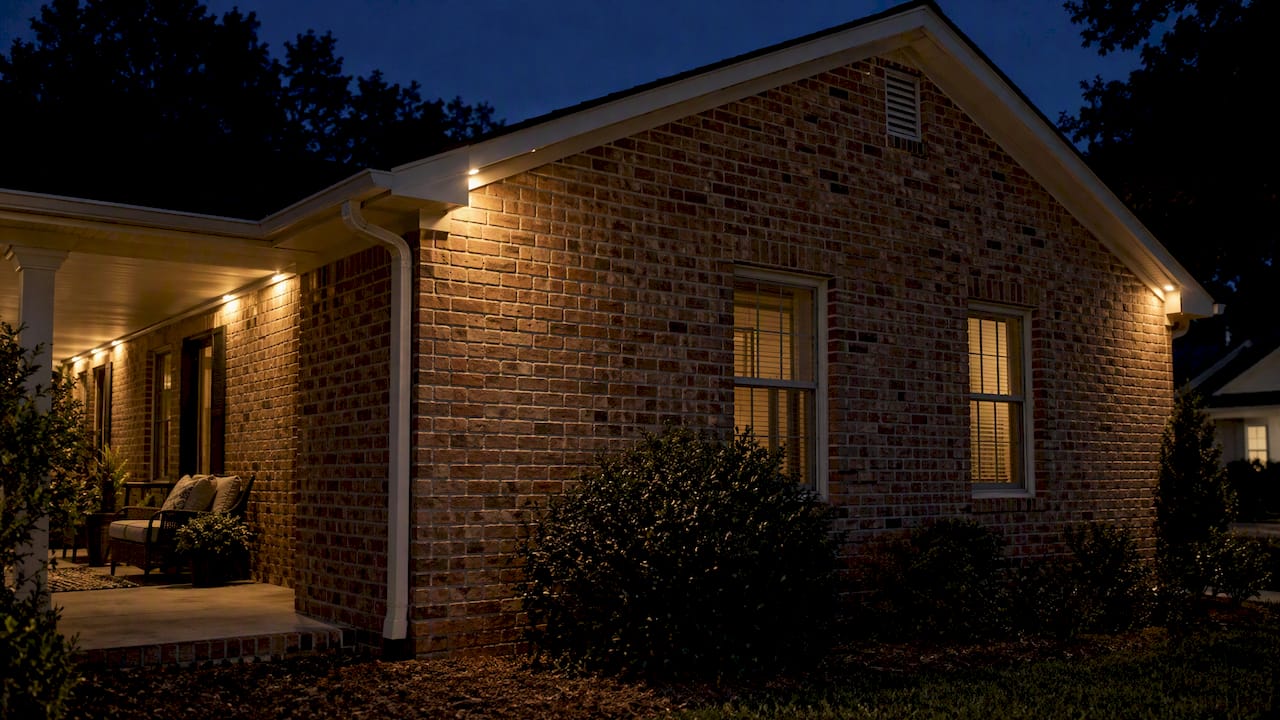
That still needs good design. Intensity at the edge of the lot, color choices and hours of use are what a neighbor notices, and they are all controllable. For safety and code checks after installation, see our permanent Christmas light safety guide. For commercial sites, where codes are often stricter, our commercial building lighting guide is a good starting point.
Planning compliant lighting in Charlotte
If you want lighting that looks good without crossing the line, we design and install permanent roofline, landscape, patio and architectural systems for Charlotte-area homes and businesses, built around HOA and municipal compliance. Our landscape lighting design service starts with how light will fall on your property, including at the edges, and our permanent lighting for the roofline is controlled from your phone. Contact us through our website for a free estimate.
FAQ
What is light trespass?
Light trespass is artificial light that spills onto a property where it is not wanted or needed. Typical examples are a floodlight shining into a neighbor’s window or a bright fixture visible from across the lot line. Engineers often measure it in foot-candles or lux at the boundary.
Is light trespass illegal in the United States?
There is no federal law against it. Legality depends on your city or county ordinance, any HOA rules and, in some cases, state nuisance law. Many local codes require shielded fixtures and set limits at the property line, so check the code for your address.
What are the lighting laws in North Carolina and Charlotte?
State law in North Carolina addresses lights that hamper the vision of motorists on public highways. In Charlotte, the zoning ordinance requires outdoor lighting to be shielded and directed so it does not cast glare or direct light on surrounding properties and rights-of-way. Smaller towns around Charlotte may have their own rules.
How do I measure light trespass?
Ordinances commonly use a light meter held parallel to the ground at the property line, with limits stated in foot-candles. Limits differ by place, for example 0.5 or 0.1 foot-candle in some California regions. Use the method in your local code.
How can I stop my lights from bothering neighbors?
Switch to fully shielded fixtures, aim them down, lower the brightness, choose warm tones and add timers or motion sensors. Then check from your neighbor’s side of the line after dark. Smart-controlled systems make these adjustments easy.
Sources
- FHWA Lighting Handbook, 5 Considerations Concerning Lighting Systems
- DarkSky International, My neighbor’s lighting: What can I do?
- City of Charlotte Zoning Ordinance
- North Carolina G.S. 136-32.2
- San Bernardino County Outdoor Lighting Regulations
- Travelers Rest, SC Standards for Outdoor Lighting
- DarkSky Outdoor Lighting Municipal Ordinance Template
- DarkSky Assessment Guide
- IES Position on Legislation and Ordinances for Outdoor Light at Night
- U.S. Department of Energy, Five Principles for Responsible Outdoor Lighting