
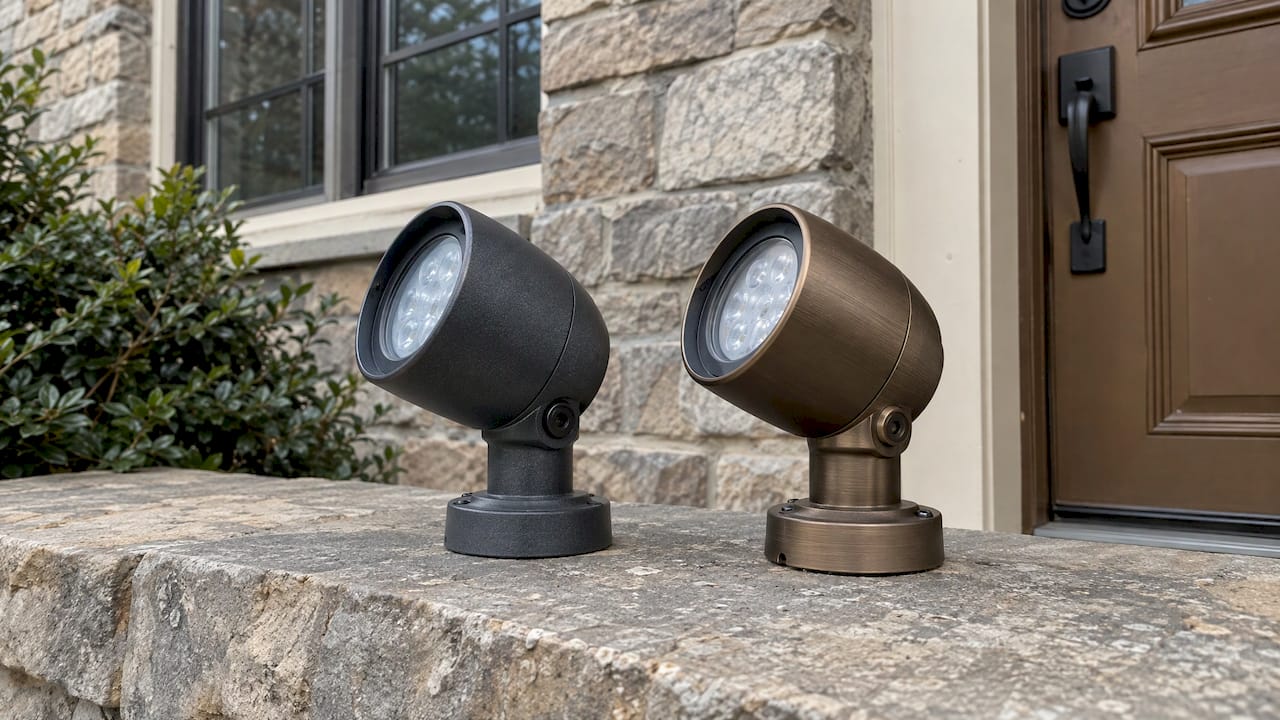
Anodizing grows a hard oxide layer out of the aluminum itself. Powder coating bakes a thicker polymer film onto the surface. Anodizing is the stronger choice against UV and scratching, and it keeps a metallic look. Powder coating gives you nearly any color and a lower cost, and it is the common choice for North American LED housings. Which one is right depends on the metal underneath, the color you need and how harsh the setting is.
This guide is for homeowners and property managers choosing outdoor lighting: roofline tracks, path fixtures, wall washers, dock lights. It explains what each finish is, where each performs best and how to match a finish to your property.
TL;DR
- Anodizing is an electrochemical process that turns the aluminum surface into a hard oxide. It works on aluminum (and a few other non-ferrous metals), not on steel.
- Powder coating is a baked-on polymer film. It works on steel, stainless and aluminum and comes in almost any color and texture.
- Sun and abrasion: anodized layers are inherently UV-stable and harder. Powder coat is organic, so some color or gloss shift over many years of strong sun is expected.
- Salt and moisture: published test results differ by method and coating system, so the quality of pretreatment, sealing and installation matters as much as the finish name.
- Color-critical or budget-conscious projects usually lean powder coat. Maximum permanence and a metallic look usually lean anodized.
Table of Contents
- How each finish is made
- Powder coated vs. anodized at a glance
- Which metals take which finish
- How they hold up outdoors
- Powder-coated steel vs. stainless steel
- Choosing a finish for your project
- Caring for either finish
- Our perspective on finishes
- Plan your lighting with a Charlotte team
- FAQ
- Sources
How each finish is made
The two finishes are made in completely different ways, and that explains almost every difference you will see on a fixture years later.
Anodizing: the finish grows from the metal
In anodizing, the aluminum part becomes the anode in an acid bath, and an oxide layer grows from the aluminum itself. After cleaning and etching, the process builds a porous aluminum-oxide structure partly into and partly above the original surface. Because the finish is part of the metal, it cannot peel the way a paint film can.
The layer is thin. Typical anodized films run 5 to 25 micrometers, so the part keeps its precise dimensions and its metallic look. The tradeoff is color: the palette is limited compared with paint.
Powder coating: a baked polymer film
Powder coating is a paint process. After chemical pretreatment, dry powder is sprayed electrostatically onto the part and cured in an oven into a continuous film that sits on top of the metal. The film is much thicker, around 60 to 120 micrometers, which hides surface marks and allows virtually any color and texture. Its weak point is that a thick film can chip if it is struck.
Powder coated vs. anodized at a glance
| Factor | Anodized | Powder coated |
|---|---|---|
| How it is made | Electrochemical, grows from the aluminum | Electrostatic spray, oven-cured polymer film |
| Typical thickness | 5–25 µm | 60–120 µm |
| Metals | Aluminum, plus titanium and magnesium | Steel, stainless, aluminum and more |
| Color range | Limited, metallic look | Nearly unlimited colors and textures |
| Peeling or flaking | Cannot peel, integral to the metal | Can chip if struck |
| UV behavior | Inorganic, inherently UV-stable | Organic polymer, gradual color or gloss shift possible |
| Upfront cost | Higher | Lower |
The thickness, metal and color rows are drawn from CharMax’s comparison and Metal Supermarkets. For LED housings specifically, one manufacturer puts the anodizing cost at roughly 1.15 to 1.30 times powder coat.
Which metals take which finish
This is often the deciding factor before durability even comes up.
Anodizing is limited to aluminum and its alloys for practical purposes, with titanium and magnesium as the other candidates. Steel and stainless steel cannot be anodized.
Powder coating is far more flexible. All the common industrial metals, including steel, stainless steel and aluminum, can be powder coated. The main limit is that the part must withstand the curing heat, which Metal Supermarkets puts at about 400°F.
The practical takeaway: if a fixture is steel, the question is not powder coat versus anodized. It is powder coat versus a naturally corrosion-resistant metal such as stainless, covered below. If it is aluminum, you have a real choice.
Alloy matters for anodizing
Not every aluminum anodizes the same. A380, the most common die-cast LED housing alloy, anodizes to a darker, less uniform appearance than wrought alloys like 6061 or 6063 because of its silicon content. If you need a clean, even anodized look across many fixtures, the alloy has to be right. Powder coat does not have this limitation, which is one reason it dominates cast housings.
How they hold up outdoors
Sun and UV
This is anodizing’s clearest advantage. The inorganic oxide layer does not contain the chromophores that break down in sunlight, so fading or chalking is highly unlikely. Powder coats are organic polymers, and the same source notes that after 15 to 20 years in direct southern sun, some color shift or gloss reduction is likely. SAF makes the same point more bluntly: anodizing is unaffected by sunlight, while organic coatings eventually degrade under UV.
Quality powder coats are engineered to resist this. Architectural-grade systems must pass long weathering tests; one spec guide describes the AAMA 2605 standard as requiring a minimum five-year South Florida exposure with limited gloss and color change. A fixture finished to a recognized standard will behave very differently from one with a thin, unspecified coat.
Scratches and abrasion
Anodized aluminum is much harder. One lab comparison lists 6H pencil hardness for anodized versus 2H for powder coat. SAF notes anodizing suits high-traffic areas where the coating faces physical abuse and abrasive cleaners. For wall-mounted fixtures near walkways, garage doors or lawn equipment, that matters.
The other side: anodized films are more brittle, so they are more susceptible to cracking from thermal stress. Powder coat flexes more but can chip, and a chip on steel is where trouble starts.
Salt, humidity and corrosion
Salt-spray test numbers vary widely depending on who ran the test and what coating system was used. In ASTM B117 salt fog testing meant to mimic coastal Hawaii and Florida, one pole manufacturer reported that an anodized coating began to fail in under 500 hours while powder coat showed no wear until 2,500 hours. A different lab comparison of specific systems found 1,000 hours for anodized versus 1,500 hours for powder coat. For LED housings, a manufacturer lists 300 to 600 hours for unsealed Type II anodizing and 600 to 1,000+ hours when sealed.
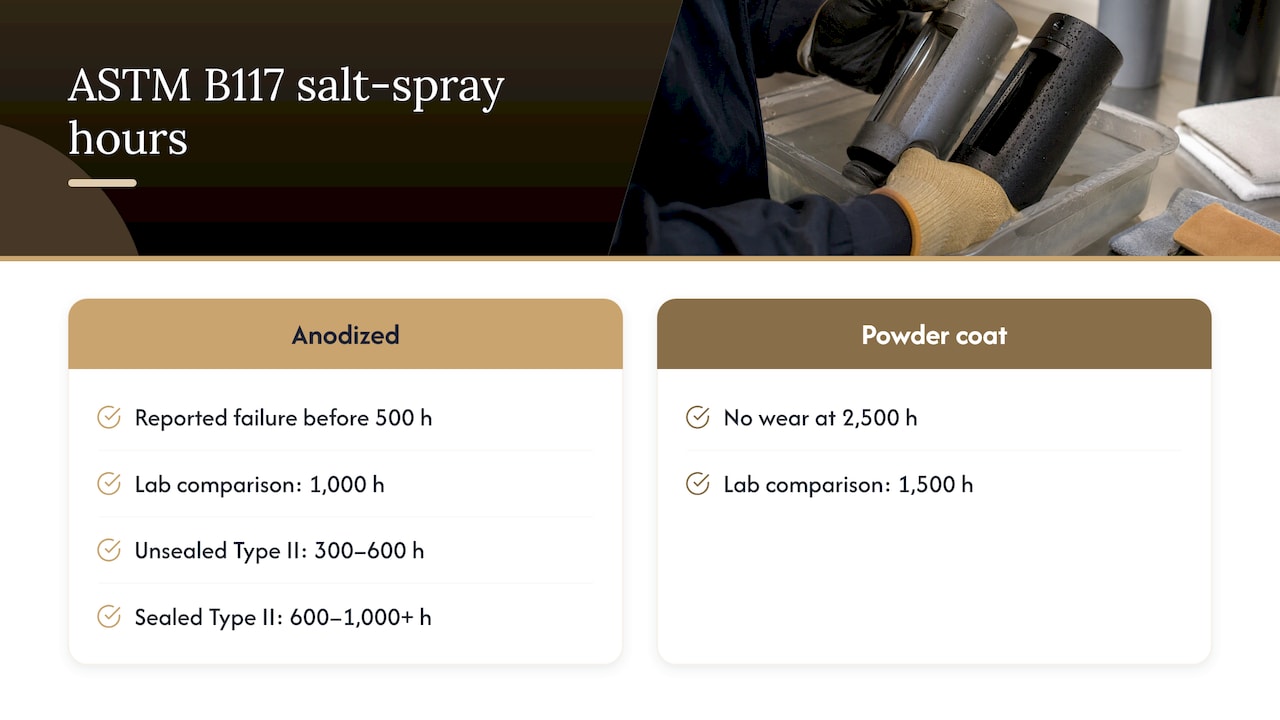
The consistent lesson is that execution beats the label. The BRANZ building research bulletin makes this point for anodizing: a well-sealed 10 µm film resists better than a poorly sealed 25 µm film. The same logic applies to powder coat pretreatment and cure. If your property sits near a lake dock or saltwater, read our guide on what to demand from any fixture in coastal conditions.
Powder-coated steel vs. stainless steel
People searching this comparison often have a different question: not aluminum finishes, but whether to buy coated steel or stainless.
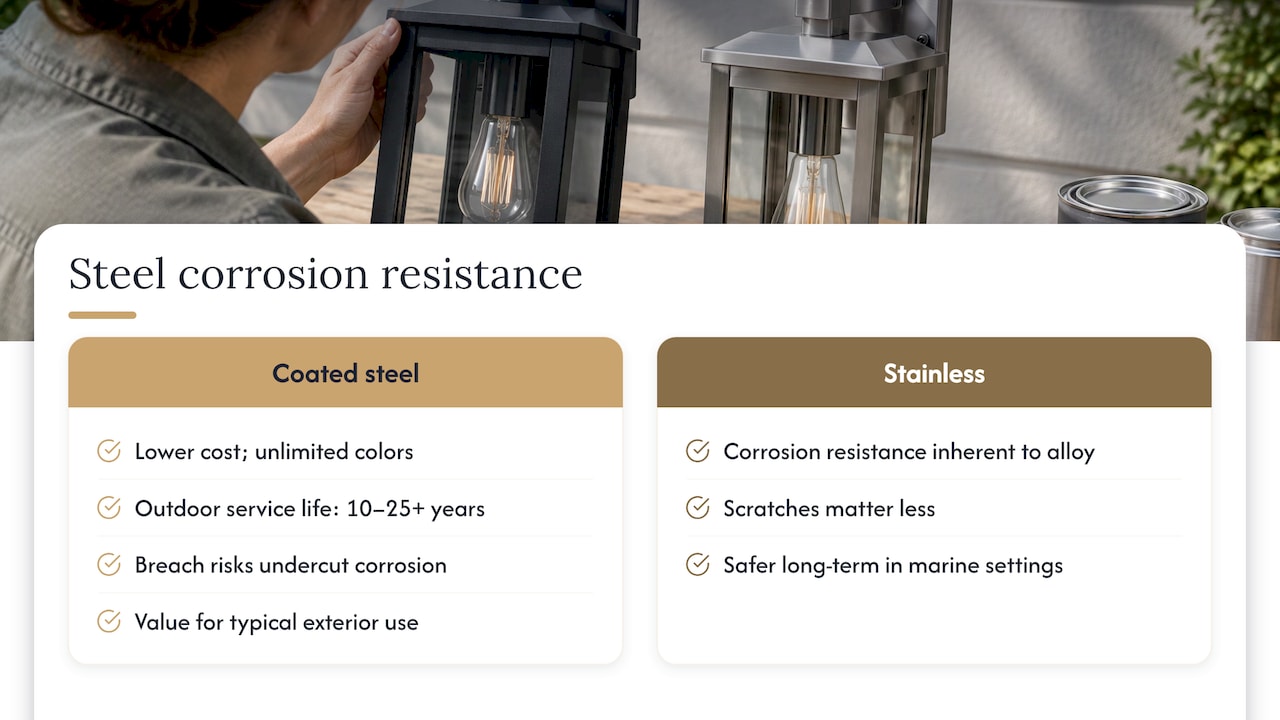
Powder-coated steel costs less and offers unlimited colors, but its protection depends on the coating. Powder-coated carbon steel has an outdoor service life of 10 to 25+ years depending on system and environment, and is vulnerable to undercut corrosion where the coating is breached. Stainless steel’s corrosion resistance is inherent to the alloy, so scratches matter less. The same source suggests stainless is the safer long-term pick for corrosive settings such as marine environments, and coated carbon steel is excellent value for typical exterior architectural uses where budget and color matter.
In short, anodized versus powder coat is a choice about a surface layer on aluminum. Coated steel versus stainless is a choice about whether you want corrosion resistance to come from a coating or from the metal.
Choosing a finish for your project
Use these criteria rather than a blanket rule.
Lean anodized when:
- Long-term permanence and a metallic, non-plastic look are the priority, with harsh environments, high-touch areas or a budget that allows a premium finish.
- The part is aluminum and will be handled, cleaned often or brushed against.
- You want the finish to hold its look under strong UV for decades.
Lean powder coat when:
- You need a specific RAL or Pantone color match, complex color schemes or a uniform color across different materials.
- The hardware includes steel or mixed metals.
- The budget is tighter and exposure is moderate.
For reference, one manufacturer serving North America says the recommended treatment for LED housings there is TGIC polyester powder coat, most often in black, white or gray. That reflects how common powder coat is on fixtures sold in the US.
Matching color to the building
For roofline and architectural installations, color matching is often what homeowners and HOAs care about most. A track that disappears against your fascia or soffit is a color-matching exercise, and powder coat’s range makes that straightforward. You can see more about how color choices work in our outdoor lighting color wheel guide, and for placement ideas see our exterior accent lighting ideas.
The finish is only part of the story. The LED source may last 50,000 hours, but a chalky or scratched profile will spoil the installation long before the diodes dim. A finish specified by standard, rather than described loosely, is what keeps the result looking right.
Caring for either finish
Both finishes last longer with simple cleaning. BRANZ gives reasonable minimum cleaning intervals for anodized and powder-coated aluminum: every six months in rural or unpolluted urban areas and every three months in polluted urban, industrial or marine settings. It also says coated aluminum should never be cleaned with abrasive compounds or solvent-based cleaners.
For powder-coated hardware, a lighting-industry white paper recommends yearly inspection for fading, chalking, cracking and peeling, and notes that field touch-ups need care because of color matching.
A few habits that help on any home:
- Rinse with fresh water and a soft cloth. Skip scouring pads and harsh solvents.
- Look for chips or scratches at fixture edges and mounting points, where moisture gets in first.
- Keep sprinklers from soaking fixtures every day.
- Log what you check and when.
Our roofline track cleaning guide, the 10-check roofline maintenance routine and the outdoor lighting maintenance calendar turn this into a schedule. If you are budgeting for upkeep, see landscape lighting maintenance costs.
Our perspective on finishes
We install permanent lighting across the Charlotte area, so we see how hardware behaves through humid summers, pollen, thunderstorms and the occasional ice event. Our view is that the finish name on a spec sheet is only a starting point.
What matters is the whole system: commercial-grade, climate-optimized hardware, tracks that are color-matched to your roofline, and smart controls that are installed to meet HOA and municipal requirements. That is how we design every project, and it is why we back our work with a climate-specific warranty and the GlowCare maintenance program.
If you are weighing finishes for your own property, think about three things: the metal underneath, the color the building needs and how close the installation is to water. Answer those and the choice usually becomes obvious. A track that blends into your roofline by day and performs reliably every night is the goal, whichever finish gets it there.
Dave
Plan your lighting with a Charlotte team
If you would rather not sort through finishes, metals and standards yourself, we handle the design and installation. We build smart LED roofline tracks, landscape and architectural lighting, patio and deck lighting and dock lighting, all controlled from your phone, and we design for the Carolinas’ weather and local compliance rules.
See our permanent lighting options and GlowCare maintenance plan or contact Forever Glow Lighting for a free estimate. If your project is a garden or front-of-house design, start with landscape lighting design. For fixtures that touch the water, our dock and waterfront lighting is built with that environment in mind.
FAQ
What is the difference between anodized aluminum and powder-coated aluminum?
Anodized aluminum has an oxide layer grown from the metal, typically 5 to 25 micrometers thick, so it cannot peel and keeps a metallic look. Powder-coated aluminum has a thicker polymer film that allows almost any color but can chip. Anodizing is harder and more UV-stable, and powder coating is more flexible on color and cost.
Which metals can be powder coated?
Steel, stainless steel and aluminum are the common ones, and the main requirement is that the part survives the oven cure, around 400°F. Some suppliers also coat materials like glass or composites. Anodizing, by contrast, is limited to aluminum and its alloys for practical purposes.
Is powder coating or anodizing better for coastal or lakefront properties?
Neither wins on its name alone. Published salt-spray results conflict, and sealing quality, pretreatment and alloy all change the outcome. Pair a well-specified finish with regular rinsing and inspection, and see our coastal corrosion guide for what to look for in fixtures near water.
Can you powder coat over anodized aluminum?
It is possible in some cases, but anodized surfaces generally need proper preparation first, and a shop should confirm the process. Because anodizing adds almost no thickness, it is often chosen for tight-tolerance parts, whereas powder coat adds a noticeable film.
What is the difference between powder-coated steel and stainless steel?
Powder-coated steel depends on its coating for corrosion protection, so a breach can expose bare steel. Stainless steel resists corrosion through its alloy and is less sensitive to scratches. Coated steel costs less and offers more colors, while stainless is often preferred in corrosive or marine settings.
Sources
- CharMax Aluminum: Anodizing vs Powder Coating Aluminum
- Protolabs: Anodizing vs. Powder Coating
- Nova Fabrication: Anodizing vs Powder Coating Aluminum
- Metal Supermarkets: Anodizing vs Powder Coating
- KeystoneKoating: Powder Coating vs. Anodizing
- Lighting Line: Anodized aluminum vs. powder-coated profiles
- Powder Coating Finishes for Steel and Aluminum Light Poles (white paper)
- United Lighting Standards: Powder Coat and Anodized Finish
- SAF: Anodizing, Painting and Powder Coating
- Coboggi: UV Resistance for Outdoor Aluminum Enclosures
- Anerhui: LED Housing Surface Treatments
- BRANZ Bulletin 634: Finishing Aluminium
- Gladiator Window and Doors: Aluminum Door Finishes and Colors
- MWalloys: Powder Coated Steel vs Stainless Steel