
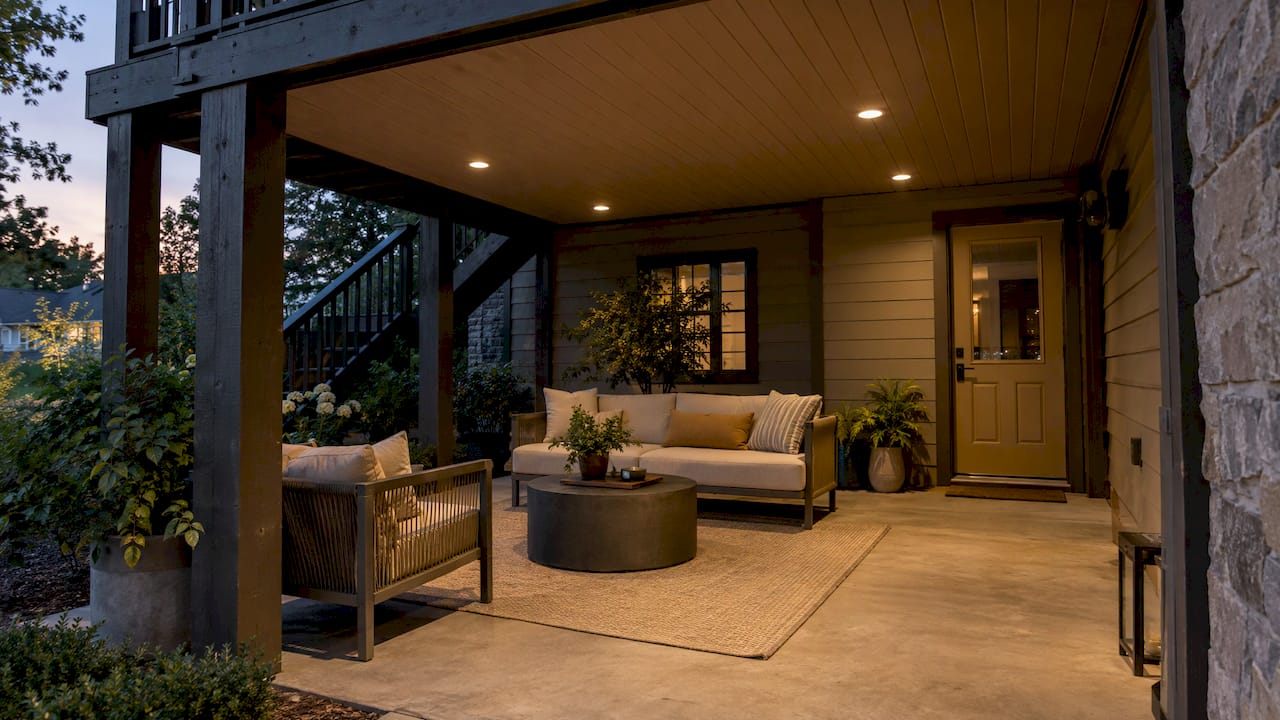
The best under deck lighting makes the space below your deck feel like a finished room: even light at seating height, no glare, and fixtures you only notice when they are off. The ideas below cover recessed ceiling lights, rail strips, string lights, stair lighting and more. They also cover where each one belongs and what a Charlotte homeowner should know about ratings and permits. At Forever Glow Lighting we design and install deck and step lighting as part of full outdoor lighting plans, so the layout, the hardware and the wiring are planned together.
TL;DR
- Recessed downlights in the ceiling of an enclosed under-deck space give the cleanest, most room-like result. Rail strips and string lights suit open decks.
- Hide the light source and aim it down. Glare, not darkness, is the most common reason a deck feels unpleasant at night.
- Choose warm white (2700K to 3000K) and fixtures built for wet exposure, such as IP67-rated lights.
- Light stairs first, then edges and seating, then decorative accents. Put each group on its own switch or dimmer.
- Low-voltage wiring still falls under North Carolina permit rules. In Mecklenburg County, ask Code Enforcement before work starts.
Table of Contents
- What “under deck lighting” actually means
- Seven under deck lighting ideas
- Quick comparison
- Layout rules that prevent glare
- Covered deck or open deck: what changes
- Ratings and electrical details that matter
- Planning the budget
- Perspective
- Have us light your deck
- FAQ
- Sources
What “under deck lighting” actually means
People use the phrase for two different jobs. The first is lighting the dry or semi-dry space beneath an elevated deck, where a ceiling or drainage system turns the area into a patio, a grilling zone or storage. The second is lighting the deck itself from below the surface: under rails, under stair treads, under bench seats. Both jobs use the same principle. The fixture sits out of sight, and you see the glow on a surface instead of the bulb.
Elevated decks are common across the Charlotte area, where many homes sit on sloped lots, so the space underneath is often too valuable to leave dark. Joists and beams give you natural mounting points overhead, and the structure hides the fixtures from above.
Seven under deck lighting ideas
1. Recessed downlights in the ceiling
If the underside of your deck has a ceiling (aluminum, vinyl or wood panels under a drainage system), recessed LED downlights are the most room-like option. They sit flush, disappear by day and keep the ceiling clean. The catch is clearance: standard recessed fixtures need more cavity depth than a shallow joist bay offers, so the joist height often decides which fixture you can use. Mini recessed fixtures fit shallower cavities and work well for accent zones.
This is the idea to choose when you want the space to function as a second living room: a sofa, a dining table, a TV. Spacing matters more here than in an indoor ceiling because deck soffits are often lower, which brings fixtures closer to eye level.
2. Under-rail LED strip lighting
On an open deck, strip lighting tucked beneath the top rail is one of the most glare-friendly options. The source sits above eye level and points down, so you see the lit deck boards and not the LEDs. It suits dining and seating areas where people sit for hours. For railings, This Old House suggests roughly 100 to 200 lumens per foot, IP67-rated or higher strips and UL-rated products, and warns that a strip fed from one end can dim along its length, so the feed point matters.
3. Stair and riser lights
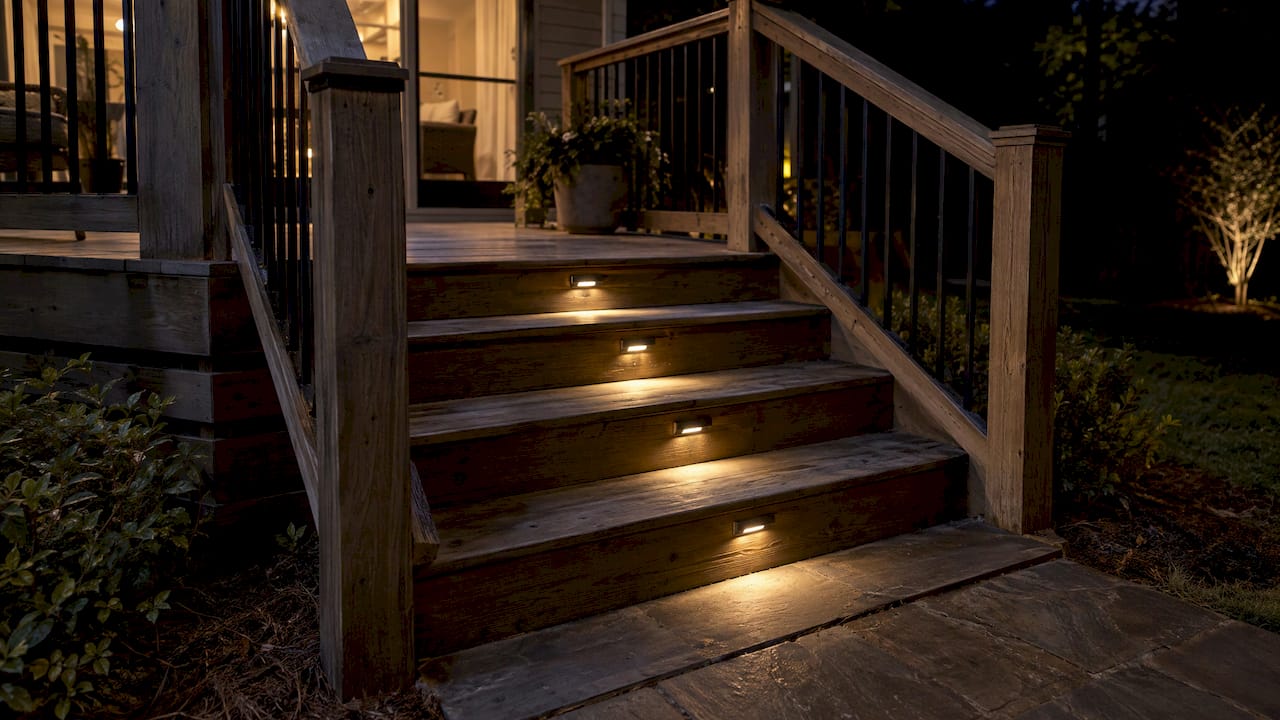
Stairs are where lighting does the most for safety, and they should be the first thing you budget for. Small lights set into risers or under the nosing of each tread light the step you are about to take without lighting the whole yard. We cover the options, placement and typical price factors in our guide to step lighting outdoors.
4. Bistro and string lights hung from joists
String lights are the simplest way to give an under-deck space a café feel. Hung from joists in rows or zigzags, they provide overhead ambiance and work on both covered and open decks. Height and spacing decide whether they look intentional or sloppy. Keep bulbs well above head height on walkways, and use a guide wire on longer runs so the cable is not carrying the load. Our notes on string light height and bulb and support spacing go into the numbers. If you want them designed as part of the whole patio, see our bistro string lighting service.
5. Post cap and post-mounted lights
Post lights mark the perimeter of the deck and give a soft downward glow. Treat them as markers rather than your main source. Used alone, they leave the middle of the deck dark and the edges bright, which is the opposite of what you want for conversation and dining.
6. Zoned lighting for grilling, seating and storage
Under an elevated deck you often have several uses side by side. A linear fixture or a separate run of downlights over the grill, a warmer dimmable group over the seating and a motion-activated light over storage lets each area be lit for its purpose without physical dividers. Our outdoor kitchen lighting ideas show how task lighting and ambient lighting work together near a grill.
7. Accent lighting for planting and posts
A few small accent lights aimed at a column, a planter or a textured wall add depth. One accent per post or focal object is usually enough. These pair naturally with the landscape beyond the deck, which is where landscape lighting layering comes in: the under-deck glow, the path lights and the tree uplights should read as one scene.
Quick comparison
| Idea | Best for | Where it mounts | Glare risk |
|---|---|---|---|
| Recessed downlights | Enclosed under-deck rooms | Ceiling panels | Low when shielded |
| Under-rail strips | Open decks, dining | Beneath top rail | Low |
| Stair and riser lights | Safety on steps | Risers, nosing | Low |
| String lights | Casual ambiance | Joists, guide wire | Medium with bare bulbs |
| Post cap lights | Marking edges | Post tops | Low when frosted |
| Zoned linear lights | Multi-use spaces | Joists, beams | Low |
| Accent spots | Posts, plants | Joists, ground | Medium if aimed up |
Layout rules that prevent glare
Most disappointing deck lighting has plenty of light in the wrong place. Three habits fix most of it.
Hide the source. Recess it, shield it or tuck it under a rail so you see illuminated surfaces, not bulbs. Glare comes from two places: looking directly at an LED, and light bouncing off a glossy deck surface into your eyes. Downward aim and diffusion address both.
Use more low-output lights, not fewer bright ones. Evenly spaced, modest fixtures wash a ceiling or deck without hot spots or dark gaps. Spacing should follow the beam angle and joist spacing: wide beams can sit farther apart, narrow beams need to sit closer. Running fixtures parallel to the joists keeps the pattern consistent when you look up from below.
Layer by priority. Stairs and level changes first, edges and walkways second, seating and ambiance third, decoration last. That order puts your budget where a missed step would hurt. Aim for pools of light rather than uniform brightness; a space lit at one flat level feels like a parking garage.
Keep one color temperature across everything. The warm range, 2700K to 3000K, reads as residential and flatters wood, stone and skin. This Old House lists that range for a cozy atmosphere and notes the cooler 4000K to 6500K range as the brighter alternative, which is better kept for work areas such as a grill station.
If you want to sketch the plan before you talk to a designer, a lighting plan layout guide walks through fixture placement room by room, and the same thinking applies to a deck ceiling. Our landscape lighting checklist covers the outdoor side.
Covered deck or open deck: what changes
The two situations call for different fixtures.
- Covered or enclosed (a ceiling under the deck, or a roofed porch). The ceiling carries the main lighting layer. Recessed downlights, flush mounts or a fan with a light kit work, and fixtures are partly protected from weather, though moisture and temperature swings still reach them.
- Open deck (no roof above). Overhead fixtures are not an option, so the light comes from rails, stairs, posts and low walls. Everything is exposed to rain, so it needs wet-rated hardware.
Fixtures near the edge of the deck should also stay out of the drip line, where water falls off the boards and the ceiling below. In winter, ice and snow load can stress string lights and exposed cable, which is one reason a professionally specified, commercial-grade string system lasts longer than a seasonal one.
Ratings and electrical details that matter
The numbers on the box decide how long a deck lighting system survives.
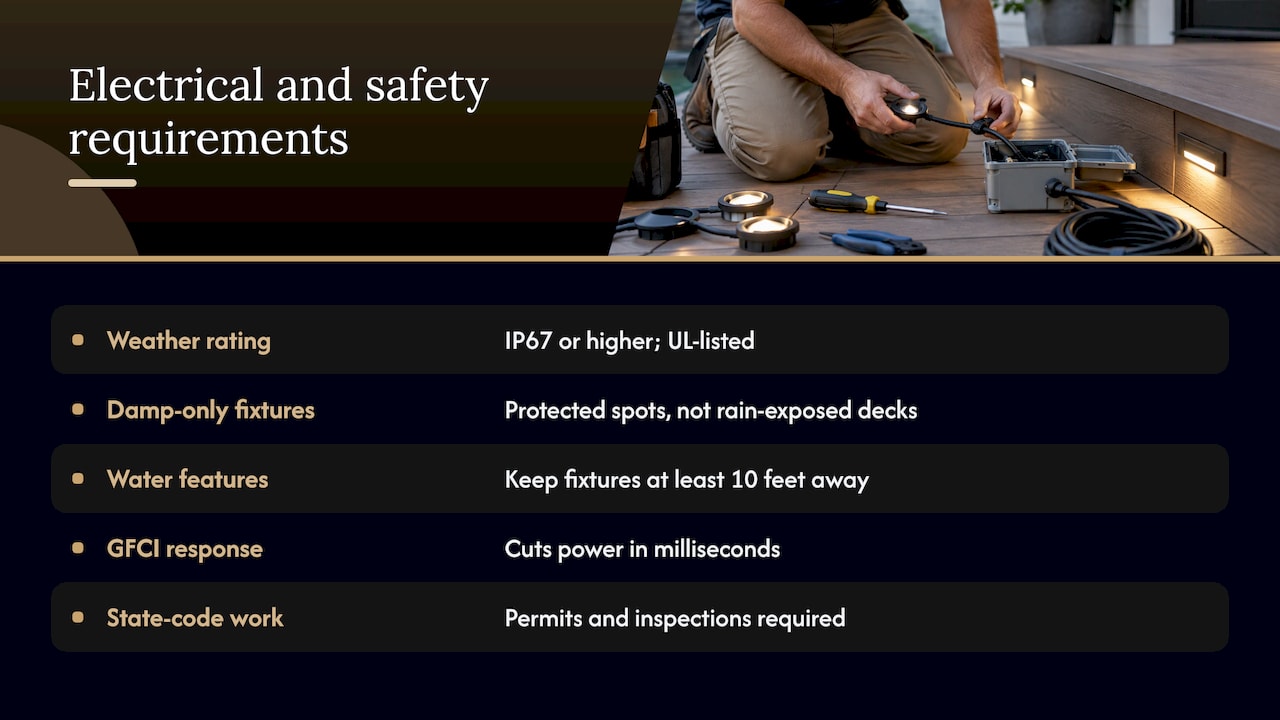
Weather rating. Look for an IP rating, which tells you how well the fixture resists dust and water. This Old House recommends IP67 or higher for deck conditions, and UL-listed products. A fixture marked only for damp locations is meant for protected spots, not a deck that rain reaches.
Brightness. Under a deck ceiling, surfaces absorb light, so plan on somewhat more output than you would for the same fixture in an open yard. Dimmable control lets you tune it after dark instead of guessing in daylight.
Power source. Low-voltage LED systems run from a transformer or driver, usually near a GFCI-protected outdoor outlet. Fine Homebuilding describes this setup, in which a driver box plugs into a GFCI receptacle or is hardwired by an electrician. A GFCI (ground-fault circuit interrupter) cuts power in milliseconds if current leaks, which is why it belongs on every outdoor circuit. If the deck is near a pool, spa or fountain, fixtures must stay at least 10 feet away, according to TimberTech’s installation guide. Our article on pool area lighting safety explains GFCI testing in more detail.
Why low voltage. It is safer to work with, easier to route through joists and efficient to run. We lay out the reasoning in why low voltage landscape lighting is the smart choice.
Permits in Charlotte. Low voltage does not mean no paperwork. Mecklenburg County Code Enforcement says that some low-voltage systems are exempt from the requirement of installation by a licensed electrical contractor, yet permits and inspections are still required for work within the scope of the state building codes. Call their permitting line at 980-314-CODE (2633) before you start, or have your installer confirm what applies to your deck. HOA rules can add their own limits on fixture color and brightness; our designs account for HOA compliance.
Planning the budget
Where the money goes matters more than the total. Put it into stairs and transitions, then the main seating zone, then accents. Fixtures are only part of the cost: the transformer, wiring, switching and the labor of working in tight joist bays and finished ceilings all count. We do not publish fixed prices because each deck differs in height, enclosure, number of zones and controls, so we quote after seeing the space. A free estimate is the quickest way to get a real figure for your deck.
Perspective
Most of the decks we see lit badly were lit in pieces: a string of lights one summer, a few stair lights the next, a solar cap on every post. Each piece works alone, but nothing connects them, so the deck ends up with bright spots, glare and no plan for control.
Our view is that a deck is part of the whole property’s lighting. The under-deck ceiling, the steps, the rail, the patio and the landscape beyond should share one color temperature, one control system and one set of switching zones. That is why our installations use commercial-grade, climate-optimized hardware with advanced smart controls, so you can set the scene from your phone instead of walking to a switch.
Carolina weather is hard on outdoor fixtures: humidity, summer storms and the occasional ice event. We design for that climate, and our systems are backed by a climate-specific warranty and the GlowCare maintenance subscription. We also design to meet HOA and municipal requirements, so the deck you light this year is not one you have to rework next year.
If you want the under-deck space to feel like a finished room, start with the plan, not the fixtures.
Dave
Have us light your deck
We design and install deck and step lighting as part of our patio lighting work in the Charlotte area, with smartphone control, multi-color options and weather-resistant hardware. If your plan includes string lights, stair lights, an enclosed under-deck room or all three, we can design them as one system. See our patio lighting services or request a free estimate.
If the deck is part of a larger project, our landscape lighting design service ties the deck, yard and architecture together, and permanent lighting on the roofline means the holiday display shares the same smartphone control as the deck.
FAQ
What is the best lighting for under a deck?
For an enclosed under-deck space, recessed LED downlights in warm white give the most even, glare-free result. For an open deck, under-rail strips plus stair lights are the better combination. Most good schemes mix two or more types, each on its own switch or dimmer.
What color temperature should I choose?
Choose warm white, 2700K to 3000K, for living areas. It looks natural on wood and stone and keeps the space comfortable at night. Use one temperature across the entire deck so the fixtures look like they belong together.
Do I need a permit for low-voltage deck lighting in Charlotte?
Permit rules depend on the work. Mecklenburg County Code Enforcement states that some low-voltage systems do not need a licensed electrical contractor, but permits and inspections are still required for work within the state building codes. Call 980-314-CODE (2633) or have your installer confirm before work begins.
Can string lights stay up all year under a deck?
Commercial-grade string lights with replaceable LED bulbs, hung from joists with a guide wire on longer runs, are made for long-term use. Keep them above head height, on a GFCI-protected circuit, and out of the drip line. Our bistro and string lighting is designed for year-round use in Carolina weather.
How bright should under-deck lights be?
Aim for soft pools of light rather than a uniform glare. Stairs and transitions need the most attention, seating areas moderate warm light, and accents only a little. Dimmers let you adjust the level to the occasion.
Sources
- How to Install Deck Rail Lighting, This Old House
- Installing Low-Voltage LED Lighting, Fine Homebuilding
- TimberTech lighting installation guide
- Low-Voltage Wiring, Mecklenburg County Code Enforcement